BAKU, Azerbaijan, March 3. The United Kingdom's
growing interest in Central Asia is increasingly evident, with its
engagement gradually taking the shape of a long-term strategic
approach. In the wake of its departure from the European Union, the
UK has found itself in a position where forging independent
economic pathways outside Europe has become essential. In this
context, Central Asia emerges as a region of considerable
importance, marked by a burgeoning market, valuable resources, and
its strategic role as a crucial transit hub connecting East and
West.
In this broader framework, Uzbekistan plays a pivotal role. In
recent years, the country has solidified its position as one of the
fastest-growing economies in Central Asia, alongside becoming a
significant node in the regional logistics network. As a result,
Tashkent has become an indispensable partner for London.
Economic indicators further underscore the increasing interest
in bilateral relations. Over the past five years, trade between the
two nations has witnessed a remarkable doubling. As of February 1,
2026, 251 enterprises with British capital are now operating within
Uzbekistan, while Uzbek sovereign and corporate bonds amounting to
over $15 billion are listed on the London Stock Exchange,
emphasizing the importance of the UK financial market for Tashkent.
Furthermore, the Joint Economic Committee, which began its work
last year, will convene for its next meeting in the spring of
2026.
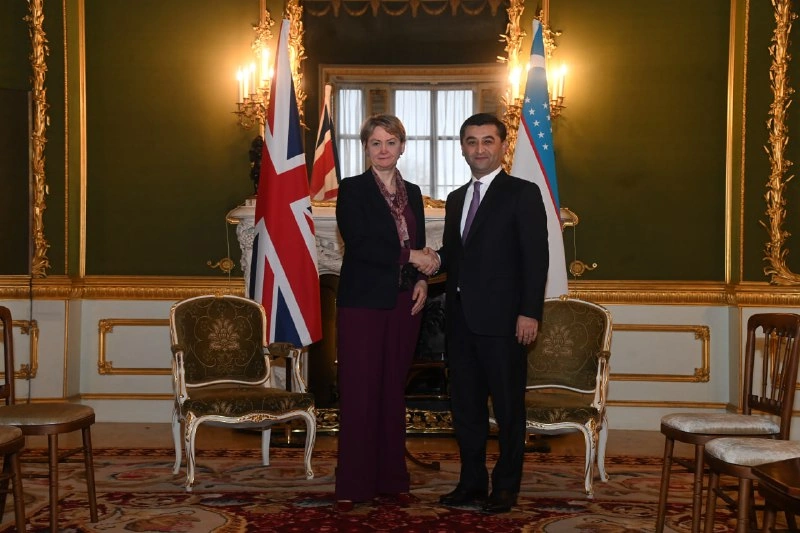
The London summit, the first meeting of foreign ministers of
Central Asian countries and the United Kingdom in the C5+1 format,
marked the institutionalization of Britain’s sustained interest in
the region. However, its significance lies not in the meeting
itself, but in the substance of the follow-up agreements. During
talks between Uzbekistan’s Foreign Minister Bakhtiyor Saidov and UK
Home Secretary Yvette Cooper, the focus was placed on trade,
investment, green infrastructure, energy, and regional
connectivity. These areas reflect the United Kingdom’s own
strategic priorities - from its climate agenda to the
diversification of supply chains. The signed memoranda are aimed at
launching concrete projects, expanding green financing instruments,
and developing educational cooperation.
Particular importance attaches to cooperation with UK Export
Finance (UKEF). The signing of a memorandum on the use of the
agency’s financial instruments signifies a shift from political
declarations to mechanisms of practical support. Export guarantees
and credit lines enable British companies to participate in
infrastructure projects in Uzbekistan with government-backed risk
insurance. This increases the likelihood of real contracts rather
than merely protocol agreements.
Ahead of the summit, the visit to Tashkent by the UK Trade Envoy
for Central Asia and Azerbaijan, Lord John Alderdice, further
confirmed a systematic approach. The British side expressed
readiness to provide up to £4 billion in export guarantees for
infrastructure and mining projects. A roadmap for the development
of investment cooperation was signed following the visit. This
effectively creates a financial cushion that makes British
participation in Uzbek projects competitive against Chinese,
European, and Russian initiatives.
The issue of critical minerals deserves particular attention.
Central Asia possesses reserves of lithium, uranium, rare earth
elements, manganese, and chromium. For the United Kingdom, which is
pursuing a green transition strategy and seeking to reduce
dependence on a limited number of raw material suppliers,
diversifying sources has become a matter of economic security.
Uzbekistan, with its developed mining base and intention to attract
foreign technologies, could become part of new resilient supply
chains.
Thus, British activity carries a dual calculation. On the one
hand, it offers access to a rapidly growing market and
infrastructure projects. On the other hand, it facilitates the
formation of long-term raw material and logistics ties necessary
for Britain’s own industrial and energy transformation.
For Uzbekistan, deepening cooperation with the United Kingdom
fits into its broader strategy of partner diversification. At a
time when China maintains a large-scale investment presence, Russia
remains an important economic actor, and the European Union
advances its own transport initiatives, Tashkent seeks to expand
its circle of partners without becoming dependent on a single
center of power. British financial instruments, educational
opportunities, and technological solutions complement existing
areas of cooperation.
It is also significant that relations are moving to an
institutional level - through the Joint Economic Committee,
roadmaps, and concrete financing mechanisms. This reduces the risk
that agreements will remain declarative.
However, success will depend on implementation. Announced
guarantees and memorandums create a framework, but their
translation into specific contracts will determine whether the
United Kingdom can establish itself in the region as an independent
economic player rather than a secondary partner.
Overall, the British-Uzbek rapprochement reflects a broader
trend: Central Asia is becoming a space of competing economic
strategies. How effectively the agreed initiatives are implemented
will determine whether London can transform political engagement
into a sustainable economic presence and whether Tashkent can use
this interest to accelerate its own modernization.