Baku and Abu Dhabi have maintained an ongoing conversation
that flows effortlessly, without the need for meticulous
statements. It's grounded in a grasp of the region's framework,
discerning which risks are here to stay and which are
temporary, and which solutions work in practice, not just in
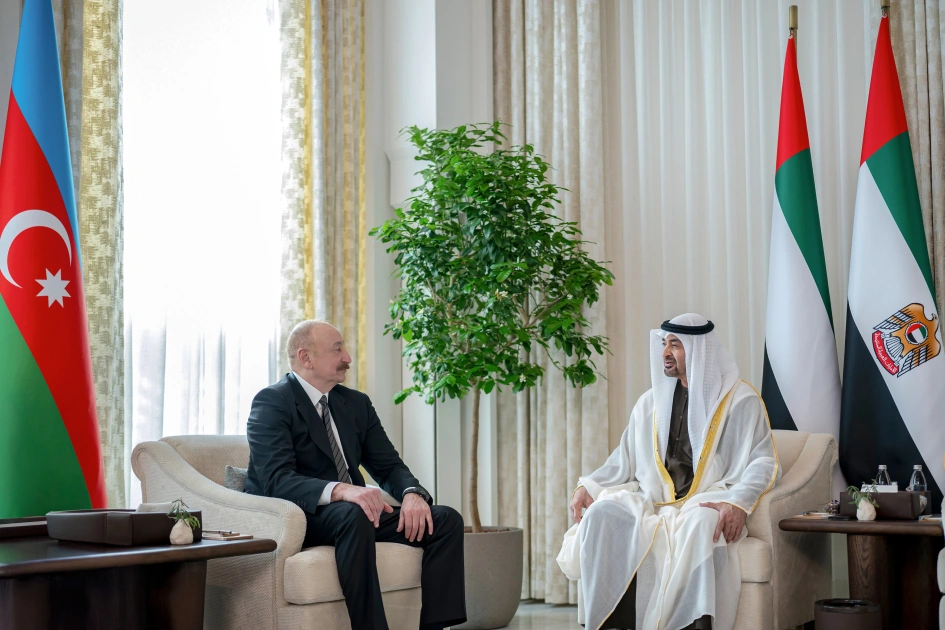
rhetoric. That's why the agenda of yesterday's meeting between the
presidents of Azerbaijan and the UAE in Abu Dhabi was broad yet
focused: politics, economics, energy, defense, and humanitarian
issues.
Ilham Aliyev and Mohammed bin Zayed Al Nahyan discussed
practically the entire spectrum of bilateral relations—from
politics and economics to energy, and from defense to humanitarian
cooperation. Without excessive declarations, but with a clear
understanding of where the parties already align and where they are
ready to move further. It's symbolic that the focus was on
long-term areas: energy, security, and investment. Azerbaijan and
the UAE today speak the language of states that think not in terms
of seasons or years, but of the horizon. This is especially evident
in Abu Dhabi. They know how to "play the long game" here and value
partners who possess a vision for development decades ahead. And
the sincere personal relationship between the leaders has become a
solid foundation upon which this long-term cooperation is
successfully moving forward.
The signing of a document related to the sale of a portion of
the Azerbaijani Ministry of Economy's non-controlling stake in the
Southern Gas Corridor project to XRG, the investment arm of the Abu
Dhabi National Oil Company (ADNOC), became a logical continuation
of this dialogue. For Baku, this signifies widening the net of
trustworthy allies surrounding a pivotal infrastructure endeavor.
For Abu Dhabi, it is participation in a route that has long since
turned into an important element of the European energy
configuration.
Defense cooperation stood as an independent subject. The joint
operational-tactical exercises "Peace Shield - 2026," currently
taking place in Abu Dhabi, are perceived as a working tool for
building cooperation between the armed forces of the two countries.
Without loud formulations, without demonstrative gestures. Sharing
experiences, enhancing compatibility, and building professional
contacts are precisely what is valued more than any mere
declaration in today's world.
The letter of intent on cooperation between the Ministries of
Defense of Azerbaijan and the UAE carefully outlines this vector.
Here, too, a shared philosophy is evident: security is viewed as
part of sustainable development, not as a separate, isolated
sphere.
A special place in the visit program was occupied by the meeting
of the President of Azerbaijan with the Secretary-General of the
Muslim Council of Elders, Mohamed Abdelsalam. The conversation went
beyond formalities. They reminisced about visits to Azerbaijan,
discussed the activities of the Zayed Foundation, and discussed the
humanitarian legacy of Sheikh Zayed bin Sultan Al Nahyan and how
the values of dialogue and respect are practically embodied in
contemporary politics.
In this context, awarding Ilham Aliyev the Zayed Award for Human
Fraternity is perceived as an important symbolic, yet tangible,
gesture. It showcases Azerbaijan's stance toward a nation that
continually champions conversation and works to ease tensions
whenever it can.
The visit continues, fostering an atmosphere of openness. It is
in this mode that partnerships that live long are usually
formed.