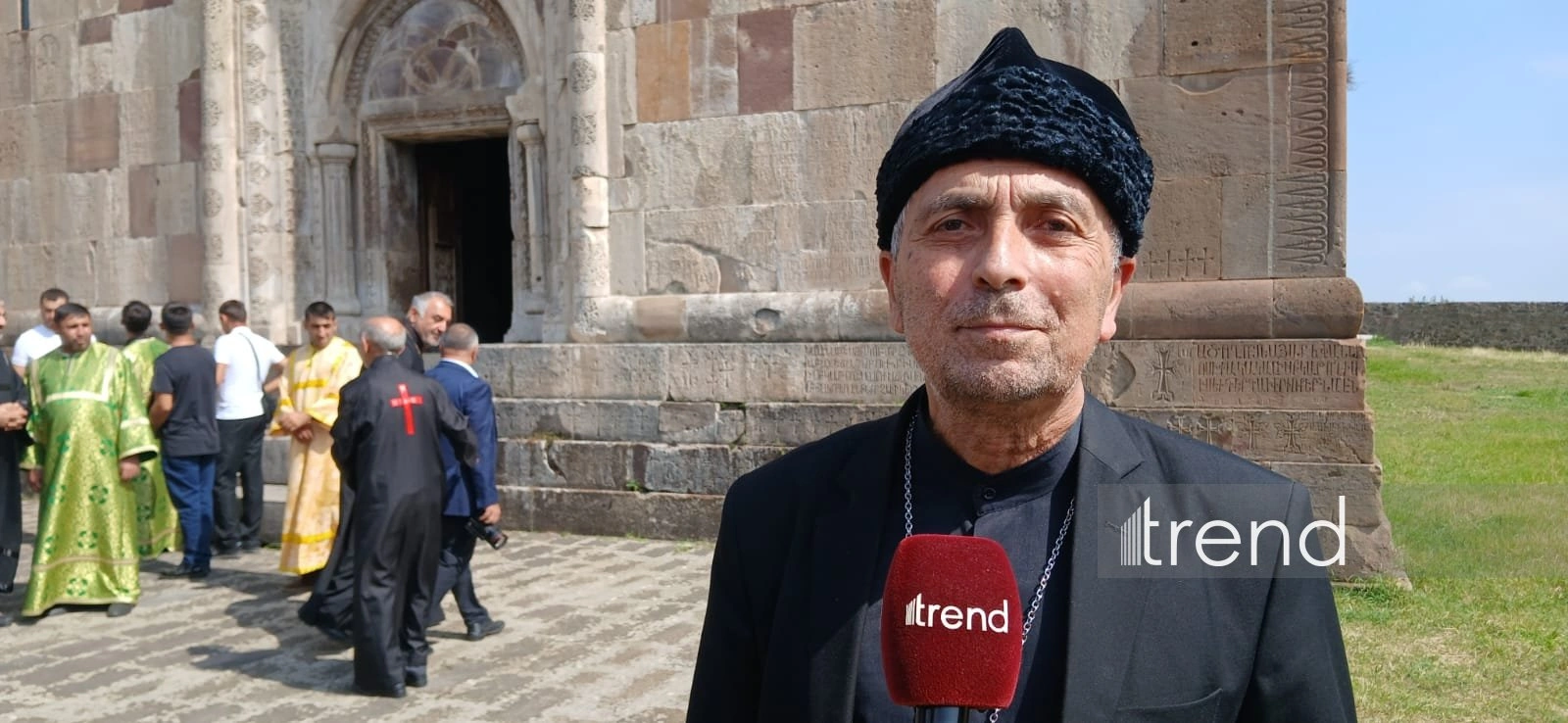
AGHDARA, Azerbaijan, September 21. The Ganjasar
Monastery is part of the heritage of the Albanian Church, Robert
Mobili, chairman of the Albanian-Udi religious community, told
reporters during a visit to the Ganjasar monastery complex,
Trend's Karabakh
bureau reports.
He noted that members of the community recited prayers in
Ganjasar and honored the memory of the martyrs.
“Today is the Nativity of the Most Holy Mother of God. Yesterday
was State Sovereignty Day, and today is World Peace Day. It is
especially important for us to visit the Ganjasar monastery complex
on such significant days,” said R. Mobili.
According to him, the Ganjasar monastery complex is one of the
most important examples of the Christian heritage of Caucasian
Albania.
“This is our first visit to Ganjasar. We have visited many
churches in the liberated territories, prayed, and lit candles. The
Ganjasar Monastery is an important example of the surviving
Albanian ecclesiastical heritage of Caucasian Albania,” noted the
community chairman.
Mobili said that the ancient Christian churches in Azerbaijan
are part of the heritage of the Albanian Church.
“The legacy of the ancient Albanian churches that exist today in
Azerbaijan is the legacy of the independent Apostolic Albanian
Autocephalous Church. It is a very rich legacy. These churches have
no connection whatsoever to the Armenian Church,” he
emphasized.
The community chairman said that after Christianity was adopted
as the state religion in Caucasian Albania, many churches were
built in the region.
According to him, the cessation of the Albanian Church’s
activities in 1836 and its subordination to the Armenian Church had
a serious impact on the Albanian Christian heritage.
“The decree-statute of March 11, 1836, put an end to the
activities of the Albanian Church. The center of the Albanian
Church was located in Ganja. After that, the heritage of the
Albanian Church was Armenianized. Part of the Albanian community
left for Georgia, including the Udis. Some converted to Islam. “We,
the Udis living in Gabala, have preserved our native heritage,”
Mobili said.
He noted that the opportunity to visit Christian churches in the
region following the liberation of Karabakh from occupation is a
significant event for the Alban-Udi community.
“Today, the doors of the churches are open, and services are
being held there. We can pray in our native churches. This is a
great blessing bestowed upon us by God,” the community chairman
said.
Mobili also emphasized that the sphere of influence of the
Albanian Church is not limited to the current territory of
Azerbaijan. He cited the ancient churches in Eastern and Western
Zangazur, including the Tatev Monastery, as well as those in the
Derbent region, as part of the historical heritage of the Albanian
Church.
The community chairman also drew attention to the existence of
the Albanian alphabet and religious texts in the Albanian
language.
“Caucasian Albania had its own centers of scholarship. Religious
books were translated into Albanian. In this regard, ancient
sources have also been preserved at the Monastery of St. Catherine
on Mount Sinai,” R. Mobili said.
He noted that the ancient church located in the village of Sheki
Kish is also an example of Albanian Christian heritage.
R. Mobili also noted that depictions of crosses and other
religious symbols in Azerbaijan are part of the heritage of the
Albanian Church.
“At a UNESCO event held in Geneva in 2010, we expressed our
position regarding the affiliation of cross-shaped elements and
symbols found in Azerbaijan to the Albanian Church,” he added.
The community leader emphasized that the atmosphere of tolerance
prevailing in Azerbaijan allows the Alban-Udi community to preserve
its religious heritage.
“One of the most heartwarming moments for us is the tremendous
support we receive in Azerbaijan, where the overwhelming majority
of the population is Muslim. The tolerance of the Azerbaijani
people and the atmosphere in the country allow us to attend our own
churches. This is our heritage,” Mobili said.