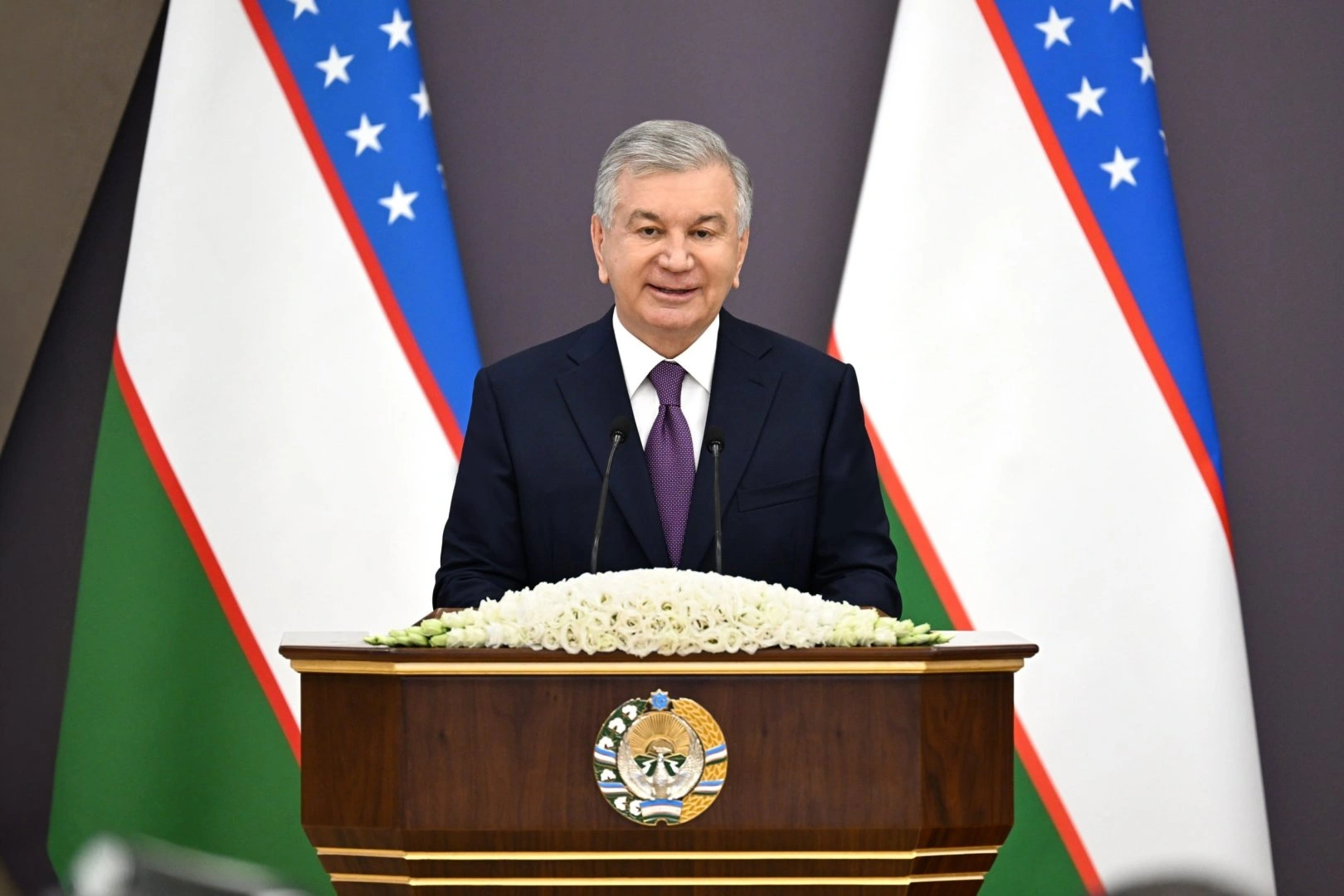
BAKU, Azerbaijan, July 23. Despite Uzbekistan
recording an impressive 8.5% economic growth rate in the first half
of 2026, President Shavkat Mirziyoyev used a video conference not
as an occasion to highlight achievements, but as an opportunity to
reassess and redefine the government’s priorities for the remainder
of the year. Instead of focusing solely on headline economic
indicators, the meeting centered on enhancing productivity,
strengthening corporate governance, accelerating privatization
processes, reducing administrative barriers, and addressing
structural constraints that continue to affect the country’s
long-term competitiveness. The discussion reflected a growing
recognition by Uzbekistan’s leadership that maintaining high
economic growth requires not only investment and increased output
but also improved efficiency, stronger institutions, and more
effective implementation of ongoing reforms.
Economic growth remains strong, but higher targets
set
The video-conference confirmed that Uzbekistan maintained one of
the highest economic growth rates in the region during the first
half of 2026. GDP expanded by 8.5%, supported by broad-based growth
across major sectors. Services increased by 16.9%, construction by
13.8%, industry by 8%, and agriculture by 4.7%. Investment reached
$28 billion, while exports totaled $14.4 billion.
At the same time, President Mirziyoyev emphasized that these
results are no longer viewed as sufficient. He argued that economic
growth of 9–10% will be necessary to improve living standards for a
population approaching 40 million. This statement effectively
raises the government's benchmark for success and signals that
future policy will prioritize accelerating productivity rather than
simply maintaining current growth.
An important political message also emerged from the meeting.
Rather than allowing ministries to present traditional performance
reports, the president demanded concrete proposals for new sources
of growth and instructed officials to prepare contingency scenarios
for possible deterioration in global economic conditions. This
reflects a transition toward more proactive economic governance
amid increasing external uncertainty.
Focus shifts from expansion to efficiency
A central theme of the video-conference was the growing
importance of efficiency. While previous years focused heavily on
expanding production and attracting investment, the government is
now paying greater attention to how efficiently state-owned
enterprises operate.
Shavkat Mirziyoyev highlighted significant increases in
production costs at strategic enterprises, including Navoi Mining
and Metallurgical Company, Uzbek Metallurgical Plant and
Uzkimyosanoat. Rising production costs were presented as evidence
that strong output alone does not guarantee improved
competitiveness.
The president also pointed to operational shortcomings at
Uzbekistan Airways, estimating that inefficient scheduling, delays
and limited competition in auxiliary services result in annual
revenue losses of approximately $120 million.
These remarks indicate that the government increasingly views
corporate governance reform and operational modernization as
essential components of future economic growth.
Franklin Templeton assessment becomes roadmap for SOE
reforms
One of the most significant outcomes of the meeting was the
presentation of Franklin Templeton's assessment of major
state-owned enterprises preparing for privatization.
According to the analysis, substantial value can be unlocked
through improved management rather than additional investment
alone. Hududiy Elektr Tarmoqlari could potentially double its
market value through operational improvements, while Uzbekistan
Airways could increase its valuation by approximately 40% and
Uzbektelecom by around 50%.
The government's decision to publicly reference these estimates
suggests that independent international assessments are becoming an
important benchmark for evaluating reform progress. Rather than
focusing exclusively on privatization itself, authorities appear
increasingly concerned with improving enterprise performance before
bringing assets to the capital market.
Privatization enters a new stage
The meeting confirmed that privatization remains one of
Uzbekistan's principal economic priorities.
The government announced preparations for a new privatization
program involving approximately 100 trillion soums ($8.3 billion)
worth of state assets. The package will include 1,300 real estate
properties, 8,000 hectares of land, and government stakes in 66
companies.
Authorities also introduced more favorable financing conditions
by reducing required down payments from 30% to 15% while allowing
interest-free installment payments.
These measures suggest that the government is attempting to
accelerate investor participation at a time when global investment
conditions remain uncertain. Easier purchasing terms may help
attract a broader range of domestic and foreign investors while
speeding up the transfer of state assets into private
ownership.
Business climate reforms move toward
deregulation
Another major policy direction announced during the
video-conference concerns regulatory reform.
Shavkat Mirziyoyev criticized the existing system under which 51
government agencies can impose penalties across 322 categories,
noting that nearly 3 trillion soums (around $250 million) in fines
have been collected since 2024.
Rather than emphasizing enforcement, the president instructed
regulators to adopt a more advisory role and ordered ministries to
prepare proposals within one week to reduce bureaucracy,
administrative fees and penalties.
The initiative reflects Uzbekistan's broader effort to improve
its investment climate by reducing compliance costs for businesses.
It also corresponds with the government's strategy of encouraging
entrepreneurship as a key driver of economic diversification.
Export policy shifts toward utilization of existing
capacity
Although Uzbekistan has invested heavily in export-oriented
manufacturing, the meeting demonstrated that the government
believes existing industrial capacity is not being fully
utilized.
During the discussion, officials reported that 509
export-oriented production facilities worth $11 billion have been
launched during the past three years, yet 208 of them have not
begun exporting.
Similarly, 29 of the country's 47 special economic zones
recorded no exports during the first half of the year.
Rather than announcing additional investment programs, the
president ordered the creation of rapid-response teams to help
enterprises overcome operational barriers related to certification,
financing, logistics and market access.
This approach reflects a broader policy shift from constructing
new production facilities toward maximizing returns from
investments that have already been made.
Infrastructure becomes a strategic
bottleneck
Transport and energy infrastructure emerged as two of the most
significant structural constraints discussed during the
meeting.
In the energy sector, Shavkat Mirziyoyev estimated that
modernization will require approximately $8 billion over the next
decade. At the same time, electricity losses reached 17.2%,
equivalent to 4.8 billion kilowatt-hours, while gas network losses
totaled 7.6%.
In rail transport, the president acknowledged serious shortages
of freight wagons despite rapidly growing trade volumes. Around 70%
of Uzbekistan's foreign trade cargo moves by rail, making logistics
increasingly important for sustaining export growth.
The government therefore instructed officials to seek $200
million in World Bank financing for railway modernization while
also developing plans to attract 10,000 idle freight wagons from
partner countries.
These initiatives demonstrate that infrastructure development is
becoming increasingly linked with industrial competitiveness rather
than being viewed as a separate policy area.
Inflation management remains
supply-oriented
Unlike many countries that rely primarily on monetary tightening
to control inflation, Uzbekistan continues to pursue a supply-side
strategy.
President Mirziyoyev reiterated that inflation should be
restrained by increasing the availability of goods and services
rather than through restrictive macroeconomic measures alone.
Special attention was given to rising meat prices, with regional
governors instructed to prepare detailed procurement strategies and
make greater use of government support for imports.
This approach illustrates the government's preference for
targeted market interventions designed to stabilize prices while
preserving high economic growth.
Regional policy increasingly focuses on
competitiveness
The meeting also revealed growing attention to regional economic
imbalances.
President Shavkat Mirziyoyev criticized widening import-export
gaps in several regions and instructed governors to prioritize
import substitution and export-oriented production.
Commercial banks were also ordered to explain why 9.3 trillion
soums (about $774.7 million) worth of assets remain unsold on their
balance sheets, reflecting the government's broader effort to
mobilize dormant economic resources.
By linking regional performance more closely with exports,
investment and industrial efficiency, the government appears to be
strengthening accountability at the local level.
Overall assessment
The July 21 video-conference represents an important transition
in Uzbekistan's economic policy. While maintaining its emphasis on
rapid growth, the government is increasingly prioritizing
productivity, corporate governance, privatization, infrastructure
modernization and regulatory reform.
Rather than announcing a fundamentally new economic strategy,
the meeting refined existing reform priorities by placing greater
emphasis on implementation and efficiency. The repeated references
to international assessments, operational performance and
measurable outcomes indicate that the authorities are seeking to
transform strong macroeconomic growth into sustainable long-term
competitiveness.
Overall, the video-conference suggests that the second half of
2026 will be characterized less by the launch of new reforms than
by efforts to ensure that previously announced policies deliver
tangible economic results.