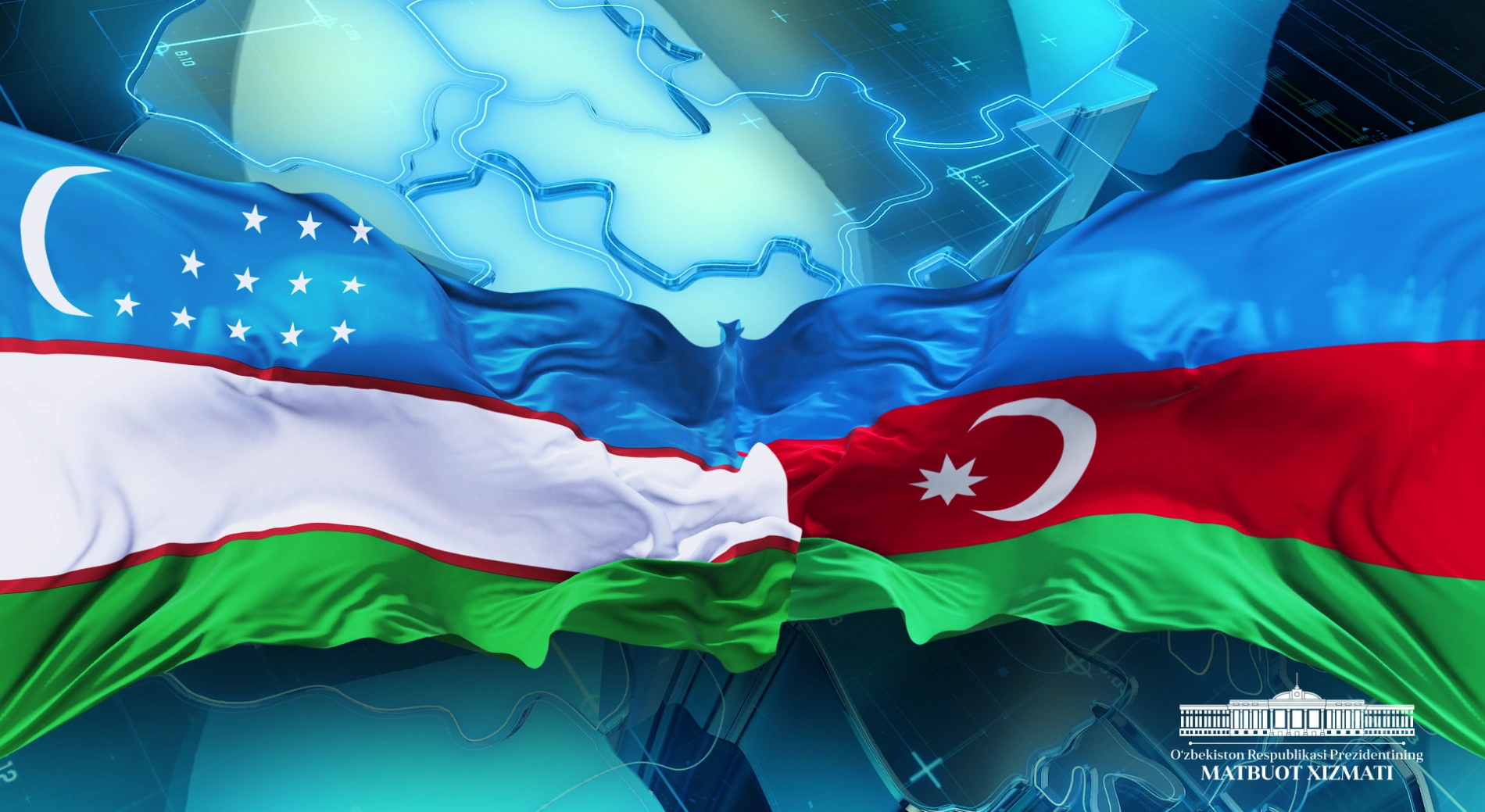
BAKU, Azerbaijan, July 14. Azerbaijan and
Uzbekistan significantly accelerated the implementation of their
allied partnership during 2025–2026, transforming political
commitments into tangible economic outcomes. Expanding trade,
industrial cooperation, transport connectivity, and institutional
coordination indicate that bilateral relations are evolving from a
traditional strategic partnership into a multidimensional economic
alliance. Rather than focusing solely on increasing trade volumes,
both governments increasingly prioritize production cooperation,
infrastructure connectivity, and long-term investment projects,
creating a more resilient foundation for bilateral relations.
Trade patterns point to important structural changes in
bilateral economic cooperation. Both governments have shifted their
emphasis from expanding commodity trade toward deeper industrial
collaboration through joint manufacturing, localization of
production, and the development of higher-value-added industries.
Cooperation in textiles, automotive manufacturing, construction
materials, tourism, and agriculture demonstrates that Azerbaijan
and Uzbekistan are increasingly building integrated production
networks instead of relying solely on traditional export-import
relations. This transition is particularly significant because it
creates long-term economic linkages that are less vulnerable to
short-term market fluctuations.
The expansion of bilateral trade has been supported by
increasingly institutionalized mechanisms of economic cooperation.
The 14th meeting of the Uzbekistan–Azerbaijan Joint
Intergovernmental Commission on Cooperation, held in Baku on June
20, 2025, reaffirmed both governments' commitment to expanding
trade, investment, and industrial cooperation. The commission
continues to serve as the principal platform for coordinating
bilateral economic policy, identifying new areas of cooperation,
and overseeing the implementation of joint initiatives.
Complementing this framework, interregional cooperation has become
an increasingly important driver of economic engagement, with
successive regional forums strengthening direct links between local
authorities and businesses.
Official statistics published by Azerbaijan's State
Statistical Committee further illustrate the growing intensity
of bilateral trade. During the first five months of 2026,
Azerbaijan exported goods worth $59.5 million to Uzbekistan,
accounting for 0.43 percent of its total exports, while imports
from Uzbekistan reached $84.6 million, representing 1.24 percent of
Azerbaijan's total imports. The figures indicate that Uzbekistan
remains a net exporter in bilateral trade while also reflecting
growing demand for Uzbek products in the Azerbaijani market.
Although bilateral trade remains below the long-term objective of
$1 billion, the latest data point to steadily deepening economic
ties between the two countries.
Investment cooperation has likewise entered a new stage. Rather
than focusing primarily on capital inflows, bilateral projects
increasingly emphasize integrated production capacities across key
sectors. According to the Ministry of Investment, Industry and
Trade of Uzbekistan, as of June 1, 2025, 280 enterprises with
Azerbaijani capital were operating in Uzbekistan, including 58
joint ventures and 222 wholly Azerbaijani-owned companies. Their
presence across manufacturing, finance, real estate, energy, trade,
and services demonstrates that bilateral investment has become
increasingly diversified and embedded in both economies.
This trend is reflected in the composition of flagship
investment projects. In the textile sector, Azerbaijani and Uzbek
companies are jointly developing large-scale cotton and textile
clusters supported by PASHA Holding and the Azerbaijan-Uzbekistan
Investment Company. Cooperation has also expanded into sericulture
through the launch of silk-processing facilities, while major
tourism investments—including the construction of the Ritz-Carlton
Tashkent and the Tashkent Luxury Residences project—reflect growing
Azerbaijani participation in Uzbekistan's hospitality and real
estate sectors. Industrial cooperation has further expanded through
automotive manufacturing projects between Uzavtosanoat and
Azermash, as well as construction materials production involving
Matanat-A. Collectively, these initiatives demonstrate that
bilateral investment is increasingly directed toward long-term
industrial development rather than standalone commercial
projects.
Transport connectivity remains one of the strongest pillars of
bilateral cooperation. Following the data published by the Ministry
of Investment, Industry, and Trade of Uzbekistan, in 2024, cargo
transportation between Azerbaijan and Uzbekistan reached 105,000
tons, while transit of Uzbek goods through Azerbaijani territory
exceeded 1.09 million tons, reinforcing Azerbaijan's position as
Uzbekistan's principal gateway to European and international
markets. Air connectivity has also expanded steadily, with regular
flights between Tashkent and Baku operating eight times a week and
both governments agreeing to increase the frequency to 21 weekly
flights. These developments demonstrate that transport cooperation
has evolved beyond infrastructure development into an essential
component of trade route diversification and the broader Middle
Corridor strategy. Taken together, they indicate that both
governments increasingly view economic interdependence as a
strategic instrument for strengthening regional connectivity and
improving access to international markets.
Political cooperation has also become increasingly
institutionalized. Uzbekistan's ratification of the Treaty on
Allied Relations in May 2025 strengthened the legal framework of
the allied relationship, creating broader opportunities for
cooperation across economic, industrial, transport, agricultural,
and humanitarian sectors. The implementation roadmap for 2025–2029
and new sectoral cooperation programs demonstrate that bilateral
relations are increasingly governed through permanent coordination
mechanisms rather than standalone agreements. This institutional
framework enhances policy continuity and provides greater
predictability for businesses and investors engaged in bilateral
projects.
The partnership acquired an additional regional dimension in
November 2025, when Azerbaijan became a full-fledged participant in
the Consultative Meetings of the Heads of State of Central
Asia. The decision expanded bilateral cooperation into a
broader regional framework, reinforcing Azerbaijan's position as a
strategic partner for Central Asia beyond traditional bilateral
relations. For Uzbekistan, Azerbaijan increasingly represents an
essential link connecting Central Asia with the South Caucasus and
international markets through transport corridors, digital
infrastructure, and energy cooperation. The accession also reflects
growing recognition that regional cooperation is becoming an
important driver of economic resilience and connectivity across
Eurasia.
The organization of the Fourth Uzbekistan–Azerbaijan
Interregional Forum in July 2026 further illustrates the evolution
of bilateral cooperation. The continuation of the interregional
forum format reflects an important institutional trend whereby
regional administrations, businesses, and investors are assuming a
more active role alongside national governments. By promoting
direct business-to-business and business-to-government engagement,
investment projects, and industrial partnerships, the forum
supports a more decentralized model of economic cooperation that
can accelerate the implementation of joint initiatives. Such
mechanisms are expected to play an increasingly important role in
advancing the long-term objective of expanding bilateral trade to
$1 billion.
Taken together, developments throughout 2025–2026 demonstrate
that Azerbaijan and Uzbekistan have entered a new phase of
bilateral relations. The partnership is increasingly characterized
by institutionalized political dialogue, expanding trade,
diversified investment, integrated industrial projects, growing
transport interdependence, and broader regional cooperation.
Although bilateral trade remains below the stated $1 billion
target, the pace of implementation during the past two years
indicates that both countries are laying the institutional and
economic foundations for one of the most comprehensive bilateral
partnerships linking the South Caucasus and Central Asia.