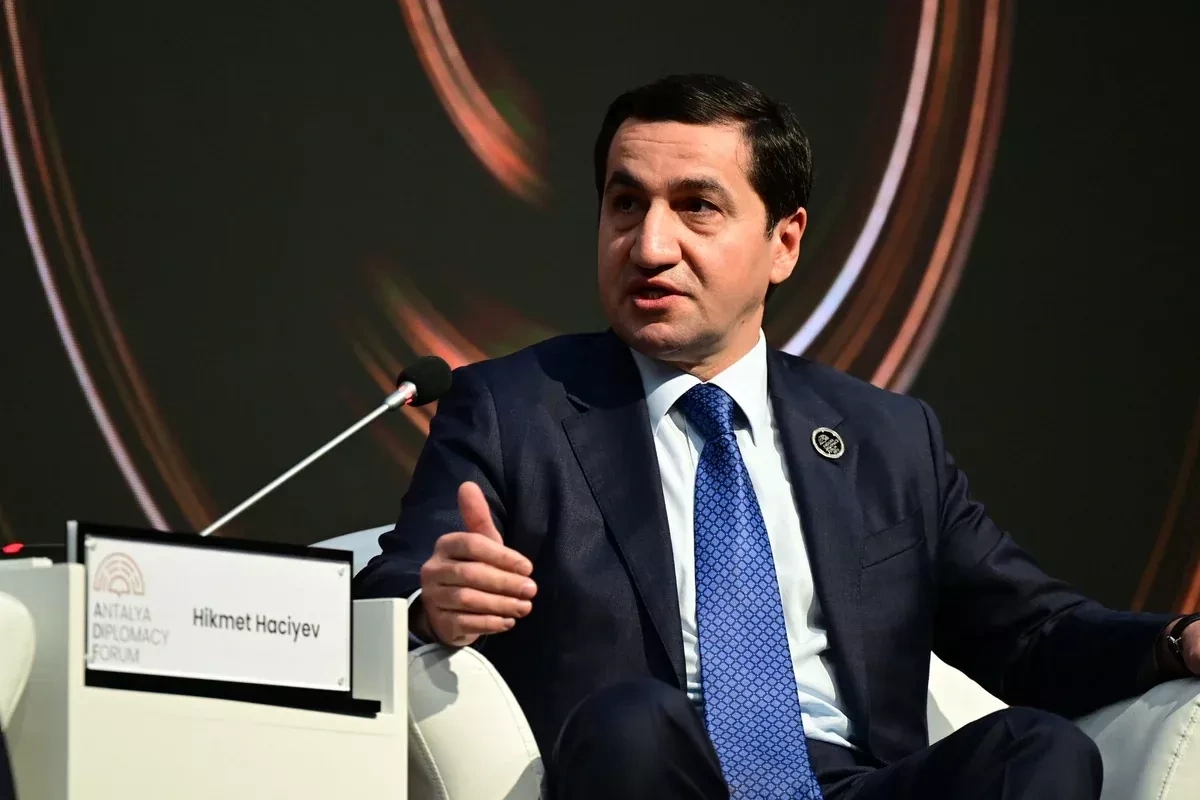
Azerbaijani President’s Assistant, Head of the Foreign Policy Department of the Presidential Administration Hikmet Hajiyev described the South Caucasus as a region undergoing a historic transformation from conflict to stability, with a particular emphasis on what he said was the region’s lack of prior experience with peace.
Speaking at a panel discussion titled “South Caucasus: A Strategic Hub in the Making” at the Antalya Diplomacy Forum, Hajiyev referred to remarks by President Ilham Aliyev, highlighting the emotional and historical significance of the current period, Caliber.Az reports.
“Let me also be a little bit emotional here with the words of my president and his interaction with his foreign counterparts. He said [..] 'We are defining peace in the Caucasus,’ and ‘We are learning to live in peace.’ It may sound somehow a little bit simplistic. It is not. Because in the Caucasus, we don’t know what is the peace. And we are in the process of defining [it- ed.]. [..] It is a fabulous feeling. It is a feeling that we never had before. We should value and cherish that,” he noted.
Transition toward de facto peace
Hajiyev concluded by arguing that the region is already experiencing a form of de facto peace following the developments of 2023, while acknowledging that long-term normalistion still requires sustained diplomatic work.
He suggested that the speed of progress between Armenia and Azerbaijan demonstrates a rare opportunity for durable stability, contrasting it with post-war peace processes elsewhere that took significantly longer to formalise.
From conflict zone to emerging trade hub
Moreover, Hajiyev said the South Caucasus is shifting away from its long-standing image as a conflict zone and is instead becoming an integral part of global energy and logistics systems.
He argued that global supply chains have been significantly disrupted by the war in the Middle East, making reliable transit regions more important than ever. In this context, he said Azerbaijan has established itself as a stable and predictable energy partner, currently supplying gas to 10 European countries, including eight EU member states.
He added that Azerbaijan continues to expand its role in global energy markets, including investment in renewable energy and cooperation with international partners to enhance export capacity.
Middle Corridor
A major focus of his address was the development of the Middle Corridor, which connects Asia to Europe through the South Caucasus.
Hajiyev said the corridor is already operational and increasingly multimodal, with Azerbaijan playing a central role alongside Georgia and Türkiye. He highlighted key infrastructure such as the Baku–Tbilisi–Kars railway as a backbone of the route.
He also referred to emerging connectivity initiatives involving Armenia under the TRIPP framework, describing it as a strategically important route that could link Central Asia, the South Caucasus, and Europe. According to him, work is ongoing with Armenia, the United States, and European partners on related transit routes, including access to Nakhchivan.
He further pointed to broader regional planning under the “Four Seas” concept, linking the Caspian, Black, Mediterranean, and Adriatic regions.
Regional partnerships
Hajiyev said Azerbaijan’s foreign policy is evolving beyond the South Caucasus, reflecting deeper engagement with Central Asia, the Turkic world, and the Middle East.
He highlighted the role of the Organization of Turkic States as an emerging geopolitical platform and pointed to trilateral cooperation between Azerbaijan, Türkiye, and Syria as an example of expanding regional engagement.
According to him, this broader orientation reflects Azerbaijan’s effort to position itself as a connector across multiple regions rather than a purely South Caucasian actor
By Sabina Mammadli