BAKU, Azerbaijan, April 1. A high-level
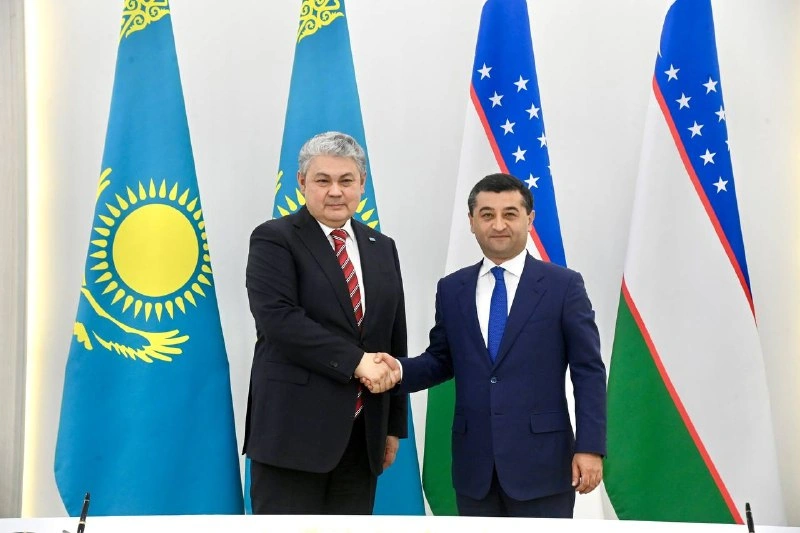
delegation from Kazakhstan, led by Minister of Foreign Affairs
Yermek Kosherbayev, arrived in Uzbekistan yesterday for a series of
bilateral meetings, culminating in the signing of a Cooperation
Program between the Ministries of Foreign Affairs for
2026-2027.
This visit highlights the growing momentum in the bilateral
relations between Tashkent and Astana, which have seen a notable
intensification of contacts in recent years. Both countries are
progressively advancing toward a more structured and comprehensive
cooperation framework.
During the discussions, Uzbekistan’s Minister of Foreign Affairs
Bakhtiyor Saidov emphasized, "In recent years, our cooperation has
reached an unprecedented level, driven by the strong political will
of our Presidents."
Amid rising external interest from global actors such as China,
the EU, and Russia, both Tashkent and Astana are increasingly
focusing on leveraging their own resources. This shift reflects not
only a response to external geopolitical dynamics but also a
proactive approach to shaping regional processes and advancing
mutual interests.
The economy remains the key driver of rapprochement. By the end
of 2025, trade turnover between the two countries reached $4.97
billion, increasing by 11.4%. At the same time, an imbalance
persists: exports amounted to $1.55 billion, while imports rose by
16.6% to $3.4 billion. This indicates growing trade alongside a
still uneven structure.
The trade growth is increasingly complemented by a deeper
expansion of investment presence. By early 2026, 1,221 enterprises
with Kazakh capital were operational in Uzbekistan, signaling a
significant shift from trade-based exchanges to more profound
economic engagement. Investment cooperation has also been steadily
evolving: between 2005 and 2025, Kazakhstan’s investments in
Uzbekistan amounted to approximately $1 billion, while Uzbek
investments in Kazakhstan reached $73.2 million.
Looking ahead, the two sides have set a more ambitious target,
raising trade turnover to $10 billion by 2030. This goal was
formalized with the signing of a program in March 2025. However,
achieving this ambitious objective will require not only sustained
growth in trade but also the establishment of new joint production
facilities, deeper industrial cooperation, and more robust regional
collaboration.
A pivotal instrument in this effort is expected to be the
International Center for Industrial Cooperation “Central Asia,”
where a series of joint projects are slated for launch. However,
the success of these initiatives will largely hinge on the speed
and effectiveness with which these plans are translated into
concrete actions.
Moreover, transport and logistics are emerging as critical areas
of cooperation. Kazakhstan and Uzbekistan are progressively
enhancing their coordination on railway routes and border
infrastructure. This collaboration is viewed not only as a matter
of bilateral trade but also as part of a broader strategy to secure
a competitive transit role in Eurasia. For Uzbekistan, the focus is
on diversifying its external trade routes, while Kazakhstan seeks
to reinforce its position as a key regional transit hub.
The dynamics are already reflected in the figures: by the end of
2025, railway cargo transportation between the countries reached a
record 32.3 million tons, up 16% year-on-year and marking the
highest level in the past 10 years. At the same time, the sides are
discussing expanding capacity at key junctions, including
Saryagash, Oasis, and Syrdarya, as well as completing the
Darbaza–Maktaaral section.
Against this backdrop, it is becoming clear that Astana and
Tashkent increasingly understand that competition for cargo and
investment does not exclude coordination. On the contrary, without
it, even growing routes will face infrastructure constraints,
tariffs, and transportation speed limitations. The approach is
therefore gradually shifting - from developing separate routes to
linking them into a single regional network. This is especially
important amid competition with other Eurasian corridors.
Energy is also gradually becoming part of the shared agenda.
Kazakhstan and Uzbekistan are working to enhance the resilience of
their power systems, coordinate during peak demand periods, and
develop green energy, including solar and wind projects. Overall,
this demonstrates that cooperation between the countries is already
expanding beyond individual sectors and covering multiple areas -
from trade and transport to energy.
Political dialogue between the countries has also intensified.
Regular meetings, new formats of interaction, and active contacts
at the leadership level in 2024–2025 indicate a high degree of
coordination.
In a broader context, cooperation between Kazakhstan and
Uzbekistan is becoming one of the key factors of stability in
Central Asia. Both countries are setting the pace for regional
integration. At the same time, reaching the $10 billion target will
require further deepening of economic interaction and
implementation of joint projects.
Thus, the current visit of the Kazakh delegation demonstrates
the parties’ intention to consolidate the achieved progress across
specific areas - from foreign policy to economy and logistics. How
quickly this potential can be realized in practice will become
clear in the near future. However, it is already evident that
Tashkent and Astana are ready to move from growing indicators to
more sustainable and deeper cooperation.