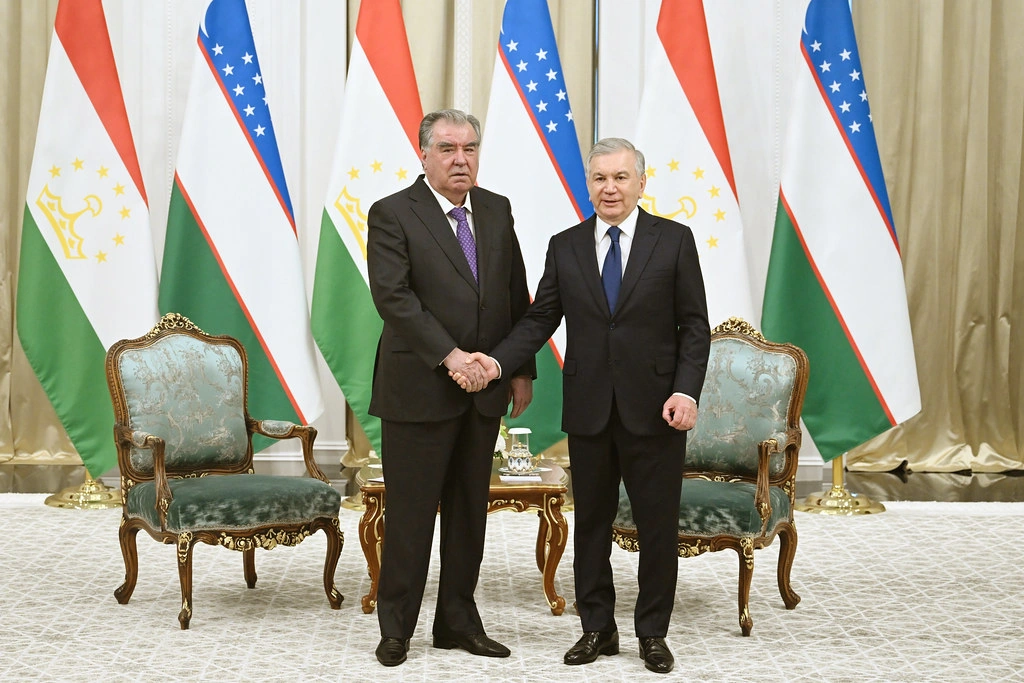
BAKU, Azerbaijan, March 26. Tajik President
Emomali Rahmon will pay a state visit to Uzbekistan on March 26–27,
where he is set to meet President Shavkat Mirziyoyev for the first
session of a new Supreme Interstate Council and sign a package of
agreements expected to elevate bilateral ties to a full-fledged
alliance.
The visit marks a significant step in the evolution of
relations. Since signing a Treaty on Allied Relations in April 2024
in Dushanbe - which entered into force in March 2025 - the two
sides have resolved nearly all outstanding border issues. A key
milestone came in March 2025, when the leaders of Uzbekistan,
Tajikistan and Kyrgyzstan signed a trilateral agreement in Khujand
defining the junction point of their borders, effectively closing
the last disputed segments.
Economic cooperation remains the main driver. Bilateral trade
reached $718.3 million in 2025, up 22.5% year-on-year, according to
Tajik data. Broader estimates put the figure closer to $912 million
- a 3.8-fold increase since 2017. Growth has accelerated further in
early 2026, with trade up 81.5% in January.
The structure of trade highlights complementarity: Uzbekistan
exports machinery, fertilizers and petroleum products, while
Tajikistan mainly supplies coal - nearly all of its export volume
in 2025 went to Uzbekistan. Investment ties are also expanding. As
of mid-2025, 357 enterprises with Tajik capital were operating in
Uzbekistan, up by roughly one-third from a year earlier. Both
governments have set a target of boosting trade to $2 billion in
the coming years.
Energy - once a source of friction - is increasingly an area of
alignment. The Rogun hydropower plant, previously a point of
concern for Tashkent over water flows, is now seen as a foundation
for cooperation. Tajikistan is already exporting electricity from
the plant to Uzbekistan at around 3.4 cents per kWh, with volumes
expected to rise as new capacity comes online. For Uzbekistan, this
helps cover peak summer demand with relatively green energy; for
Tajikistan, it provides a stable export market and financing
stream.
The agenda also includes transport connectivity, industrial
cooperation and cultural exchanges. In 2025, Uzbekistan hosted
nearly 2.78 million visitors from Tajikistan, underscoring the
scale of cross-border ties.
Regionally, the visit comes amid accelerating Central Asian
integration, with Tashkent and Dushanbe positioning their
relationship as a model of bilateral alliance-building. At the same
time, structural differences remain: Tajikistan’s economy relies
heavily on hydropower and remittances, while Uzbekistan is driven
by gas resources and domestic reforms.
Around 10–15 agreements are expected to be signed, alongside
concrete steps to expand trade and investment. The launch of the
Supreme Interstate Council is intended to institutionalize
high-level engagement, turning periodic meetings into a standing
coordination mechanism.
Whether the two countries can reach their $2 billion trade
target within the next few years - and significantly advance joint
energy projects - will depend on implementation. If momentum holds,
the visit could emerge as a practical model for deeper regional
cooperation in Central Asia, with its longer-term impact shaped by
the pace of follow-through.