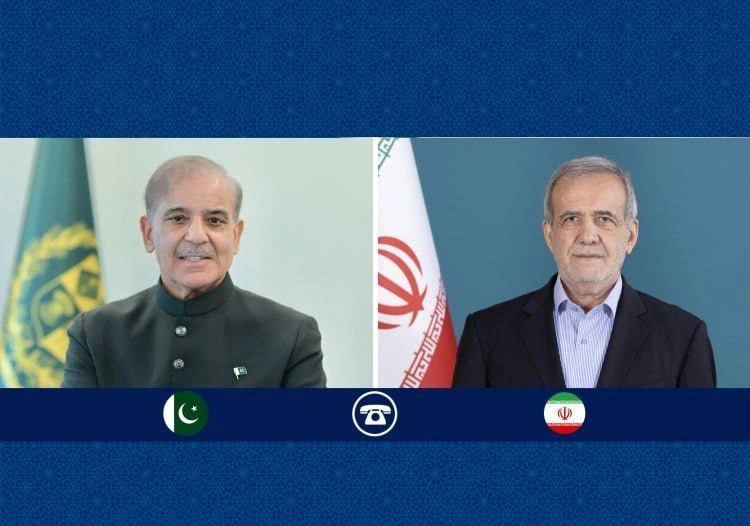
BAKU, Azerbaijan, March 11. President of Iran
Masoud Pezeshkian and Prime Minister of Pakistan Shehbaz Sharif
discussed the military escalation in the region, Trend reports.
According to the information, the discussion took place during a
telephone conversation between the parties.
During the phone call, Iranian President Masoud Pezeshkian urged
the international community and international organizations to
investigate the root causes of the military airstrikes on Iran and
the onset of the war.
Pezeshkian stated that the lack of an investigation would
negatively affect the current situation in the field of
international security.
The Iranian president stressed that Iran has no intention of
attacking countries in the region or engaging in confrontation with
them.
During a telephone conversation, Pakistani Prime Minister
Shehbaz Sharif also expressed his condolences on the death of
Iran's Supreme Leader Ayatollah Seyed Ali Khamenei and
congratulated Ayatollah Seyed Mojtaba Khamenei on his election as
the new leader.
Since negotiations between the U.S. and Iran on the nuclear
program did not lead to a concrete agreement, on February 28, the
U.S. and Israel launched military airstrikes against Iran. In
response, Iran has since been striking Israel and U.S. military
targets in the region with missiles and drones.
On the first day of the military airstrikes on Iran, Iran's
Supreme Leader Ayatollah Seyed Ali Khamenei and several
high-ranking military officials were killed. On March 8, the
Iranian Assembly of Experts unanimously elected Ayatollah Seyed Ali
Khamenei's son, Seyed Mojtaba Khamenei, as Iran's third supreme
leader.
From March 1 through March 5, the conflict expanded to include
various countries in the Middle East.
According to the U.S., at least eight people were killed, and
more than 140 were injured.
The conflict also seriously threatened the region's energy
infrastructure and maritime transport. Due to security tensions
around the Strait of Hormuz, oil prices on the world market rose
sharply, and a number of countries urged their citizens to leave
the region.