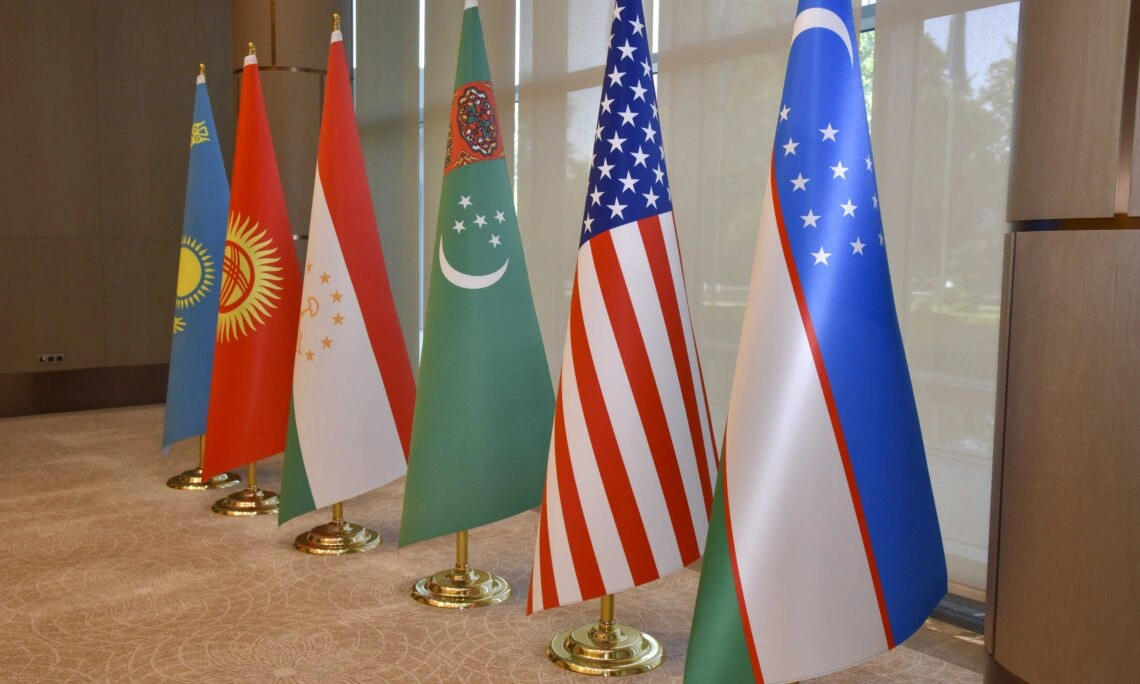
BAKU, Azerbaijan, February 5. The second B5+1
business forum is currently underway in Bishkek, the capital of
Kyrgyzstan, bringing together representatives from the governments
of five Central Asian countries, international organizations,
chambers of commerce, business associations, and experts. The forum
is organized with financial support from the U.S. Department of
State’s program to improve the business environment in the region
(IBECA), in cooperation with the Cabinet of Ministers of Kyrgyzstan
and the Center for International Private Enterprise (CIPE) under
the U.S. Chamber of Commerce.
The forum builds upon a business platform established at the
September 2023 summit in New York, where leaders from the U.S. and
Central Asian countries convened. It acts as a pragmatic extension
of the diplomatic C5+1 framework, with this session focusing more
on translating high-level agreements into tangible actions and
broadening the private sector's involvement in project
implementation.
Unlike the inaugural forum in Almaty in 2024, the current
meeting is geared towards operationalizing prior commitments,
ensuring that cooperation extends beyond abstract dialogues into
actionable initiatives.
The Central Asian region presents a highly attractive
proposition for international business, driven by several
compelling factors. First, its sizable domestic market—home to over
80 million consumers—coupled with a youthful demographic and rising
urbanization trends, makes it a dynamic and evolving market.
Second, the region’s strategic location serves as a vital transit
hub, connecting Asia, Europe, and the Middle East, enhancing its
role in global trade routes. Furthermore, the region’s rich natural
resource base, including critical minerals, alongside ongoing
infrastructure development, significantly bolsters its investment
appeal.
At the forum’s opening, First Deputy Chairman of the Cabinet of
Ministers of Kyrgyzstan Daniyar Amangeldiev highlighted the high
growth of Kyrgyzstan’s economy. The country recorded GDP growth of
11.1% in 2025 and has implemented reforms in digitalizing
government administration, simplifying business procedures,
developing infrastructure, and protecting investor rights. Specific
initiatives include the launch of the state-backed USDKG
stablecoin, the “Digital Nomad” program, and the development of
technology and creative parks aimed at attracting international IT
specialists and innovative companies.
These initiatives have received support from the United States.
U.S. Special Envoy to South and Central Asia, Ambassador Sergio
Gor, recalled the first B5+1 forum and emphasized that the platform
provides an opportunity for direct dialogue between business and
government structures, while also promoting joint initiatives in
technology and artificial intelligence.
During the first two days of the forum, regional ministers of
economy, investment, and industry shared their insights and
perspectives. Bakyt Sydykov of Kyrgyzstan emphasized the pivotal
role of business in driving economic transformation. Yersayin
Nagaspayev of Kazakhstan highlighted the country’s efforts to
introduce a unified tourist visa and underscored the substantial
U.S. investment in Kazakhstan’s economy. Sulton Rahimzoda of
Tajikistan outlined the government’s initiatives to create a stable
and attractive investment environment. Mammetguly Astanagulov of
Turkmenistan drew attention to the concentration of foreign capital
in key sectors such as oil and gas, agriculture, and construction.
Meanwhile, Laziz Kudratov of Uzbekistan discussed the increasing
demand for U.S. technologies and critical minerals, expressing the
country’s commitment to integrating these resources through
advanced solutions.
Alongside ongoing discussions, participants are reviewing the
implementation of recommendations from the first B5+1 forum in
Almaty and exploring ways to accelerate project execution. In the
longer term, cooperation under the B5+1 format could lead to
increased investment, the activation of digital and innovation
initiatives, and the expansion of trade and logistics networks. At
the same time, project implementation may face delays due to
regulatory barriers, economic fluctuations, or geopolitical
uncertainties. The B5+1 format may also evolve by expanding
sectoral coverage, attracting new participants, or stimulating the
creation of similar platforms for government-business
collaboration.