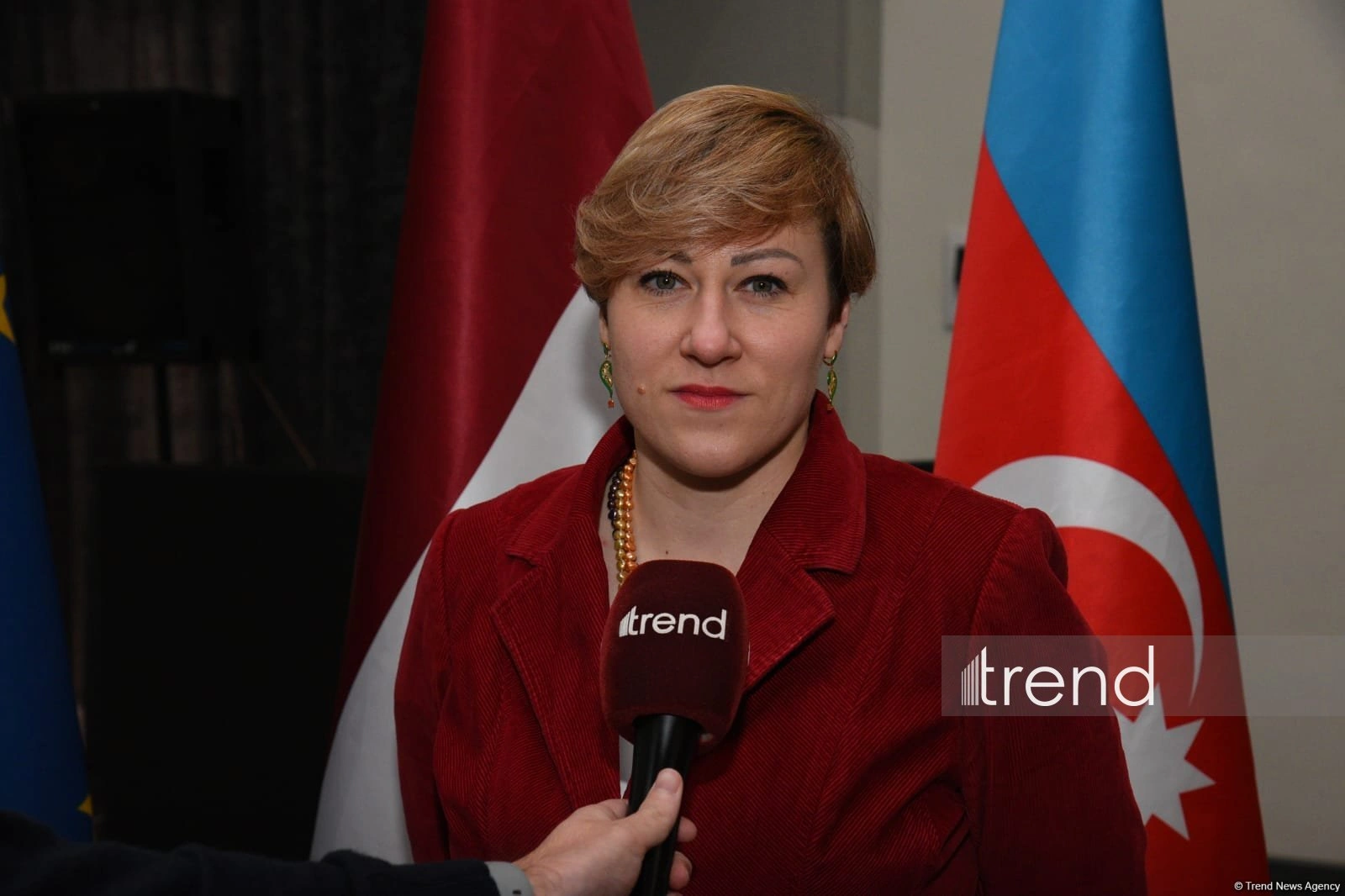
BAKU, Azerbaijan, February 2. The Latvian
Chamber of Commerce and Industry (LCCI) assesses the current state
of economic cooperation between Latvia and Azerbaijan as stable and
steadily developing, with significant potential for further growth,
LCCI Director of the European Union (EU) Projects Department, Līga
Sičeva, said in an interview with Trend.
According to her, existing trade flows, business contacts, and
institutional dialogue create a solid foundation, while recent
practical initiatives, including business missions,
business-to-business (B2B) meetings, and knowledge exchange
implemented within the LEF Network Azerbaijan project, have
contributed to deepening mutual understanding between companies and
business support organizations in both countries.
"Looking ahead, the overall cooperation potential is
substantial, especially in sectors such as logistics, food and
agricultural products, information and communication technologies
(ICT), education, and green solutions. The Chamber sees its role in
facilitating practical, demand-driven partnerships by establishing
business contacts, exchanging market information, and supporting
long-term cooperation that delivers real economic benefits for both
Latvia and Azerbaijan," she said.
Sičeva emphasized that interest among Latvian companies in
cooperating with Azerbaijani partners is practical and growing in
nature, particularly in areas where there are clear market
opportunities, reliable partners, and long-term prospects.
"Rather than viewing joint ventures as the default model, many
companies prefer phased cooperation formats such as distribution
agreements, project-based partnerships, or service cooperation.
These formats allow both sides to better understand market
conditions and business practices.
Based on recent contacts and business feedback, the most
promising cooperation formats include logistics and transport
services, the food industry and agribusiness, ICT and digital
solutions, education and professional services, as well as selected
areas of manufacturing where local presence creates added value.
LCCI supports this process by encouraging demand-oriented
cooperation models and helping companies identify the most suitable
formats that balance risks, investments, and long-term
sustainability," the department director added.
She noted that for Latvian companies, trust and mutual
understanding serve as the starting point for any cooperation:
"Business places great importance on building long-term
relationships through regular communication and practical
interaction before moving to contractual relations and more
advanced forms of partnership. It is also important to note that
Latvian companies are generally more focused on trade and
cooperation than on large-scale direct investments, which makes a
partnership-based, phased cooperation model particularly suitable
for engagement with Azerbaijani partners."
According to Sičeva, shaping a positive country image also plays
an important role in strengthening economic cooperation on both
sides.
"A strong and accurate understanding of each country’s business
environment, core values, and economic strengths fosters greater
trust between companies and supports more informed, balanced
decision-making. Equally important is recognizing differences in
business culture, such as communication styles, decision-making
approaches, and expectations, which is essential for building
lasting trust and ensuring sustainable, long-term cooperation," she
said.