BAKU, Azerbaijan, January 30. In recent years,
the global energy market has experienced increasing fragmentation.
Heightened competition for resources, rapidly growing energy demand
in Asia, geopolitical risks, and concerns over energy security are
now pivotal factors influencing the development of new
infrastructure and supply routes.
In this context, India, one of the world’s largest economies,
continues to increase its gas consumption. According to the
International Energy Agency (IEA), consumption is expected to grow
by nearly 60% - from 65 billion cubic meters in 2023 to 103 billion
cubic meters by 2030 - while the share of gas in the country’s
energy balance will rise from 6.2% in 2025 to 15% in 2030. At these
levels, India’s dependence on imported natural gas remains
significant, estimated at 44%, half of which comes from LNG
shipments.
In this context, the Turkmenistan-Afghanistan-Pakistan-India
(TAPI) pipeline is gaining renewed importance. The project plays a
crucial role in the energy security strategies of the nations
involved, reflecting broader global shifts in energy policy. These
shifts indicate an increasing emphasis on diversifying supply
sources and reducing dependence on maritime routes and vulnerable
segments of the global LNG market.
For Afghanistan, however, the project has a different
significance. More than 85% of the population receives electricity
mainly through imports from Uzbekistan, Turkmenistan, and Iran, as
well as limited hydro, thermal, and renewable generation. Demand
for natural gas is currently low, but it is considered a key factor
in developing infrastructure and reducing the energy deficit.
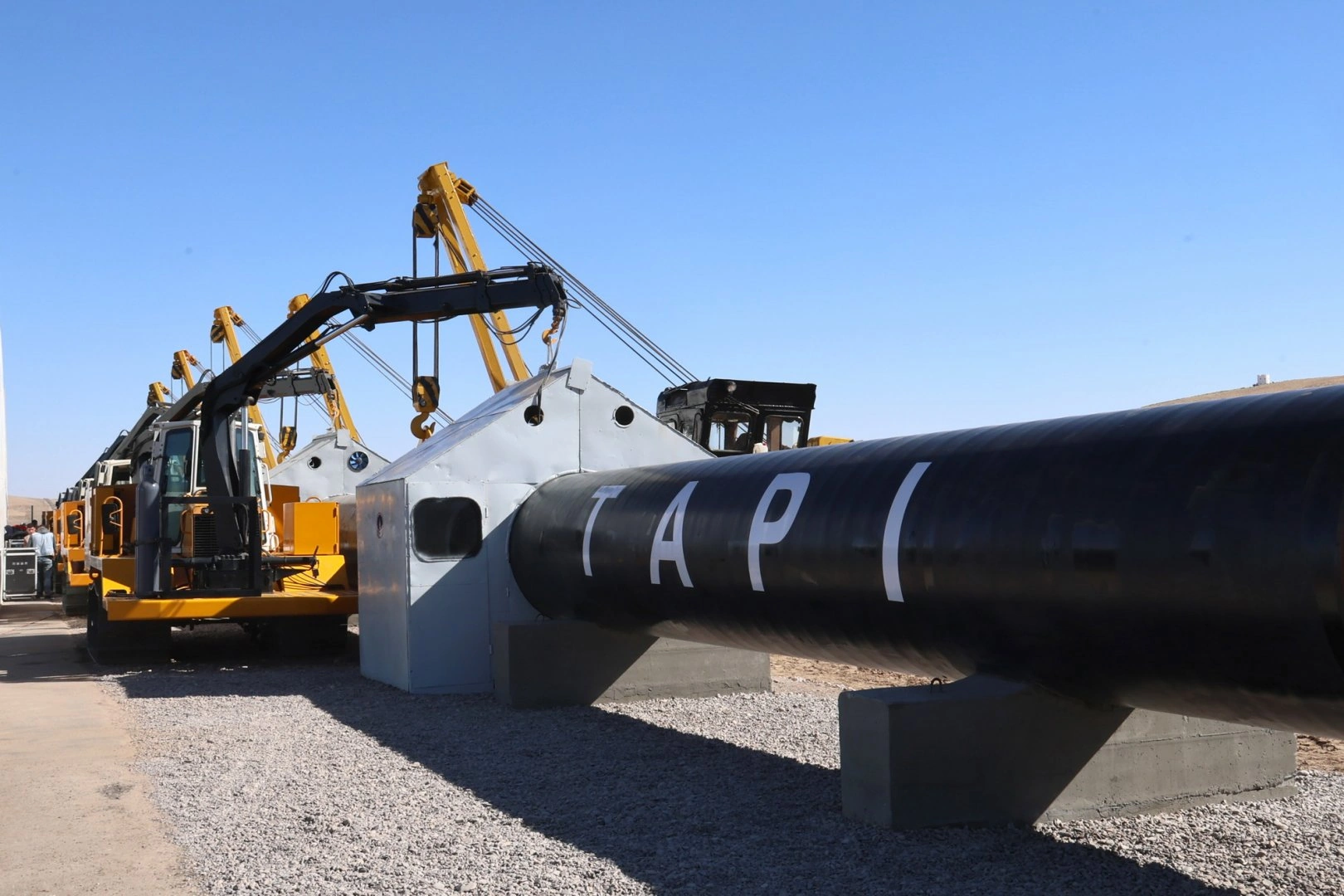
The TAPI pipeline is designed as a trunk line with a capacity of
up to 33 billion cubic meters of gas per year, spanning
approximately 1,814 km. The source of gas for the pipeline is the
large Galkynysh field in Turkmenistan, with proven reserves of 27.4
trillion cubic meters. The pipeline is intended to transport
annually 5 billion cubic meters of gas to Afghanistan and 14
billion cubic meters each to Pakistan and India.
Turkmenistan has completed construction of its 214 km section of
the pipeline and prepared it for operation in 2024. Work on the
Afghan section began in September 2024. For the Serhetabat-Herat
segment, 153 km long, 91 km of the route has been prepared for pipe
laying. Completion of this section is expected by the end of 2026.
As of the end of 2025, about 14 km of pipes have been laid in
Afghanistan.
In this context, attention was drawn to the statement by India’s
ambassador to Turkmenistan in January 2026, in which he expressed
his country’s readiness to share experience and technologies with
Turkmenistan in IT, digitalization, pharmaceuticals, healthcare,
education, and human resources development. In this statement,
special attention was given to the mutually beneficial use of
natural resources. Later that month, Turkmenistan was described by
the ambassador as a key partner for New Delhi within its “extended
neighborhood” policy. In January, Ashgabat was also visited by
India’s Secretary of State for Western Affairs, Sibi George, to
discuss energy-related matters.
The Turkmen side has also institutionalized efforts to
accelerate construction processes. At the International Conference
and Exhibition “Turkmenistan Oil & Gas - 2025,” TAPI Pipeline
Company Limited CEO Muhammetmyrat Amanov stated: “Our goal is to
finalize construction works on the Herat section by the end of next
year and begin gas supply at the end of 2026 or early 2027.”
Amanov also reported that negotiations with Pakistan on
concluding key agreements to safeguard future investments and
ensure investor confidence are at the final stage, with more than
90% of the work completed.
Considering the above, Turkmenistan seeks to strengthen its
presence in South Asian markets. Preliminary estimates suggest that
by 2030, it will supply 13-14% of the total gas imports of a
1.5-billion-people economy, provided the TAPI project is
successfully implemented. Evidently, this is why Turkmenistan has
identified the successful construction of the Serhetabat-Herat
section of the TAPI pipeline as a top priority for its oil and gas
sector in 2026.
In the competitive global landscape of digital technologies and
artificial intelligence, access to stable and sustainable energy
sources has become a fundamental pillar for long-term development.
A December 2025 report by the World Economic Forum, titled The
AI-Energy Nexus Will Determine AI’s Impact: We Must Account for It
Better, highlighted that "countries unable to ensure reliable and
sustainable energy risk falling behind in the global AI race."
China has already solidified long-term partnerships with
Ashgabat for natural gas supplies, while India, in line with its
strategic and technological objectives, is also increasingly
focusing on Turkmenistan’s energy potential. In this context, the
successful implementation and expansion of the TAPI project has the
potential not only to solidify Ashgabat’s position as a key
exporter but also to elevate Turkmenistan’s strategic importance as
a central factor in both energy and technological resilience across
the wider Eurasian region. The realization of this project would
send a strong signal to international investors and mark a new
phase in the integration of energy markets across Central and
South-East Asia.