BAKU, Azerbaijan, May 21. Multilateral
international cooperation and the systemic exchange of operational
expertise constitute non-negotiable prerequisites for advancing
sustainable urban development and executing the core tenets of the
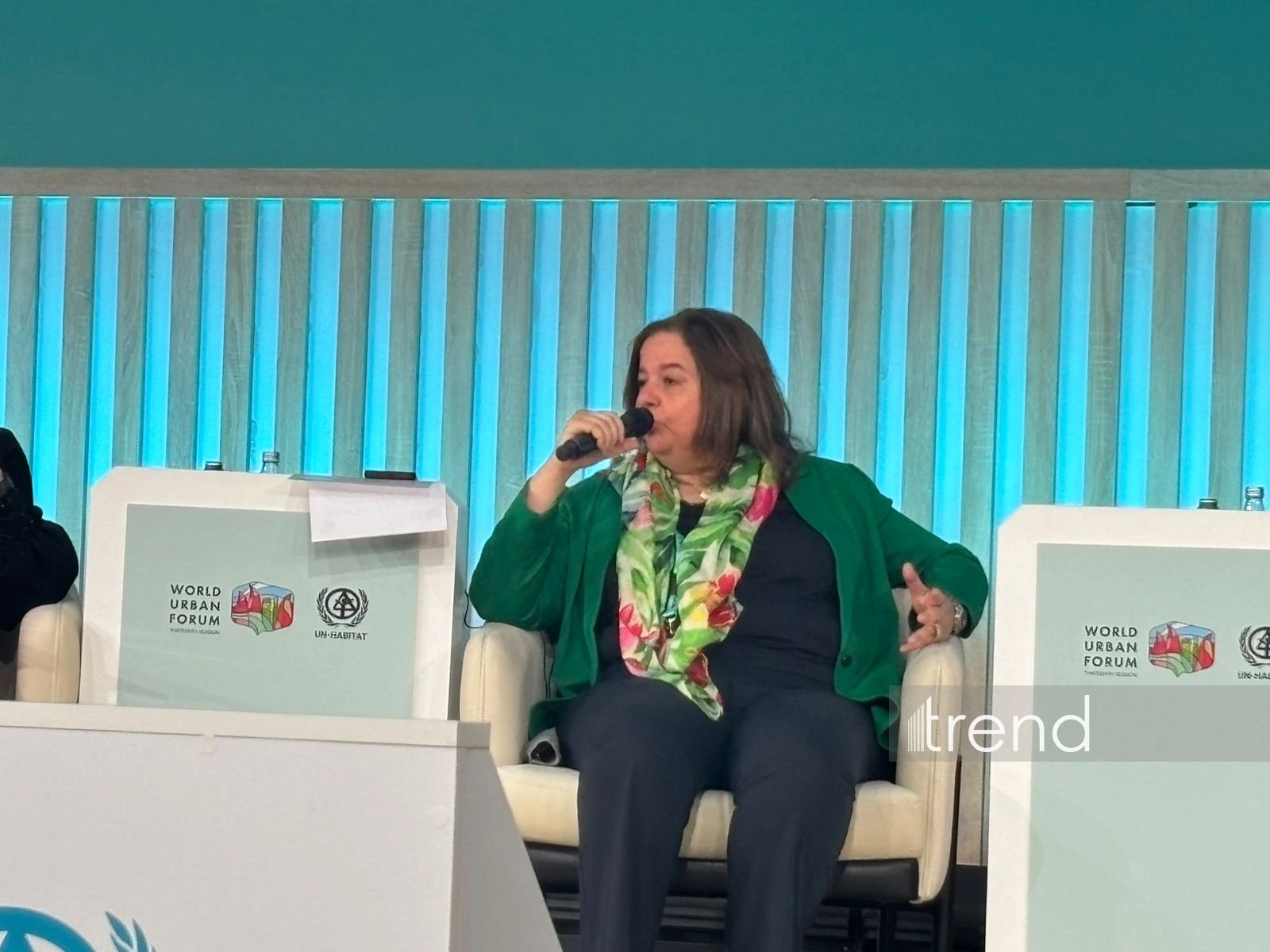
New Urban Agenda, Mai Abdel Hamid (Mai Ahmed), Chief Executive
Officer of the Social Housing and Mortgage Finance Fund of Egypt,
said, Trend
reports.
She made the remark during a high-level session titled "A New
Deal for Housing Finance" held within the framework of the 13th
session of the World Urban Forum (WUF13) in Baku.
According to her, the World Urban Forum functions as an
indispensable global platform for high-level dialogue on
sustainable urbanization challenges. She noted that participation
in the summit carries unique strategic significance for Egypt,
drawing parallels to when Cairo successfully hosted the global
forum, showcasing a metropolitan matrix that seamlessly merges
ancient historic heritage with progressive, modern urban planning
frameworks.
Abdel Hamid emphasized that sustainable metropolitan development
stretches far beyond basic infrastructure construction, acting
primarily as a structural vehicle to elevate baseline quality of
life, reinforce local social cohesion, and expand equitable
macroeconomic opportunities for all citizens. She reported that
Egypt’s national urban development policies remain tightly aligned
with the guidelines of the New Urban Agenda and the United Nations
Sustainable Development Goals (SDGs).
According to the CEO, Egypt is actively executing large-scale
pipelines targeting the optimization of residential living
conditions, the expansion of mass transit public transportation
networks, the broadening of municipal green spaces, and the
enforcement of strict energy-efficiency standards across
residential and commercial buildings. She directed specific
attention toward ongoing urban renewal initiatives across Cairo,
alongside state-backed strategic efforts to develop secondary
cities to ensure balanced macro-regional economic growth.
Moreover, Abdel Hamid concurrently underscored the profound
historical and structural significance of the post-conflict
rehabilitation and comprehensive reconstruction workflows underway
across the liberated territories of Azerbaijan, characterizing this
massive undertaking as a prime developmental window to pioneer
cutting-edge "smart city" and "smart village" models.
She pointed out that these rehabilitated regions are
successfully absorbing massive, coordinated capital investments
directed toward smart infrastructure layout, utility grids,
utility-scale renewable energy integration, and modern social
services.
Concluding her address, the Egyptian official highlighted the
critical urgency of synchronized global interaction to mitigate the
compounding challenges of rapid planetary urbanization, calling for
reinforced multilateral action to construct deeply resilient,
sustainable, and inclusive urban ecosystems.
Today marks the fifth day of WUF13 in Baku.
The first day included a ministerial meeting dedicated to the
New Urban Agenda, a ministerial roundtable, assemblies for women
and civil society, business sessions, and discussions on urban
prosperity. An official ceremony marking the raising of the UN and
Azerbaijani flags also took place.
The second day stood out for the inaugural Leaders' Summit,
featuring high-level discussions on the global housing crisis,
urbanization policy, and urban resilience. Concurrently, the
opening of the Mexico City pavilion took place, serving as a
significant platform for expanding cooperation with the Latin
American region and preparing for WUF14.
The third day of WUF13 featured a comprehensive program of
events covering the global housing crisis, the formation of safe
and inclusive cities, climate resilience, artificial intelligence
and urban governance, green urbanization, social equity, and
sustainable transport.
One of the highlights of the third day was the signing of a
sister-city memorandum between the Azerbaijani city of Shusha and
the Turkish city of Trabzon.
The fourth day of WUF13 featured a broad program of events
dedicated to urbanization, climate change, inclusive urban
development, housing policy, and sustainable governance.
One of the important events of the UN Special Program for the
Economies of Central Asia (SPECA) Cities Forum, held on the fourth
day, was the announcement of Almaty’s official accession to the
“Declaration of Intent on the Establishment of the SPECA Smart
Climate-Resilient Cities Forum.”
Also, for the first time in WUF history and at Azerbaijan’s
initiative, the “WUF13 NGO Forum: Global Partnership and
Decision-Making” was held.
WUF13, which has attracted more than 40,000 registered
participants from 182 countries, will continue until May 22. Held
under the theme “Housing the world: Safe and resilient cities and
communities,” the forum brings together governments, international
organizations, experts, and representatives of civil society to
strengthen global cooperation in the field of sustainable urban
development.