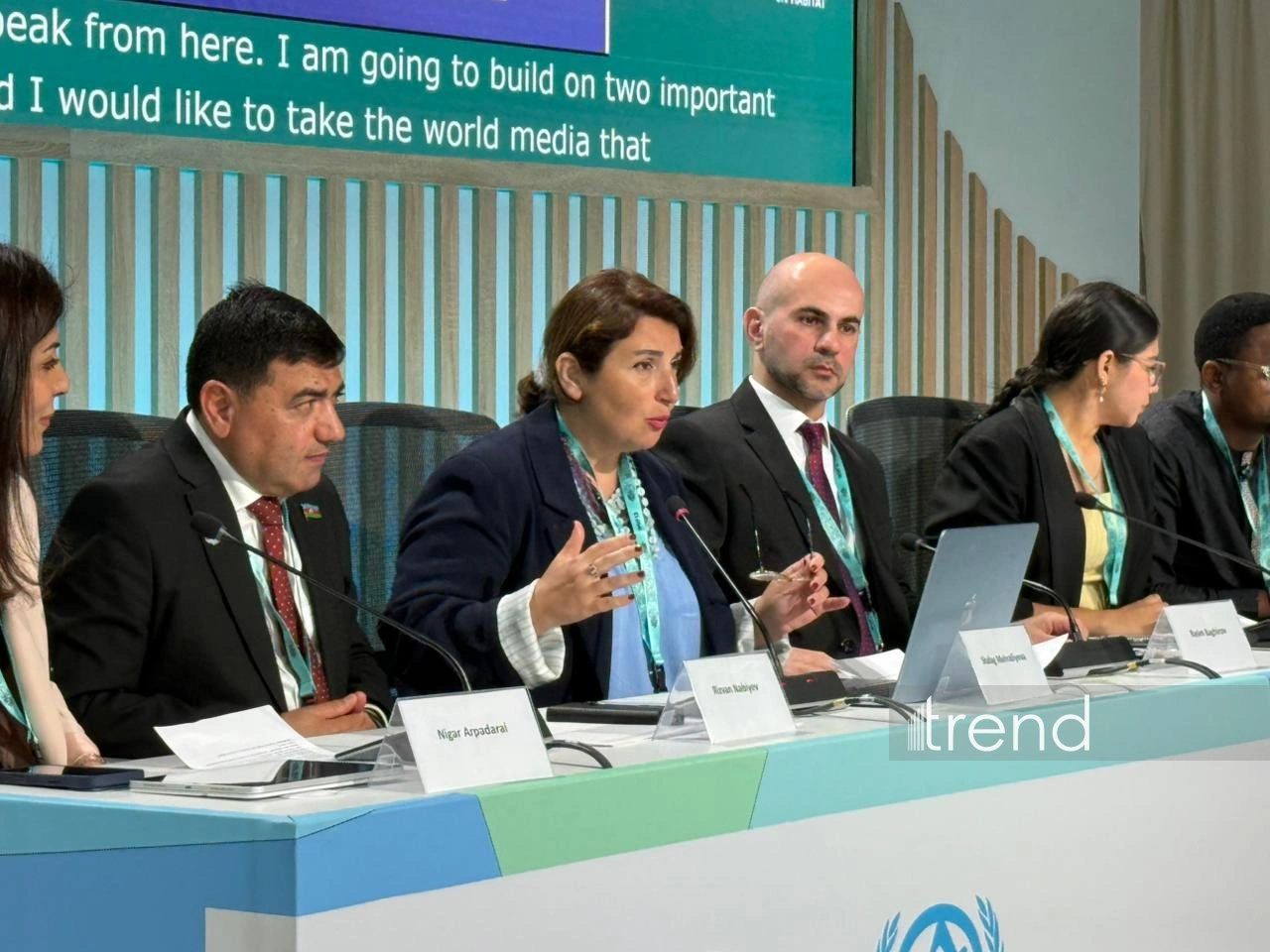
BAKU, Azerbaijan, May 20. The media is the main
driving force behind transforming urban development from a
technical issue into a people-centred dialogue, a member of the
Supervisory Board of the Media Development Agency and founding
director of the “Communications and Digital Media” program at ADA
University, Shafag Mehraliyeva said, Trend reports.
She made the statement at the event “Media as a Driver of Public
Discourse on Housing and Urban Resilience,” held as part of
WUF13.
Mehraliyeva noted that no matter how effectively state
institutions strive to fulfill their duties, they cannot
effectively address housing and sustainable urban development
issues unilaterally, without public participation and public trust.
These two elements, participation and trust, cannot exist without
communication.
Furthermore, Mehraliyeva said that communication should be
viewed not merely as an additional element of urban policy, but as
an important part of the infrastructure of sustainable
development.
The Supervisory Board member emphasized that the process of
reconstruction and resettlement in Karabakh is a unique example for
Azerbaijan and one of the best lessons that international guests
can learn from it.
“For 30 years, nearly one million people have been displaced.
Today, we are returning to our liberated territories, and every
person returning home has their own expectations, based on memories
of their hometowns from 30 years ago. For example, people returning
to Agdam today are faced with a completely different, more modern,
and sustainable environment. In this context, I would like to
express my gratitude to the Azerbaijani media, because they are
very professionally explaining to the public why the situation
around them is exactly as it is and what the future of Karabakh
will look like.
Through media projects such as “Aghdam and Me”, communities
returning to their homeland are gradually being prepared for this
process. They are told that the environment to which they are
returning will be future-oriented. This reinforces their sense of
stability.
This example demonstrates that information and communication
must be properly organized, not at the end, but from the very
beginning of urban planning processes. Very often, information is
provided to the public only after decisions have been made. This is
a global problem.
Housing policies and planning documents may exist, but if
communities do not understand how this affects their lives and do
not become participants in the process, even the most carefully
designed policy can lose its effectiveness in practice,” she
added.
Today, the fourth day of the WUF13 conference is taking place in
Baku.
The first day included a ministerial meeting dedicated to the
New Urban Agenda, a ministerial roundtable, assemblies for women
and civil society, business sessions, and discussions on urban
prosperity. An official ceremony marking the raising of the UN and
Azerbaijani flags also took place.
The second day stood out for the inaugural Leaders' Summit,
featuring high-level discussions on the global housing crisis,
urbanization policy, and urban resilience. Concurrently, the
opening of the Mexico City pavilion took place, serving as a
significant platform for expanding cooperation with the Latin
American region and preparing for WUF14.
The third day of WUF13 featured a comprehensive program of
events covering the global housing crisis, the formation of safe
and inclusive cities, climate resilience, artificial intelligence
and urban governance, green urbanization, social equity, and
sustainable transport.
WUF13, which has attracted more than 40,000 registered
participants from 182 countries, will continue until May 22. Held
under the theme “Housing the world: Safe and resilient cities and
communities,” the forum brings together governments, international
organizations, experts, and representatives of civil society to
strengthen global cooperation in the field of sustainable urban
development.