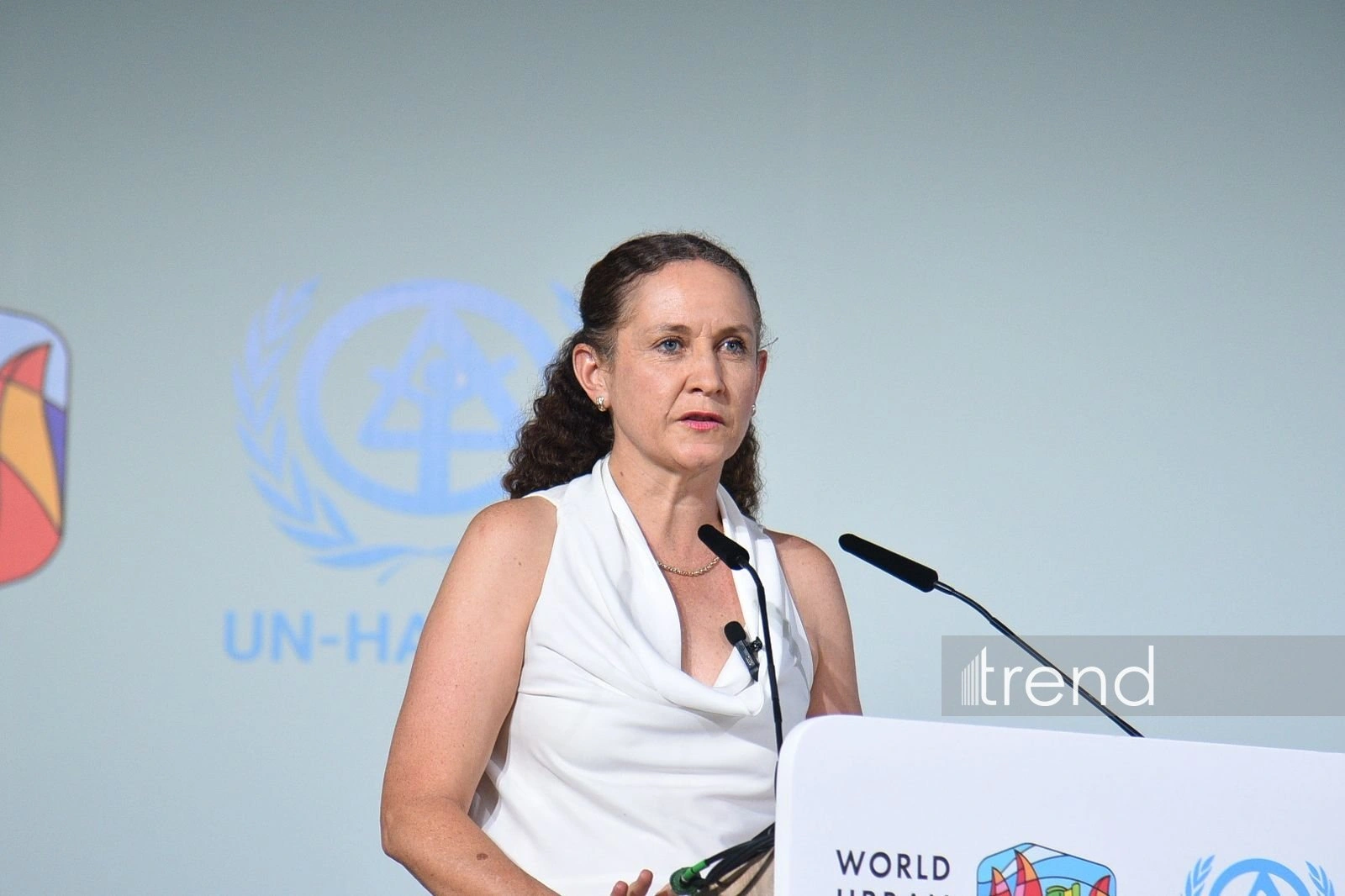
BAKU, Azerbaijan, May 20. Air quality must
become an integral part of urban planning, housing policy, and
public health issues, Executive Director of the Clean Air Fund's
Breathe Cities Initiative, Cecilia Vaca Jones, said at an event
"Breathing Life into the New Urban Agenda: Integrating Air Quality
and Green Infrastructure for Resilient Cities" within the framework
of the 13th session of the World Urban Forum (WUF13) in Baku,
Trend reports.
She noted that Baku's green belts, pedestrian-friendly urban
environment, and seaside areas made a great impression on him.
"I walked from the hotel to the coast. I reached the sea through
green corridors and almost didn't have to cross any roads. This is
an advantage that not all cities have. For this, I want to
congratulate Baku," she pointed out.
Jones emphasized that holding an event dedicated to air quality
in Baku, which means "city of winds", has a special symbolic
meaning.
"Wind is the most real form of feeling the air. That is why I
think that holding such a session in Baku can encourage young
people to be more active in this direction," she explained.
She highlighted that the first action in human life is
breathing, and this is the most fundamental common feature that
unites all people.
"We learn to breathe before we learn to talk, walk, or eat.
However, in many cities around the world, babies' first breath is
already accompanied by polluted air," the executive director
said.
According to her, air quality is often presented only as a
technical or environmental issue. However, this topic is directly
related to people's daily lives and health.
"Parents worry about whether their children are breathing safe
air when they go to school. Elderly people worry about whether they
can breathe comfortably outside. Air is present on every street, in
every home, in every school, and in every person's body," she
underscored.
Jones further noted that air pollution is currently one of the
most serious public health problems in the world.
"Millions of people lose their lives every year due to air
pollution. Air pollution is directly linked to non-communicable
diseases such as heart and lung disease, diabetes, and dementia. It
causes more premature deaths than tobacco use and is the second
leading cause of death among children under five, after
malnutrition," she clarified.
She added that clean air isn't just an environmental benefit,
but a public health tool.
"Reducing air pollution helps prevent asthma attacks, strokes,
heart disease, hospitalizations, and premature deaths," she
said.
The executive director also stressed the importance of
increasing the role of green infrastructure in urban planning.
"I saw QR codes placed on trees in Baku. These codes are used to
map the trees in the city. This is an indicator of the importance
given to preserving green infrastructure in the city," said
Jones.
According to her, a healthy city is not just a place where
hospitals and services are located, but also an environment that
prevents people from getting sick.
"Air quality should be an integral part of discussions on
housing policy, urban planning, climate sustainability, and public
spaces. Because air pollution does not affect everyone in the same
way. Children are especially vulnerable. Air pollution negatively
affects not only the lungs, but also children's brain development,"
she added.
Today marks the fourth day of WUF13 in Baku.
The first day included a ministerial meeting dedicated to the
New Urban Agenda, a ministerial roundtable, assemblies for women
and civil society, business sessions, and discussions on urban
prosperity. An official ceremony marking the raising of the UN and
Azerbaijani flags also took place.
The second day stood out for the inaugural Leaders' Summit,
featuring high-level discussions on the global housing crisis,
urbanization policy, and urban resilience. Concurrently, the
opening of the Mexico City pavilion took place, serving as a
significant platform for expanding cooperation with the Latin
American region and preparing for WUF14.
The third day of WUF13 featured a comprehensive program of
events covering the global housing crisis, the formation of safe
and inclusive cities, climate resilience, artificial intelligence
and urban governance, green urbanization, social equity, and
sustainable transport.
WUF13, which has attracted more than 40,000 registered
participants from 182 countries, will continue until May 22. Held
under the theme “Housing the world: Safe and resilient cities and
communities,” the forum brings together governments, international
organizations, experts, and representatives of civil society to
strengthen global cooperation in the field of sustainable urban
development.