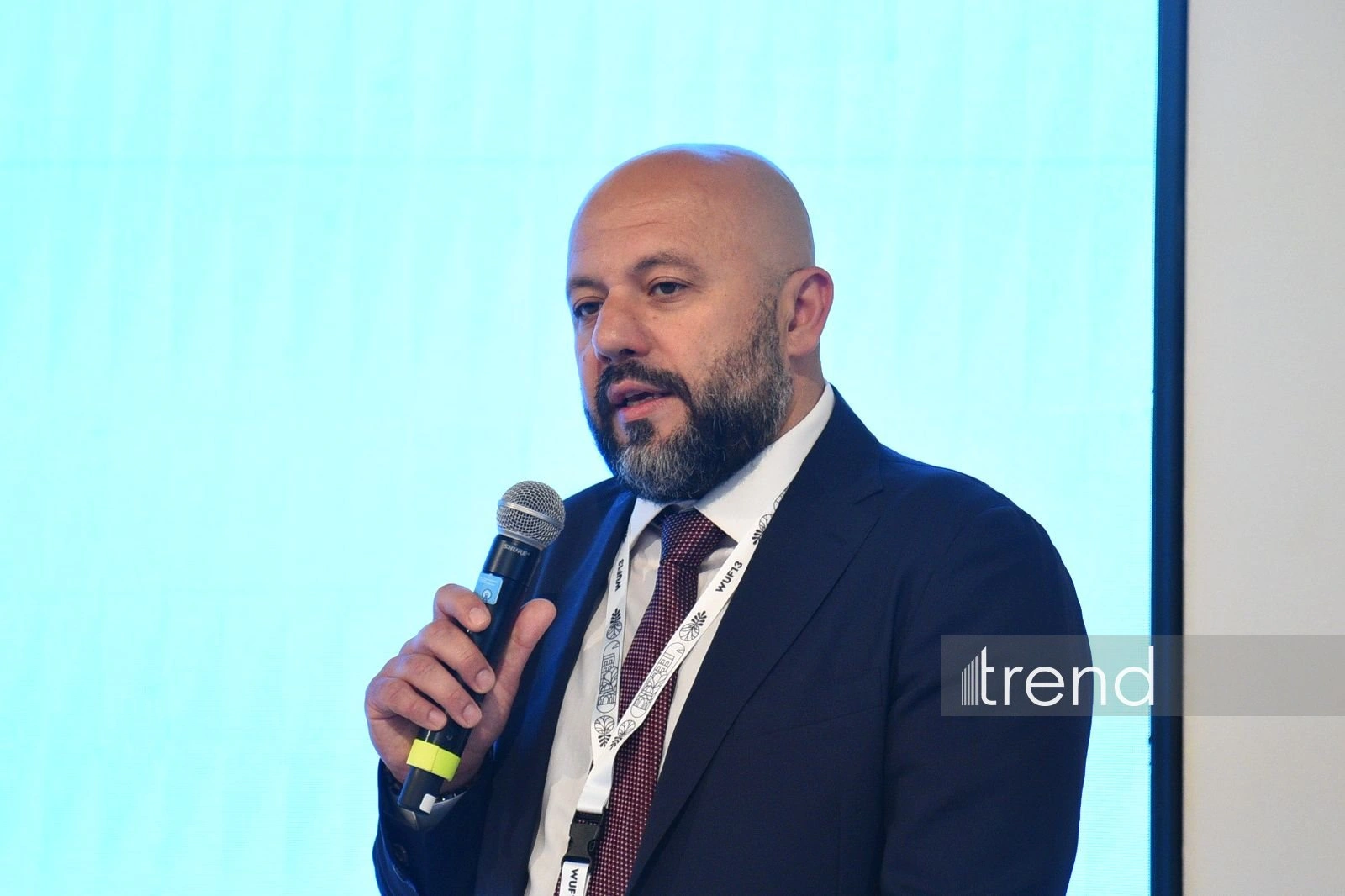
BAKU, Azerbaijan, May 20. Following the launch
of a new reform phase by the Icherisheher Administration, a
three-year transformation strategy titled "Smart Reserve" was
developed, said Rufat Mahmud, Chairman of the Board of the
Administration of State Historical-Architectural Reserve
"Icherisheher", Trend
reports.
The official made the remarks during an event titled "Urban
Value Chain in Practice: Delivering Smart and Sustainable Urban
Projects in Azerbaijan," held within the framework of the 13th
session of the World Urban Forum (WUF13) in Baku.
According to him, urban development is evaluated not by
strategies but by their practical implementation, and a clear
vision combined with a systematic approach remains essential for
successful execution.
"This strategy combines historical heritage preservation,
digital transformation, infrastructure modernization, tourism
development, public services, sustainability, and
community-oriented management into a unified governance system," he
noted.
Mahmud emphasized that this initiative moves beyond a purely
conceptual approach.
"Currently, we implement an interconnected, extensive portfolio
of projects—ranging from large infrastructure developments to
facade restoration, mobility management, museum modernization,
public services, and digital systems—utilizing a more systematic
and project-oriented management model," he stated.
He pointed out that while Icherisheher is a historical site
inscribed on the UNESCO World Heritage List, it remains a living
urban space encompassing residents, business entities, tourists,
transport, and urban governance processes.
"For many years, historical cities were managed either strictly
as museum spaces or through fragmented and reactive approaches. We
realized that this model is no longer sustainable," the official
added.
Mahmud noted that the "Smart Reserve" approach entails building
an integrated urban ecosystem rather than just deploying
digitization.
"In historical cities, technology must operate in the
background, while culture, architecture, and the community remain
in the foreground," he stressed.
According to the chairman, one of the first critical steps
involved creating a digital cadastre system.
"For the first time, we consolidated data regarding buildings,
land use, public spaces, underground infrastructure,
engineering-communication lines, and utilities onto a single
digital platform. This significantly improved planning,
coordination, and operational management," he said.
Mahmud added that since historical cities are highly vulnerable
to unregulated traffic and chaotic parking, smart mobility
management was introduced.
"In Icherisheher, we implemented digitally controlled transport
entry systems, regulated parking zones, automated payment systems,
and stricter traffic control mechanisms. This helped reduce traffic
loads, increase pedestrian comfort, and better preserve the
historical urban environment," he noted.
Public services and communication with residents also remain top
priorities.
"We created a centralized service center model through which
citizens can submit requests, track processes, and communicate
directly with the administration," he said.
Furthermore, the "Icherisheher" mobile application was launched
for tourists and residents.
"Through the application, tourists access multilingual
navigation, information on museums, events, and cultural routes,
while residents can order services and directly report local
issues," he added.
He noted that the next phase involves the implementation of
smart cameras and advanced urban monitoring systems.
"Alongside security, these systems will allow us to understand
how public spaces function in real time and manage preservation
risks," he stated.
Mahmud added that cooperation with financial and technology
partners is strengthening to expand the digital ecosystem.
"Yesterday, we signed a memorandum on a broad strategic
partnership with 'Birbank.' The goal is to create an integrated
urban services ecosystem that combines transport, payments,
ticketing, reservations, cultural services, and municipal functions
within a single digital solution framework," he said.
He emphasized that all these projects link closely together.
"Digitization supports preservation, preservation drives
tourism, tourism strengthens local business, culture shapes urban
identity, and public trust ensures long-term sustainability,"
Mahmud added.
In conclusion, he noted that the core challenge for historical
cities lies in ensuring a balance between modernization and the
preservation of authenticity.
"If historical cities successfully combine innovation, heritage,
sustainability, and human-centric governance, they can transform
into some of the strongest urban models of the future. I believe
Icherisheher will be among such cities," he concluded.
Today marks the fourth day of WUF13 in Baku.
The first day included a ministerial meeting dedicated to the
New Urban Agenda, a ministerial roundtable, assemblies for women
and civil society, business sessions, and discussions on urban
prosperity. An official ceremony marking the raising of the UN and
Azerbaijani flags also took place.
The second day stood out for the inaugural Leaders' Summit,
featuring high-level discussions on the global housing crisis,
urbanization policy, and urban resilience. Concurrently, the
opening of the Mexico City pavilion took place, serving as a
significant platform for expanding cooperation with the Latin
American region and preparing for WUF14.
The third day of WUF13 featured a comprehensive program of
events covering the global housing crisis, the formation of safe
and inclusive cities, climate resilience, artificial intelligence
and urban governance, green urbanization, social equity, and
sustainable transport.
WUF13, which has attracted more than 40,000 registered
participants from 182 countries, will continue until May 22. Held
under the theme “Housing the world: Safe and resilient cities and
communities,” the forum brings together governments, international
organizations, experts, and representatives of civil society to
strengthen global cooperation in the field of sustainable urban
development.