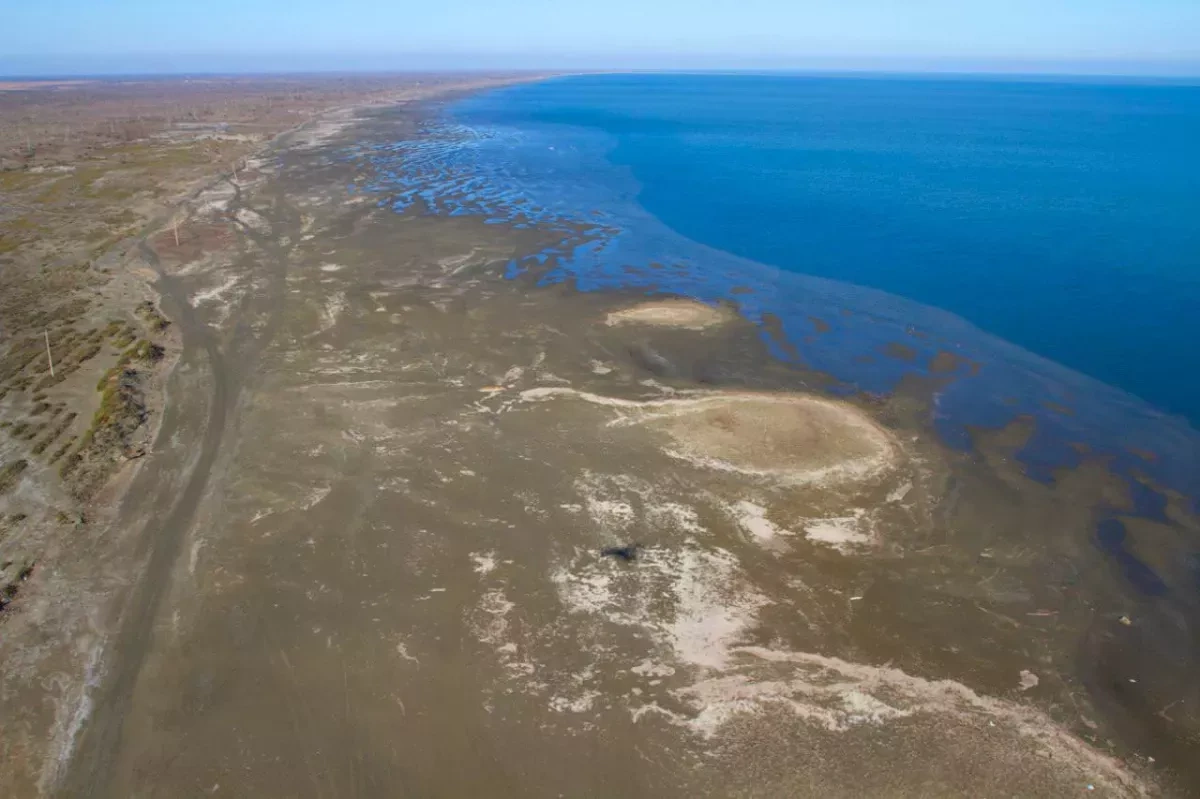
Russia has urged against politicising the issue of the declining water level in the Caspian Sea, rejecting media claims that river regulation is responsible for the changes.
Speaking at the Regional Environmental Summit in Astana, Deputy Minister of Natural Resources and Environment Dmitry Tetenkin said Russian scientists view the phenomenon as a natural process, Caliber.Az reports via Russian media.
“The Russian Federation strongly disagrees with such interpretations and has repeatedly demonstrated at the expert level that this approach is unfounded,” he said, referring to claims that river management is driving the sea’s decline.
Tetenkin added that Russian research attributes fluctuations in the Caspian Sea level mainly to climate factors, including evaporation, precipitation, and natural changes in river inflow.
He also noted that forecasting long-term changes in the Caspian remains a complex task and that there are currently no reliable mid- or long-term projections shared among regional states. He called for a comprehensive regional approach to studying and mitigating the environmental impact.
The Caspian is the world’s largest enclosed body of water. Its main water inflow comes from the Volga River, which flows through Russia. Another important tributary is the Ural River, which partially runs through Kazakhstan, where it is known as the Zhaiyk.
By Jeyhun Aghazada