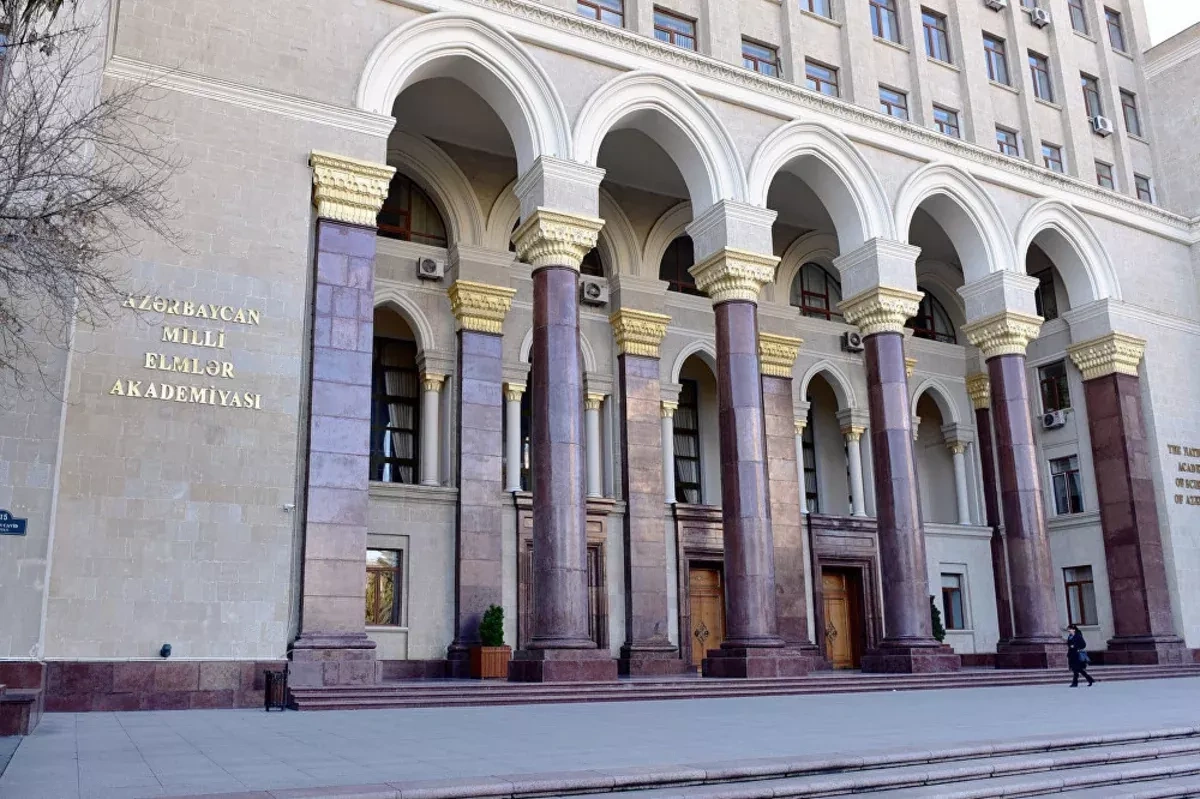
Azerbaijan’s National Academy of Sciences (ANAS) have criticised the Armenian campaign surrounding Gandzasar Monastery in the Karabakh region, stating that the controversy over Gandzasar and other monuments associated with Caucasian Albania is an attempt to create “cheap and meaningless sensationalism.”
ANAS scholars said those controversies do not reflect historical or academic realities, Caliber.Az reports, citing local media.
Gandzasar Monastery is a historical monument of Caucasian Albania and it has no connection with Armenian history, according to the scholars.
They said historical and archaeological evidence demonstrates the monument’s links to Caucasian Albania and its indigenous Albanian population.
The statement notes that Gandzasar was constructed in the historical territory of Caucasian Albania, which ANAS described as one of the state’s principal provinces. It added that Albanian rule was partially restored in the region following the collapse of the Arab Caliphate and that the Albanian-Khachin principality emerged there in the 12th and 13th centuries.
According to ANAS, the principality was ruled by Hasan Jalal (1215–1261), whom it described as a prominent Azerbaijani statesman and a descendant of the Albanian Mihranid dynasty.
The statement claimed contemporary sources referred to Hasan Jalal by titles including “prince of princes, 'Prince of Khachin,' 'King of Albania'” and others.
The scholars made clear that the period of Hasan Jalal’s rule was marked by economic, political and cultural development in the region, which they described as an Albanian Renaissance. They said Gandzasar Monastery was built as a major example of that period.
ANAS also pointed to the use of an equal-armed cross at the monastery, describing it as characteristic of Albanian heritage and saying the symbol served as a seal of the Albanians. The statement outlined that the monastery was constructed with local building materials.
The scholars further claimed that epigraphic inscriptions found at Gandzasar and other monuments in Karabakh belong to the Albanians. They referred to a book on Gandzasar’s inscriptions published in Petrograd in 1919, which they said documented the monuments’ Albanian origins before being deliberately destroyed by Armenians.
The statement also cited the monastery’s frescoes as visual evidence of what ANAS considers to be its Albanian heritage.
ANAS alleged that deliberate efforts were made to Armenianise Gandzasar during the Soviet period and later during the occupation. According to the statement, Albanian epigraphic monuments were destroyed or removed to Armenia and replaced with altered Armenian inscriptions.
The scholars also alleged that the equal-armed cross at Gandzasar was modified into a different-form Gregorian cross and that the tombs of Albanian Catholicoses inside the monastery were altered.
They further claimed that the monastery’s original appearance was damaged during restoration work carried out during the occupation, including through the use of construction materials brought from Armenia.
ANAS said the controversy in Armenia followed a visit by diplomats accredited in Azerbaijan to territories described as liberated by Baku, during which they observed what the academy characterised as Armenian-made alterations to the monuments.
The scholars argued that the criticism from Armenia was intended to obscure what they described as historical realities surrounding Gandzasar and other monuments associated with Caucasian Albania.
“We consider that the controversy raised by Armenia around Gandzasar Monastery has no scientific or historical basis and is currently aimed at undermining the peace agenda put forward by the Azerbaijani state,” the statement underscored.
ANAS further accused Armenia of pursuing a long-standing policy of appropriating Azerbaijan’s national and spiritual values, as well as culinary traditions, and of presenting Azerbaijani monuments as Armenian.
Azerbaijani scholars condemned what they described as a deliberate campaign surrounding Gandzasar Monastery and called on Armenia to address the issue on the basis of scientific evidence rather than “artificial and false propaganda”.
By Bakhtiyar Abbasov