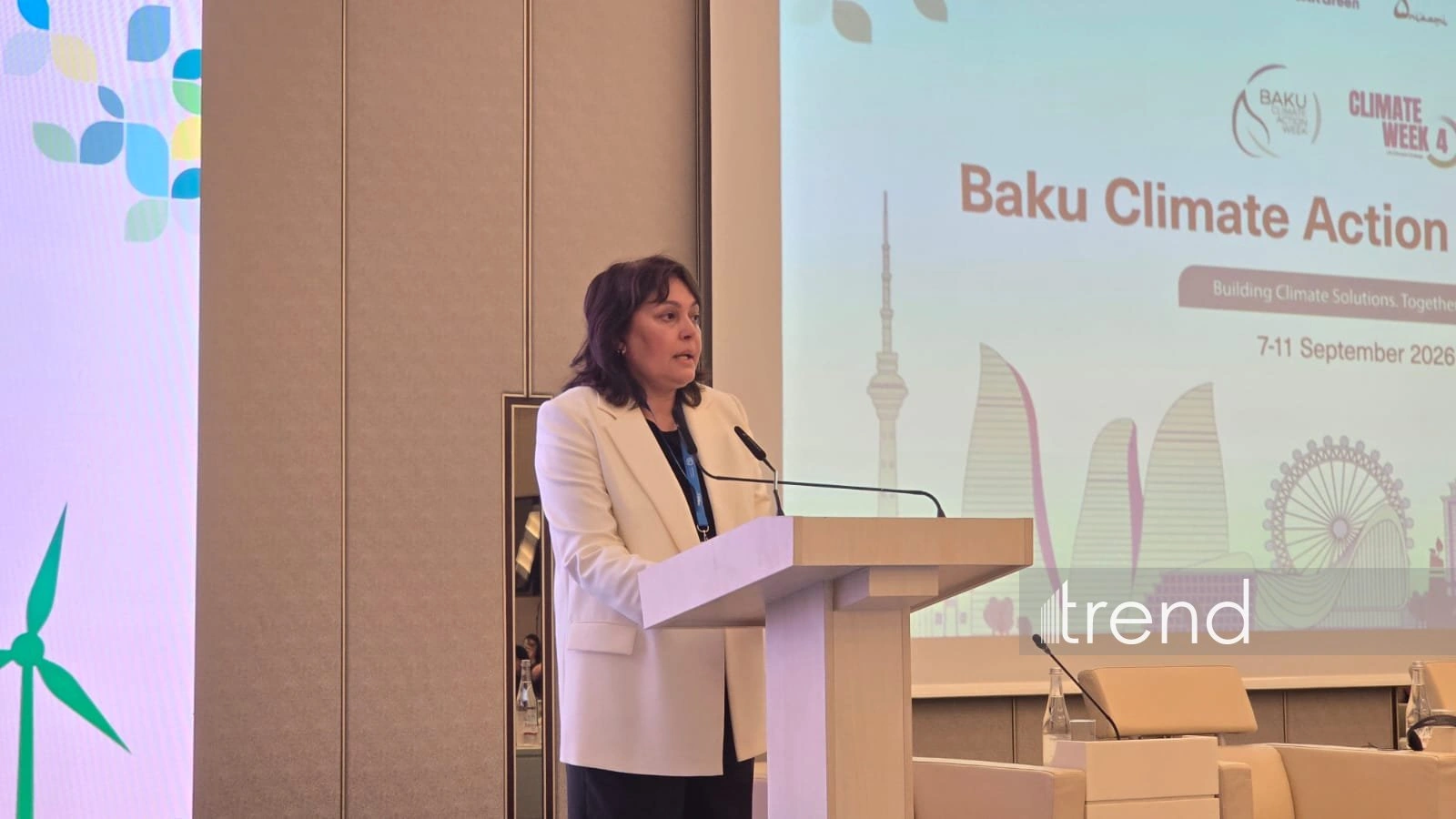
BAKU, Azerbaijan, September 8. A project to
strengthen climate information and multi-hazard early warning
systems is planned to be implemented in Azerbaijan, Deputy Minister
of Ecology and Natural Resources Umayra Taghiyeva said at a panel
session on "Advantages and Challenges of AI-integration to the
Multi-hazard Early Warning Systems" within the framework of the 4th
Baku Climate Action Week (BCAW), Trend's correspondent reports from the
event.
She noted that the consequences of climate change over the past
decade have been observed in the form of an increase in extreme
events on a global scale.
"The latest report of the Intergovernmental Panel on Climate
Change (IPCC) warns of increased vulnerability to climate risks in
urban areas in low- and middle-income countries.
Severe and longer-lasting heat waves in Europe, devastating
floods in Nepal and weather and climate anomalies in many countries
around the world demonstrate the importance of increasing climate
resilience to these processes.
According to the assessment of the Climate Change Vulnerability
Index of Azerbaijan, the number and intensity of extreme weather
and climate events have increased significantly over the past 10
years, making it necessary to integrate climate issues into
sectoral development plans.
Early warning accessible to everyone is not just information.
Sometimes, a warning is an important tool that saves lives and
significantly reduces infrastructure damage.
The World Meteorological Organization (WMO) notes that even a
warning given just 24 hours in advance can reduce such damage by up
to 30%.
The world is currently undergoing serious transformations and
new opportunities due to the impact of artificial intelligence,"
she explained.
According to her, it's no coincidence that the importance of
this issue is being confirmed on all global platforms.
"In this direction, the 'Artificial Intelligence Strategy of
Azerbaijan for 2025-2028', approved by the decree of the President
of the Republic of Azerbaijan, Ilham Aliyev in March 2025, is an
important document that determines the policy of our country.
The implementation of the strategy will accelerate the
development and application of artificial intelligence in the
country. A more systematic approach will be formed in this area. A
favorable environment will be created for the application of
innovations and new technologies. Relevant infrastructure and human
capital will be strengthened. This strategic approach will also
create new opportunities in the fight against climate change. In
particular, the establishment and development of early warning
systems will be supported.
In October 2025, the WMO adopted a decision encouraging the
application of artificial intelligence in forecasting and early
warning systems.
The integration of artificial intelligence into early warning
systems will allow for a faster assessment of climate risks. It
will be possible to take some preventive measures in a timely
manner. At the same time, "It also raises new challenges such as
data quality and accessibility, information security, technological
infrastructure, reliability, and human control," Taghiyeva
The deputy minister said that monitoring and developing
forecasting of extreme weather events is not an option - it's an
investment that saves lives.
"Our country has taken important steps towards investing in the
modernization of the national monitoring system. Azerbaijan has an
extensive meteorological observation system. Over the past 5 years,
taking into account investments for 2026, 82% of these systems have
already been automated. However, this is only the main and first
step towards creating an early warning system. There are a number
of important goals that need to be achieved. Because climate change
is no longer a threat that is happening in the distance - its
effects are a reality that we are experiencing today and here.
The UN call is clear: reducing emissions cannot be postponed.
Time is running out to achieve the 1.5°C target. Decisions made
today will determine the scale of the climate risks we will face
tomorrow. Therefore, as much as reducing emissions, strengthening
our potential to adapt to climate change is our urgent task. To do
this, it's necessary to create modern systems such as local Digital
Weather Forecasting Models and sectors are required to be provided
with impact-based information. The country's first NAP and NDC 3.0
document identified the development of early warning systems as a
target in the field of adaptation.
To this end, we plan to implement the project 'Strengthening
climate information and early warning systems against multiple
hazards for increasing resilience in Azerbaijan' in cooperation
with UNEP and the Green Climate Fund," the official said.
She noted that innovations related to artificial intelligence
are prompting a reconsideration of technological priorities.
"The call of the UN General Assembly for the integration of
artificial intelligence into forecasting and early warning systems
necessitates a new look at this project document prepared about 5
years ago. Azerbaijan organized a series of events on the topic of
strengthening early warning systems on the COP29 platform and at
the 13th World Urban Forum. We believe that the new climate finance
goal agreed at COP29 will create significant opportunities for
vulnerable countries in the field of adaptation to climate change,
as well as in the field of early warning," she added.