BAKU, Azerbaijan, September 8. Azerbaijan aims
to multiply the area of agricultural land where modern irrigation
systems are applied to approximately 300,000 hectares by 2030,
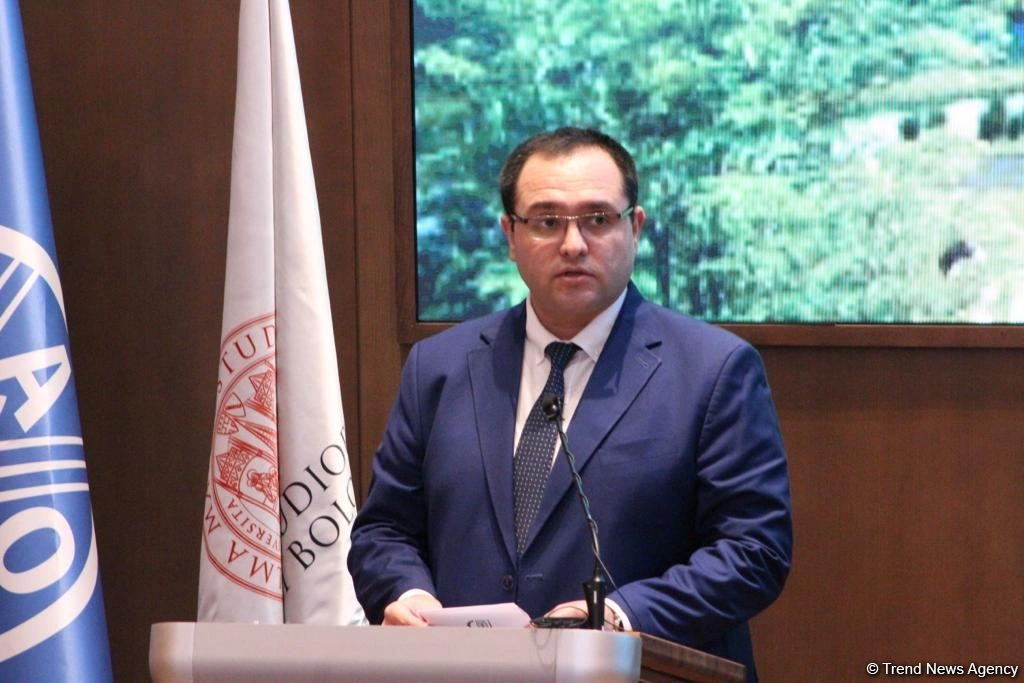
Minister of Agriculture Majnun Mammadov said during a high-level
roundtable on "Harmoniya in Action: Partnering for
Climate-Resilient Agriculture" within the framework of the 4th Baku
Climate Action Week (BCAW), Trend's correspondent reports from the event.
The minister noted that this goal is reflected in the "State
program for the development of agricultural, fisheries and
aquaculture production and processing in Azerbaijan for
2026-2030".
"The state program reconciles increasing productivity and
competitiveness with the principles of efficient use of natural
resources, innovation, digitalization and sustainability. It's
aimed to increase the area of areas where modern irrigation
systems are applied from approximately 130,000 hectares to 300,000
hectares by 2030," he explained.
According to Mammadov, the program also envisages strengthening
the climate-resilient agricultural production model and creating
early warning systems in regions sensitive to climate change.
The minister pointed out that climate change increases pressure
on land and water resources, affects productivity and creates new
risks for farmers.
"The main question is no longer whether the transformation of
agriculture is necessary, but how we can implement this
transformation faster, smarter, more sustainable and more
inclusively," Mammadov emphasized.
He also said that Azerbaijan sees the future of agriculture in a
productive, competitive, climate-resilient, increasingly
knowledge-, innovation- and technology-based development model.
According to the minister, productivity and sustainability are
not alternative goals for Azerbaijan.
"They are two complementary directions of a single agrarian
transformation. Digitalization is one of the important tools that
connects these two directions," he added.
Mammadov further noted that the use of artificial intelligence,
satellite and remote sensing technologies, climate and field data,
drones and sensors in agriculture allows for more accurate and
timely decision-making.
He pointed out that within the framework of the Artificial
Intelligence Initiative in the Agricultural Sector of the Ministry
of Agriculture, the goal is to integrate data obtained from various
sources and transform them into practical solutions.
"Currently, the process of establishing more than 180 climate
stations has been initiated to obtain meteorological and climate
data," the minister said.
According to him, the main value of technology is its
transformation into practical benefits for farmers.
"Its real value arises in the field, when it becomes a practical
benefit for farmers, when it allows for more efficient use of water
resources, earlier identification of risks, protection of crops,
increase productivity and making more informed decisions," Mammadov
emphasized.
The high-level round table was held jointly organized by the
Ministry of Agriculture of Azerbaijan, the FAO Representative
Office in Azerbaijan and the Baku Climate Action Week.
The second day of the Fourth Climate Week (CW4) of the UN
Framework Convention on Climate Change is being held in Baku.
The main focus of the second day is on sustainable cities,
transport, water resources and agriculture.
Representatives of governments and international organizations,
experts, financial institutions, the private sector, and civil
society from various countries are attending the events.
Now in its third year, Baku Climate Action Week is being held in
parallel with the UN Framework Convention on Climate Change
(UNFCCC) Climate Week for the first time this year. The Fourth
Climate Week and Baku Climate Action Week will feature a series of
sessions, panel discussions and other events on climate change,
climate finance, sustainable development and accelerating climate
action.
Baku Climate Action Week (BCAW 2026) will continue until
September 11.