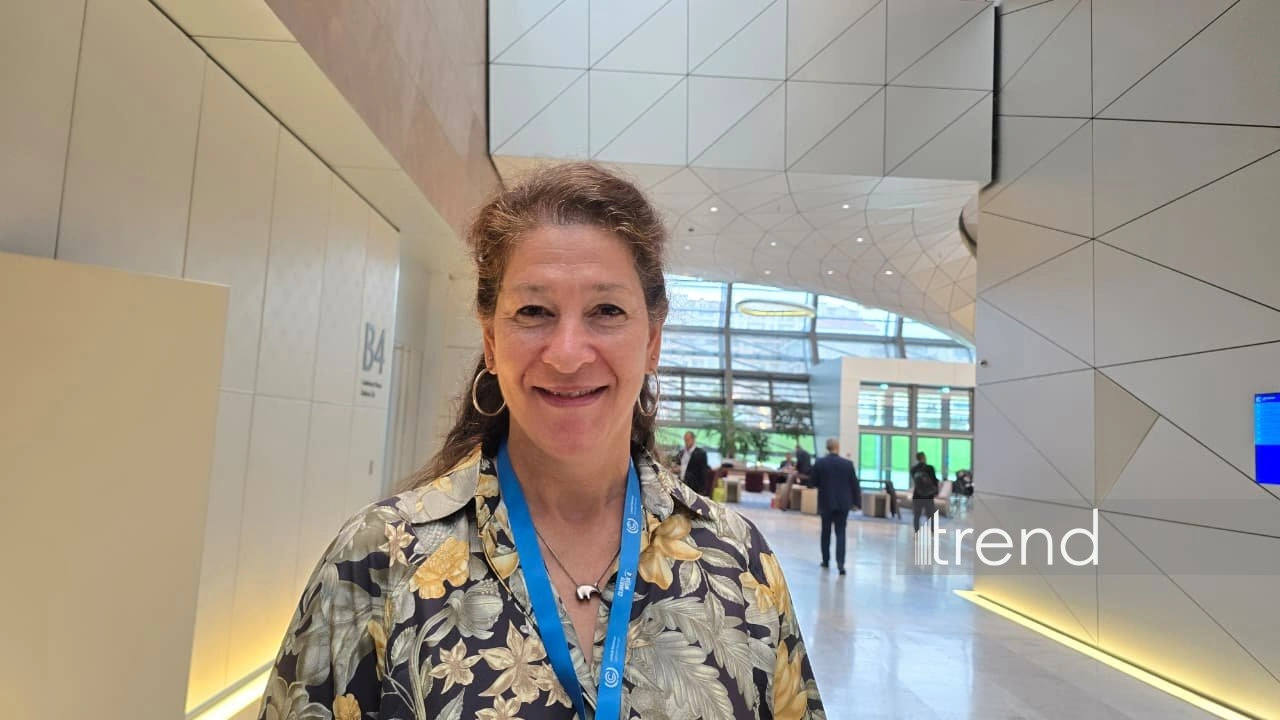
BAKU, Azerbaijan, September 8. The UN Office
for Project Services (UNOPS) is working to establish a unified
monitoring system and database for the five Caspian littoral
countries, UNOPS Multi-Country Director Simonetta Siligato told
Trend.
She made the remark on the sidelines of Baku Climate Action Week
2026, she said that addressing changes in the Caspian Sea level
requires joint efforts and cannot be achieved through actions by a
single country alone.
“I do not think there is any action that can be taken by only
one country. My recommendation has always been to look beyond
borders. There are five Caspian littoral states, and each country
carries out numerous activities related to the use of water
resources. Therefore, it is very important to communicate with each
other, hold discussions, and share data and information in order to
develop a common approach,” Siligato said.
The UNOPS official also spoke about projects being implemented
in Azerbaijan aimed at protecting the Caspian Sea. “The project we
are currently implementing on the Caspian Sea is carried out in
partnership with the World Bank, the Global Environment Facility
(GEF), which provides financing, and the UN Environment Programme,”
she said.
According to Siligato, one of the main objectives of the project
is to support the development of a unified monitoring system that
can be applied across the five Caspian littoral countries. “We are
providing support only to three countries — Azerbaijan, Kazakhstan
and Turkmenistan. However, Russia and Iran are also parties to the
Tehran Convention and are part of communication within this
framework. We are working together to create a monitoring system
that can be used jointly and a database that can be shared. This
will allow us to take a coordinated approach to planning future
activities,” she noted.
Siligato emphasized that implementing Caspian protection
measures independently by individual countries could result in
higher costs and reduce the overall effectiveness of efforts. “If
each country does this independently, first of all, it will be more
expensive. In addition, the impact will be smaller. Unless action
is taken across the Caspian Sea as a whole, the effect will not be
significant enough,” the UNOPS multicountry director said.
She also highlighted Azerbaijan’s role in regional cooperation
aimed at protecting the Caspian Sea. “Azerbaijan’s role is 100
percent essential and is as important as the role of all other
countries. I believe that holding events such as Baku Climate
Action Week, as well as other regional conferences that Azerbaijan
takes very seriously, are among the most important steps at this
stage,” Siligato said.
According to her, maintaining communication among stakeholders
and bringing countries together are key to strengthening regional
cooperation. “Continuing these connections, bringing the parties
together and actively demonstrating that cooperation and joint
action are the right path forward are among the most important
issues,” Siligato added.