BAKU, Azerbaijan, September 8. As the impacts
of climate change intensify, it is necessary to produce more food
using less water, chemicals and other resources, Trend's correspondent
reports from the event.
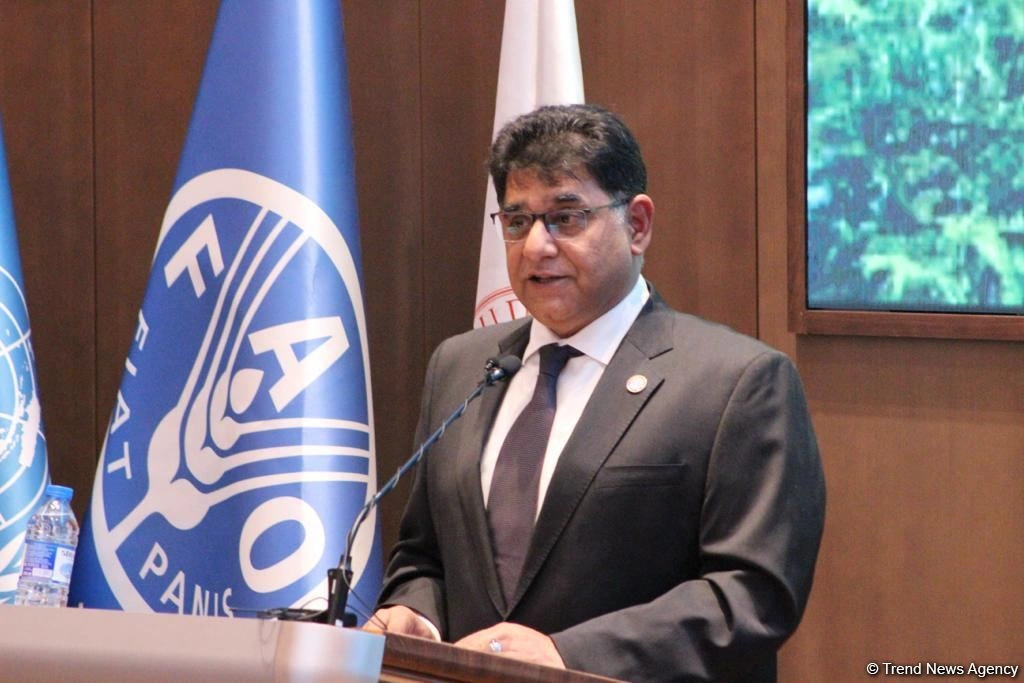
Muhammad Nasar Hayat, FAO representative in Azerbaijan, said
this at a high-level roundtable titled “Harmony in Action:
Partnerships for Climate-Resilient Agriculture,” held as part of
Baku Climate Action Week.
He said agriculture is both a sector that contributes to climate
change and one that is affected by its impacts.
“Rising temperatures, prolonged droughts, land degradation,
water shortages and more frequent extreme weather events are
already affecting agriculture,” Hayat said.
According to the FAO official, agriculture is also one of the
main sources of livelihood for people in rural areas, while food
security is under serious pressure amid climate change.
“Some 673 million people are food insecure. At the same time,
global demand for food is increasing. While food productivity has
declined by 21%, demand has increased. Therefore, if action is not
taken, this gap will widen further,” he said.
Hayat emphasized that the main goal is not simply to produce
more food.
“We need to produce better food using fewer natural resources.
At the same time, we need to ensure that farmers can adapt to
changing climate conditions and maintain their livelihoods,” the
FAO official said.
He said one of the FAO’s key priorities is developing
climate-resilient agriculture.
“We need to use less water, fewer chemicals and fewer resources,
but produce more. That is why climate resilience has become one of
the FAO’s key priorities,” Hayat emphasized.
According to him, under the FAO’s Strategy on Climate Change
2022-2031, the organization supports countries in transforming
their agrifood systems into systems that are more efficient,
inclusive, sustainable and resilient.
The FAO official noted that the organization particularly aims
to ensure that smallholder farmers, women and young people have
access to the knowledge, technology, financing and partnerships
they need to adapt to climate challenges.
Hayat said the Baku Harmony Climate Initiative reflects this
approach.
“This initiative brings together governments, development
partners, international organizations, financial institutions and
the private sector. It promotes a coordinated approach to
climate-resilient agriculture, taking into account the strong links
between agriculture, water, food systems and rural development,” he
said.
The FAO official emphasized that an important innovation of the
initiative is placing farmers at the center of support
mechanisms.
“This is not only a responsibility undertaken by governments and
other institutions; it also puts farmers at the center of this
discussion and support,” Hayat said.
He said the FAO supports the government of Azerbaijan through
the FAO-Azerbaijan Partnership Programme, Technical Cooperation
Programme projects, and initiatives financed by the Global
Environment Facility and the Green Climate Fund.
According to him, joint activities cover sustainable land
management, climate-smart agriculture, efficient water use,
improving value chains, digital innovation, biodiversity, and
capacity building for farmers and institutions.
Hayat also positively assessed Azerbaijan’s efforts to promote
the sustainable development of agriculture and strengthen the
sector’s resilience.
The second day of the Fourth Climate Week (CW4) of the UN
Framework Convention on Climate Change (UNFCCC) is being held in
Baku.
The second day has focused primarily on sustainable cities,
transportation, water resources and agriculture.
Government and state representatives from various countries,
international organizations, experts, financial institutions, the
private sector and civil society are participating in the
events.
Baku Climate Action Week, which is being held for the third
time, is taking place this year for the first time in parallel with
the UN Framework Convention on Climate Change (UNFCCC) Climate
Week. A number of sessions, panel discussions and other events on
combating climate change, climate finance, sustainable development
and accelerating climate action will be held as part of the Fourth
Climate Week and Baku Climate Action Week.
Baku Climate Action Week (BCAW 2026) will continue through Sept.
11.