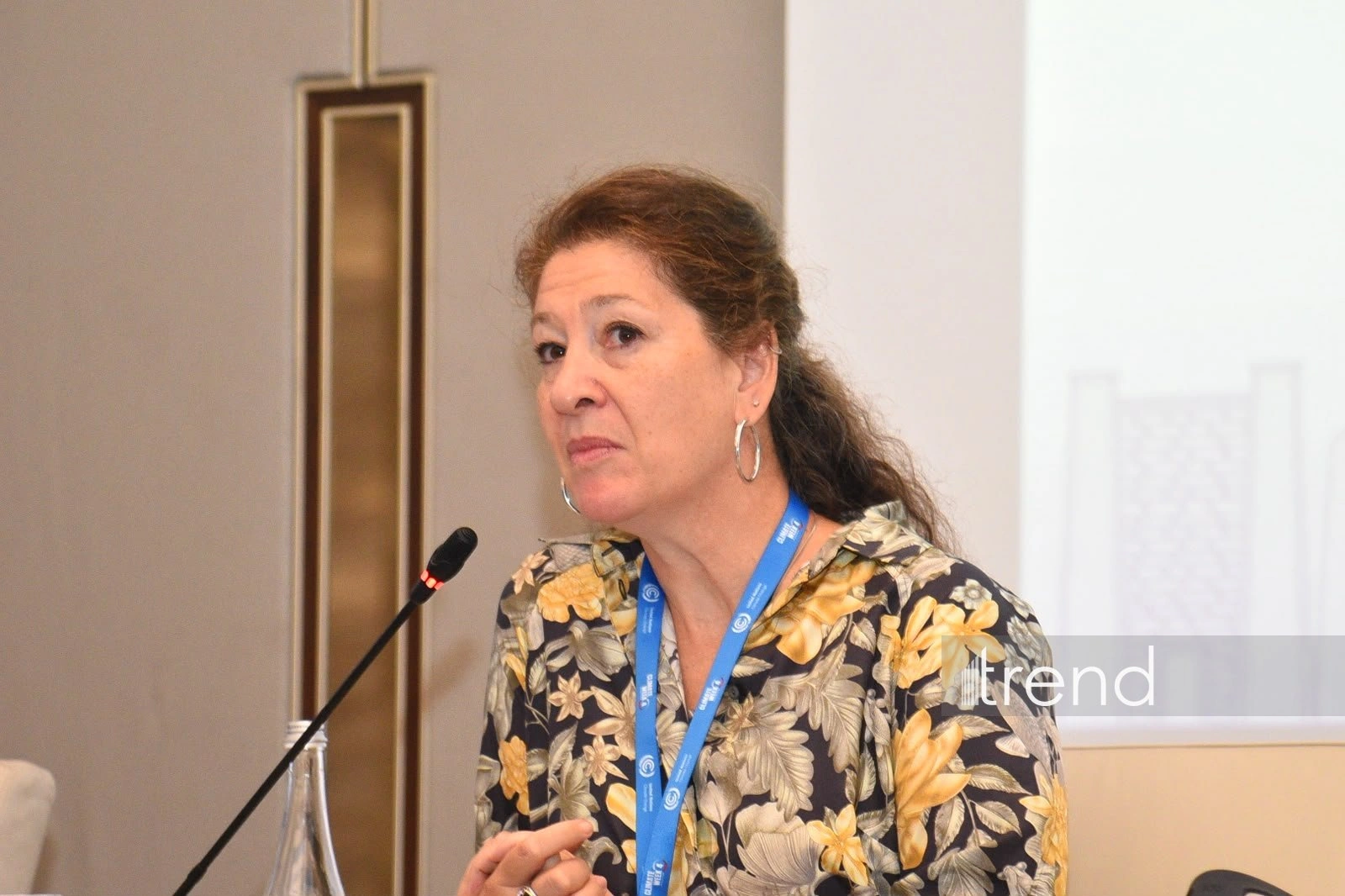
BAKU, Azerbaijan, September 8. Strengthening
regional cooperation is essential to manage the Caspian Sea and
respond to upcoming climate challenges, United Nations Office for
Project Services (UNOPS) Multi-Country Director, Simonetta
Siligato, said at a panel discussion on "Climate change challenges
on the inland water bodies: Caspian Sea case" within the framework
of the 4th Baku Climate Action Week (BCAW), Trend's correspondent
reports from the event.
She noted that in order for regional cooperation to become an
integral part of the practical management of the Caspian Sea,
institutions are needed that improve the exchange of information
and knowledge, as well as provide sustainable financing.
"This cooperation cannot be limited to governments alone. We
need research institutions, international financial institutions
and development partners. But most importantly, local communities
and the private sector must also be involved in this process.
Because real activities take place at the local level, and without
local communities being involved in the process, the impact we will
achieve will not be at the desired level," Siligato explained.
According to her, potentially drastic and dramatic changes could
occur in the Caspian Sea over the coming decades.
"There is a real urgency here. We are facing potentially drastic
and dramatic changes in the Caspian Sea over the coming decades.
This is no longer just an environmental issue. This problem
directly affects infrastructure, ports, transport, local economies
and livelihoods, as well as water security and biodiversity," she
pointed out.
The UNOPS official also mentioned serious economic grounds for
strengthening cooperation in the Caspian region.
"An isolated response by five countries to the same regional
problem would be incomparably more expensive and much less
effective than joint and coordinated efforts," she stressed.
Siligato also spoke about the practical role of UNOPS in this
direction.
"We can help translate the political commitments and scientific
knowledge that have been made into real, applicable and funded
programs. To do this, we need to work shoulder to shoulder with
governments, financial partners, the private sector and, as I
mentioned, local communities," said the UNOPS Multi-Country
Director.
She also noted that the experience gained in the Caspian Sea
could serve as an example for other transboundary water basins.
"The broader lesson from the Caspian Sea experience is that this
model should not stop there. Many closed water basins around the
world face similar climate pressures. If we can demonstrate that
the accumulated scientific knowledge, joint platforms and common
planning work effectively here, we'll have created a successful
model that can be applied to other transboundary water basins,"
Siligato added.
The second day of the Fourth Climate Week (CW4) of the UN
Framework Convention on Climate Change is being held in Baku.
The main focus of the second day is on sustainable cities,
transport, water resources and agriculture.
Representatives of governments and international organizations,
experts, financial institutions, the private sector, and civil
society from various countries are attending the events.
Now in its third year, Baku Climate Action Week is being held in
parallel with the UN Framework Convention on Climate Change
(UNFCCC) Climate Week for the first time this year. The Fourth
Climate Week and Baku Climate Action Week will feature a series of
sessions, panel discussions and other events on climate change,
climate finance, sustainable development and accelerating climate
action.
Baku Climate Action Week (BCAW 2026) will continue until
September 11.