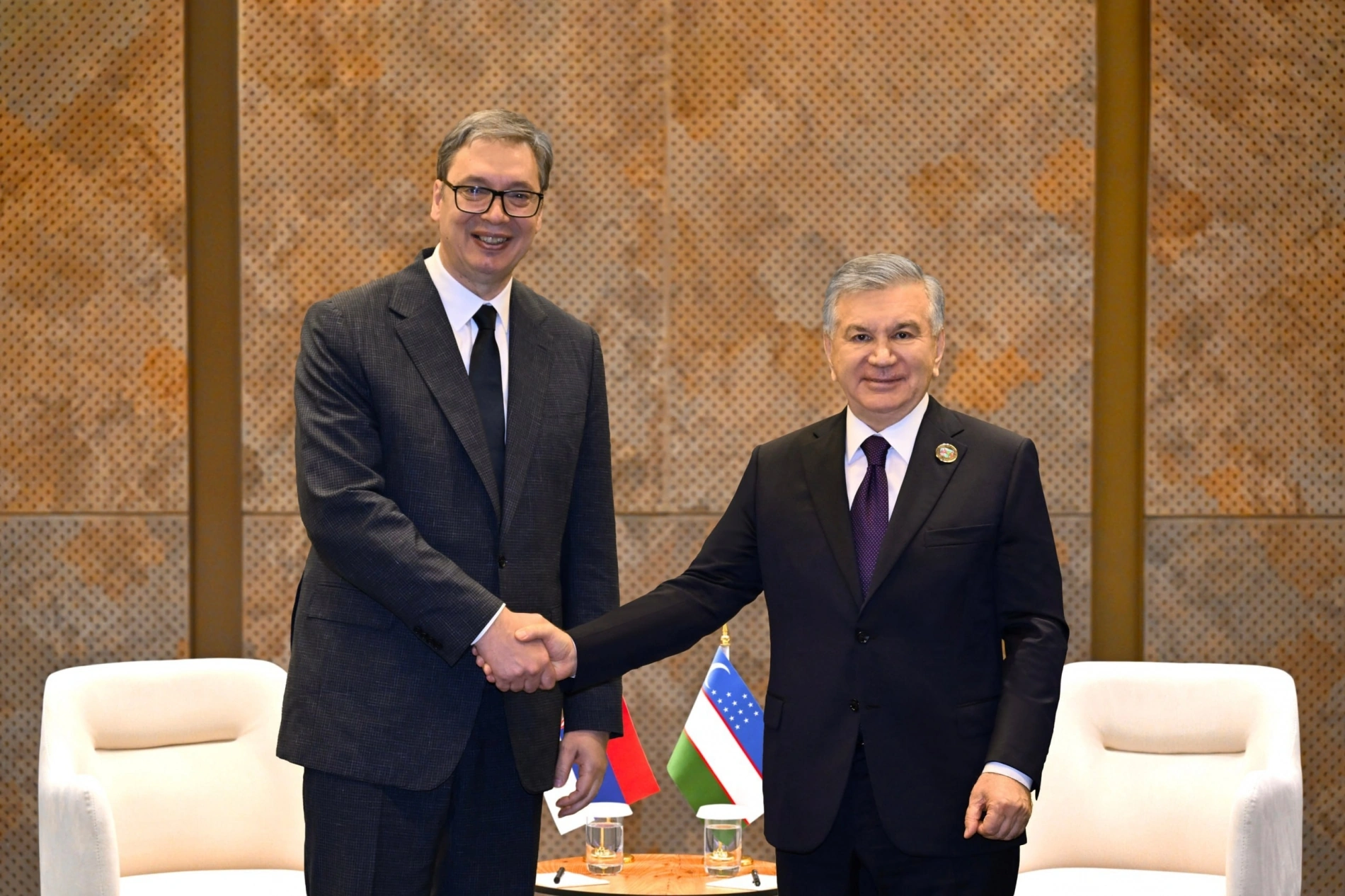
BAKU, Azerbaijan, September 8. Uzbekistan’s
President Shavkat Mirziyoyev’s official visit to Serbia reflects
Tashkent’s continued efforts to translate its increasingly active
foreign policy into practical economic partnerships. During the
September 7–8 visit, President Mirziyoyev’s program includes talks
with Serbian President Aleksandar Vučić in Belgrade, as well as a
bilateral business forum focused on expanding trade, investment,
and joint projects in transport, mechanical engineering, light and
food industries, agriculture, pharmaceuticals, and information
technology.
The visit also underscores the economic diplomacy pursued under
President Mirziyoyev, with Uzbekistan actively diversifying its
international partnerships, attracting foreign investment, and
advancing toward deeper industrial cooperation. As President
Mirziyoyev emphasized during a meeting with the country’s
ambassadors on January 15, 2026, “Economic diplomacy is not just
about negotiations. It serves to enhance human dignity by creating
new jobs, raising incomes and improving living standards.”
Although bilateral trade with Serbia remains relatively modest,
the strengthening political dialogue and expanding business
contacts are contributing to the development of a foundation for
joint ventures, new value chains, and broader access to
international markets. In this context, the bilateral relationship
retains considerable potential for further economic
development.
Trade opens further opportunities for
expansion
Despite the political rapprochement between Tashkent and
Belgrade, bilateral trade remains relatively small compared with
the scale of Uzbekistan's overall external commerce.
According to the Statistical Office of Serbia, as cited by
Serbia's Ministry of Foreign Affairs, bilateral trade totaled €37.7
million (about $43.7 million) in 2025. Serbian exports to
Uzbekistan amounted to €23.6 million (around $27.4 million), while
imports from Uzbekistan stood at €14.1 million (approx. $16.4
million). Serbia mainly exported construction finishing materials,
furniture, calcium phosphates, marble and corn, while imports from
Uzbekistan primarily included cotton and beans.
This figure is particularly modest when placed against
Uzbekistan's broader trade activity. The country's foreign trade
turnover reached $81.2 billion in 2025, increasing 20.7% year-on-year, according to
Uzbekistan's National Statistics Committee. Exports rose 24% to
$33.8 billion, while imports increased 18.5% to $47.4 billion.
Uzbekistan's largest trading partners in 2025 included China, Russia, Kazakhstan, Türkiye and
South Korea, while European economies such as Germany and France
were also among its significant partners. Serbia, therefore,
remains a relatively small trading partner for Uzbekistan.
The relatively modest scale of bilateral trade also highlights
the effectiveness of President Shavkat Mirziyoyev’s broader
strategy of expanding Uzbekistan’s economic partnerships and
turning stronger political relations into practical cooperation.
Rather than focusing solely on increasing the volume of traditional
trade, Tashkent has increasingly prioritized investment, industrial
cooperation, joint ventures, and the development of new value
chains. This approach creates opportunities to broaden the range of
goods traded with Serbia while encouraging companies from both
countries to establish direct business ties and develop production
projects. In this context, the upcoming visit reflects Uzbekistan’s
consistent efforts under Mirziyoyev to diversify its economic
partnerships, attract foreign investment, and open new channels for
Uzbek businesses in international markets. As he stated at the 5th
Tashkent International Investment Forum on 17 June 2026: “For us,
investment is far more than a source of capital. It is a catalyst
for advanced technologies, modern knowledge and expertise, new jobs
and development that keeps pace with the demands of a rapidly
changing world.”
From political agreements to economic
mechanisms
The groundwork for this shift was laid during Vučić's visit to
Uzbekistan in October 2025.
Following talks in Tashkent, the two presidents signed a Joint
Declaration and a package of intergovernmental and interagency
documents. Among them were agreements on the mutual promotion and
protection of investments, economic cooperation, medical services,
tourism, education, science and culture, as well as cooperation in
engineering, advanced technologies and artificial intelligence. The
sides also signed a memorandum on labor migration and an agreement
establishing partnership relations between Tashkent and Belgrade.
The significance of those agreements lies in their potential to
create a broader institutional framework for investment.
An investment-protection agreement, for example, can reduce some
of the legal uncertainty associated with cross-border projects,
while the economic cooperation agreement provides a broader
framework for expanding commercial relations. Cooperation in
engineering, advanced technologies and AI also moves the
relationship beyond traditional commodity trade toward higher-value
activities. The agreements are now being followed by more practical
mechanisms.
In February 2026, Uzbekistan hosted a bilateral business forum
that brought together more than 80 entrepreneurs. According to
Uzbekistan's Ministry of Investment, Industry and Trade,
discussions focused on increasing bilateral trade, removing trade
and logistics barriers, strengthening business engagement,
establishing a bilateral Business Council and opening trade houses
in Tashkent and Belgrade. The sectors discussed included
pharmaceuticals, textiles, chemicals, agriculture, construction,
energy and IT. This suggests that the September summit is not an
isolated diplomatic event but part of a sequence: political
agreements in 2025 were followed by business-level mechanisms in
2026, with the current visit potentially providing a platform for
moving those initiatives toward implementation.
Serbia offers a different type of European
gateway
One of the more significant economic aspects of the relationship
is Serbia's position as a regional manufacturing and trade hub.
Serbian authorities have emphasized the country's broad network of
trade agreements and preferential arrangements. Serbia has a
Stabilization and Association Agreement with the European Union and
free-trade agreements with countries and economic blocs including
China, Türkiye and the Eurasian Economic Union. Serbian officials
have described this trade framework as an important factor in
attracting foreign investment and expanding export opportunities.
Serbia's free-trade agreement with China, for example, entered into
force in July 2024. At that time, Serbia's government said 60% of
goods would immediately become exempt from customs duties, with
additional products scheduled for liberalization over subsequent
years.
Joint production in Serbia could provide Uzbek companies with a
platform closer to European markets, while Serbian companies can
use Uzbekistan's industrial base, labor resources and access to
Central Asian markets as a platform for regional expansion. This is
particularly relevant to the sectors now being discussed by the two
governments: engineering, pharmaceuticals, textiles, food
processing and agriculture.
Manufacturing could become the core of the
relationship
The composition of the planned projects indicates that both
countries are looking for opportunities to develop production
rather than simply increase the exchange of finished goods. At the
Uzbekistan–Serbia business forum held in Tashkent in October 2025,
more than 100 entrepreneurs participated. Uzbekistan's Ministry of
Investment, Industry and Trade said that nine enterprises with
Serbian capital were already operating in Uzbekistan at the
time.
The development of such projects could gradually alter the
structure of bilateral trade. Instead of Serbia primarily exporting
manufactured products and Uzbekistan supplying a relatively narrow
range of commodities, joint ventures could generate two-way trade
in intermediate and finished products. For Uzbekistan, this would
support its broader objective of increasing the share of
value-added products in exports. For Serbian companies,
establishing production in Uzbekistan could provide access to a
market of nearly 40 million people as well as the wider Central
Asian region.
The May 2026 meeting between Mirziyoyev and Vučić on the
sidelines of the World Urban Forum in Baku further underlined this
direction. The presidents discussed increasing trade turnover and
preparing a cooperation program covering mechanical engineering,
manufacturing, chemical and electrical industries, pharmaceuticals,
agriculture and tourism.
The next test is implementation
The expected signing of a substantial package of
intergovernmental and interagency agreements during Mirziyoyev’s
visit could give further momentum to bilateral relations, opening
new avenues for investment, industrial cooperation and trade
expansion. The agreements would further strengthen the foundation
for turning the growing political partnership between Uzbekistan
and Serbia into a dynamic and mutually beneficial economic
relationship.
The trajectory so far points to growing momentum in
Uzbekistan–Serbia economic relations, with the two countries moving
from economic and investment agreements in 2025 to business forums,
trade-house initiatives and plans for a bilateral Business Council
in 2026. With bilateral trade offering significant room for
expansion, stronger business ties, diversified trade and new joint
projects could take economic cooperation to a new level.
Mirziyoyev’s visit is expected to further accelerate this positive
trend.
For Uzbekistan, Serbia could become an additional European
economic partner and a platform for expanding industrial
cooperation beyond its traditional markets. For Serbia, Uzbekistan
offers access to one of Central Asia's largest economies and an
opportunity to establish a stronger commercial presence in the
region.
Against this backdrop, the main economic significance of
Mirziyoyev's September visit may not be the immediate increase in
bilateral trade, but the creation of conditions for a different
scale and structure of cooperation. If the agreements expected in
Belgrade translate into joint manufacturing, investment projects,
improved logistics, and stronger business-to-business links,
Uzbekistan and Serbia could begin moving from a relatively small
trading relationship toward a broader investment-led economic
partnership.