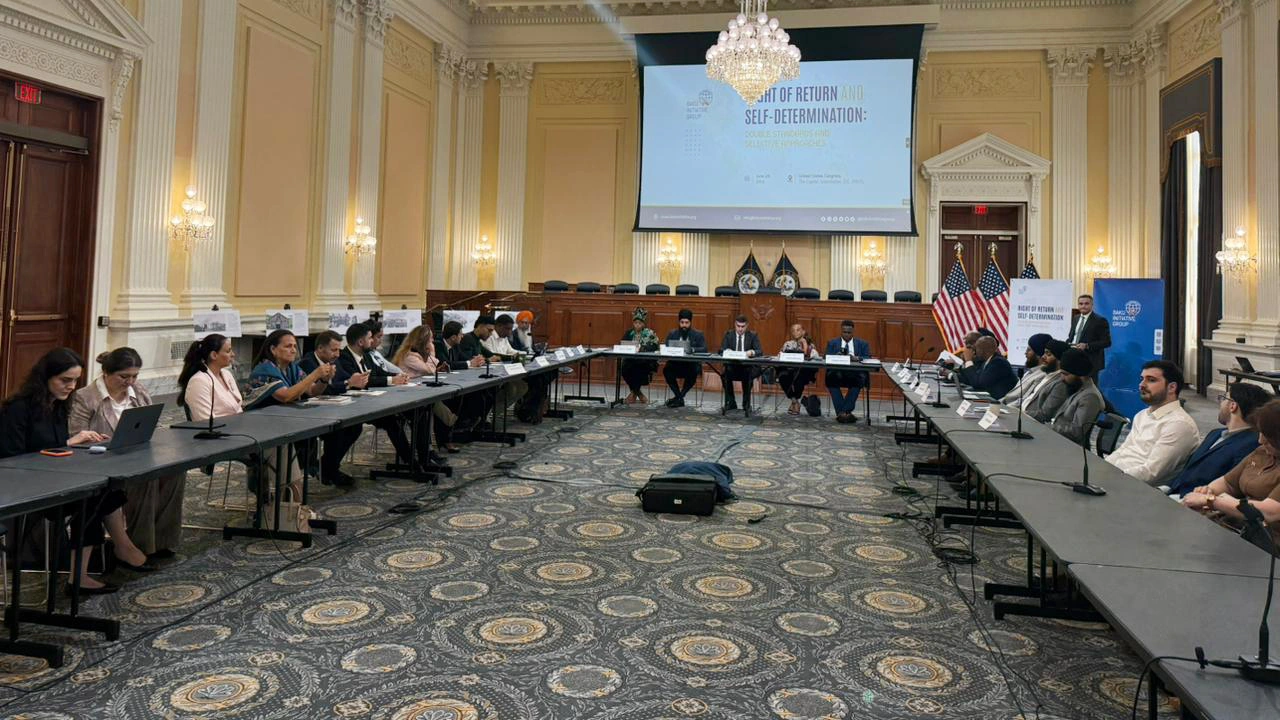
BAKU, Azerbaijan, June 24. An international
conference titled “Right to Return and Self-Determination: Double
Standards and Selective Approaches” is being held at the US Capitol
in Washington, organized by the Baku Initiative Group.
According to the group, the event is the first conference held
at the US Congress focused on the ethnic cleansing of Azerbaijanis
by Armenia.
The conference brings together experts specializing in refugee
and minority rights, human rights advocates, international law
specialists, representatives of diaspora organizations affected by
violence, discrimination and persecution based on ethnicity, civil
society representatives, and members of affected communities.
Participants are discussing the recognition and protection of
the fundamental right of hundreds of thousands of Azerbaijanis who
were displaced from their historical homeland as a result of ethnic
cleansing policies — including the right to return safely,
voluntarily and with dignity.
The discussions also focus on the legal assessment under
international law of destruction, desecration and appropriation of
Azerbaijani cultural, religious and historical heritage in Armenia,
including place names, mosques, cemeteries, shrines and other
sites.
Participants are also examining possible mechanisms for
international reporting and monitoring through the United Nations
and relevant bodies, including documentation efforts, fact-finding
missions, and potential investigations and reporting by UN special
rapporteurs and other international mandate holders.
The conference also includes discussions on the exercise of the
right to self-determination by peoples affected by colonialism,
particularly issues related to placing territories considered by
participants to be colonies on the UN list of Non-Self-Governing
Territories.
Background
Throughout the 20th century, Western Azerbaijanis were
systematically forcibly removed from their historical lands located
in present-day Armenia in several stages — in 1905–1906, 1918–1920,
1948–1953, and 1987–1991 — and subjected to ethnic cleansing. As a
result of this process, hundreds of thousands of Azerbaijanis were
displaced from their homelands, numerous people were killed,
subjected to torture and inhuman treatment, and the socio-moral and
economic foundations of families were destroyed.
The policy of ethnic cleansing was not limited to the physical
removal of the Azerbaijani population from their historical lands,
but was also aimed at erasing their cultural, religious, and
historical heritage, which had been formed over centuries. Mosques,
cemeteries, shrines, and other examples of material and cultural
heritage belonging to the Azerbaijani people remaining in Armenia
have been destroyed, insulted, or appropriated, more than 2,000
toponyms of Azerbaijani origin have been changed and Armenianized,
thereby implementing a systematic policy aimed at falsifying
historical memory and the ethno-cultural identity of the
region.
The 1951 Geneva Convention on the Status of Refugees confirms
the right of return as one of the important requirements of
international law, the restoration of the rights of persons
displaced as a result of ethnic cleansing. In this regard, ensuring
the safe, voluntary, and dignified return of Western Azerbaijanis
forcibly expelled from the territory of present-day Armenia to
their historical homeland, the restoration of their rights to
housing, land, property, cultural and religious heritage should be
assessed in the context of Armenia's international legal
responsibility.
Conference venue and time: Washington, U.S. Congress, Kennedy
Caucus Hall, Russell Senate Office Building, June 24, at 09:00.