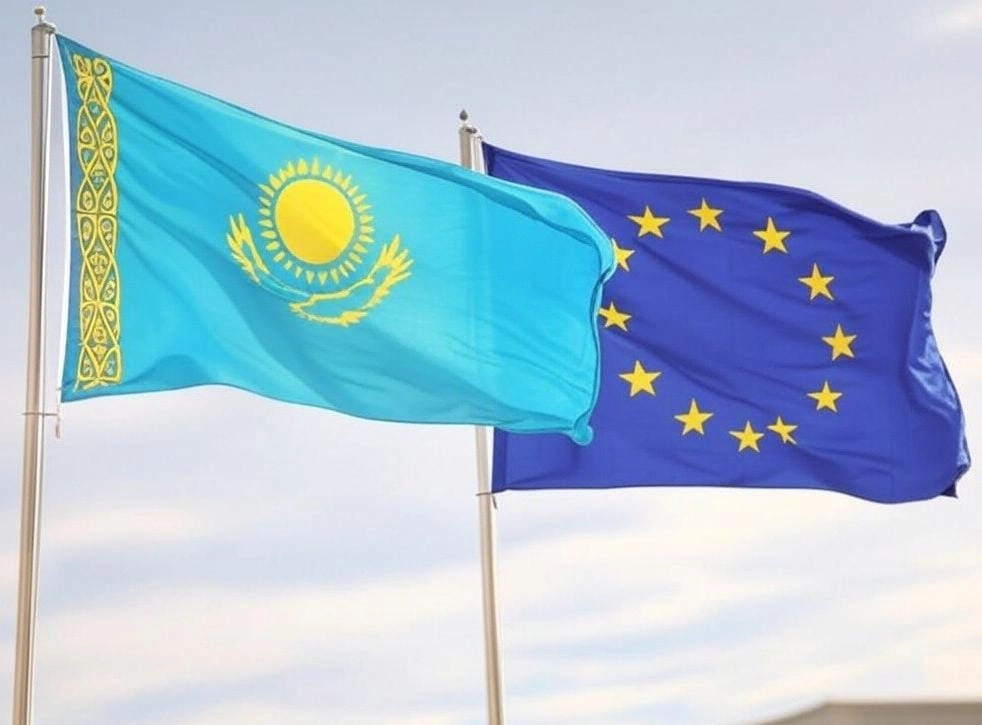
BAKU, Azerbaijan, June 22. The President of
Kazakhstan Kassym-Jomart Tokayev is paying an official visit to
Brussels on June 22–23 at the invitation of the President of the
European Council António Costa. The program includes talks with
Costa and the President of the European Commission Ursula von der
Leyen, a meeting with Belgian Prime Minister Bart De Wever, as well
as a roundtable with heads of major European companies.
Notably, alongside negotiations with EU leadership, the program
also includes a separate meeting with European business
representatives. This indicates that the visit is focused not only
on political dialogue but also on advancing economic cooperation
and attracting investment.
Tokayev’s visit comes amid intensified contacts between
Kazakhstan and European countries. Thus, on June 18-20, Montenegro
President Jakov Milatović made a historic first visit to Astana.
Montenegro is an EU candidate country, and the development of
dialogue with Podgorica can be seen as part of Kazakhstan’s broader
course toward expanding its European foreign policy direction—both
through engagement with EU institutions and individual European
states.
The European Union remains Kazakhstan’s largest trade partner
and investor. According to official statements, over the past 20
years total European investment has exceeded 200 billion euros, and
around 80% of all EU trade with Central Asian countries is
accounted for by Kazakhstan. According to the Bureau of National
Statistics of Kazakhstan, in January–April 2026 the EU’s share in
Kazakhstan’s foreign trade turnover amounted to 27.7%, or 12.4
billion dollars.
However, the interests of both sides go beyond standard trade.
In 2022, Kazakhstan and the EU signed a memorandum of cooperation
in the field of sustainable raw materials, batteries, and “green”
hydrogen. For Europe, this is part of its policy to diversify
supply chains and reduce dependence on a limited number of
strategic resource suppliers. Against this backdrop,
Kazakhstan—rich in uranium, lithium, and rare earth
metals—represents significant interest for the EU.
In turn, Kazakhstan can leverage Europe’s interest to attract
deeper participation of advanced Western companies in production
chains and gradually increase the share of higher value-added
products instead of exporting only raw materials.
Another important area of cooperation is the Trans-Caspian
International Transport Route (TITR). The EU is investing in the
modernization of the Aktau port and the reconstruction of roads in
Kazakhstan. This shows that the European Union views the country as
a key partner in developing regional transport connectivity. The EU
has previously also announced plans to allocate 10 billion euros
for the development of the TITR. For Kazakhstan, this means
increased transit flows, higher transport revenues, and stronger
transport infrastructure.
Cooperation in digitalization is also expanding. Under the
Global Gateway program, the EU plans to allocate around 12 billion
euros for Central Asia—for satellite communications, internet
infrastructure development, and cybersecurity. Kazakhstan, in turn,
has proposed establishing an “Central Asia–EU Innovation Campus”
based at Astana Hub.
Thus, the talks in Brussels are taking place against the
backdrop of accelerating rapprochement between Kazakhstan and the
EU, largely driven by shifts in the global economy and politics in
recent years. Europe’s interest in Kazakhstan as a supplier of raw
materials, a transport corridor partner, and a participant in
digital projects has intensified amid the EU’s efforts to diversify
supply chains and reduce dependence on individual markets. For
Kazakhstan, this presents an opportunity not only to increase
exports and transit potential, but also to integrate more deeply
into higher value-added production and technology chains.