Venture capital investment in defence technology has surged to record levels in 2026, as wars in Ukraine and the Gulf accelerate demand for drones, autonomous systems and battlefield artificial intelligence, while also fuelling concerns that parts of the market may be overheating.
Companies in the sector have raised $12.3 billion from venture capital funds since the start of 2026, almost double the amount raised in the same period last year and already exceeding the $9.95 billion recorded for the whole of 2025, according to data compiled for the Financial Times by PitchBook.
The rapid inflow of capital reflects what investors describe as a structural shift in warfare.
Daniel Rudnicki Schlumberger, head of JPMorgan’s security and resiliency initiative for Europe, the Middle East and Africa at JPMorgan Chase, said: “We’re seeing the most important change in the way wars are being fought arguably ever,” adding that rising valuations reflect long-term demand, with investors increasingly viewing defence tech as a permanent feature of government spending cycles.
The boom is being driven by a wave of start-ups developing autonomous platforms, surveillance systems and next-generation weapons technologies, with US firms dominating the market. American companies alone accounted for $11.4 billion of the total VC funding this year.
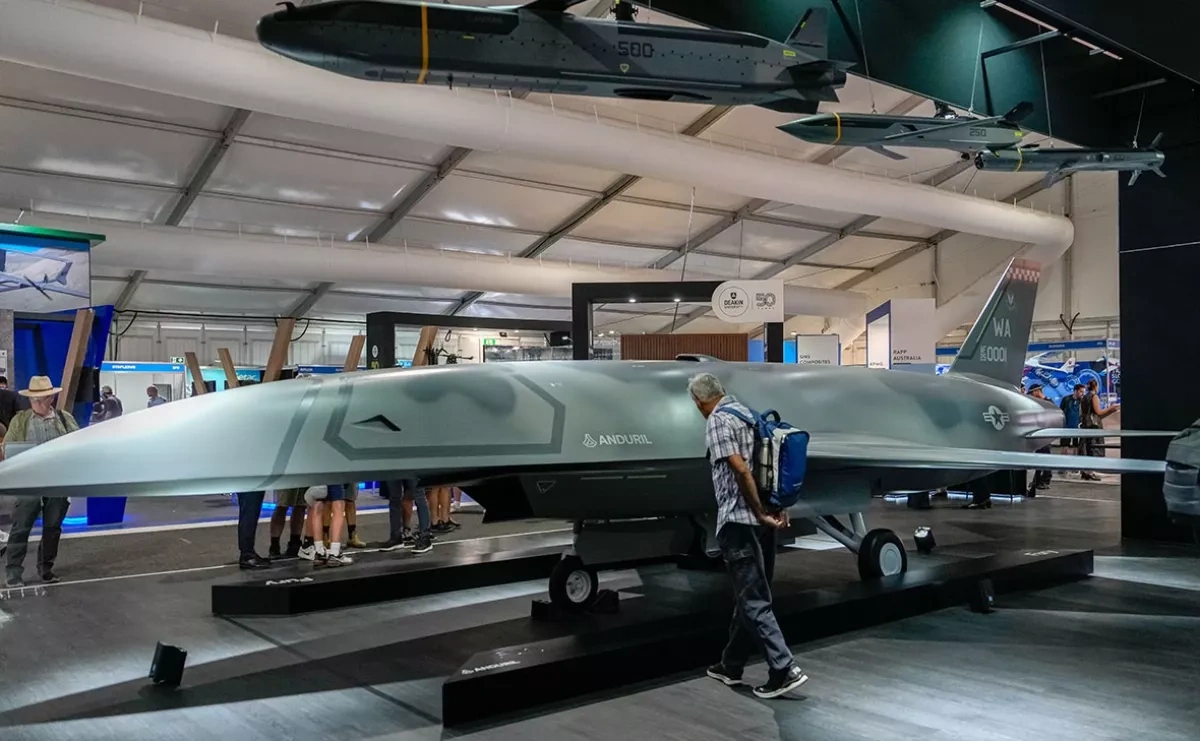
Among the biggest beneficiaries is Anduril Industries, the US defence start-up specialising in autonomous systems and surveillance technologies, which almost doubled its valuation to $61 billion in a $5 billion funding round last month. Its backers include Andreessen Horowitz and Thrive Capital.
Other heavily funded US firms include Saronic Technologies, which focuses on autonomous maritime vessels, and Shield AI, which develops AI-powered drone systems.
In Europe, defence tech investment remains smaller but is accelerating. German drone developer Helsing has reportedly been raising $1.2 billion at a valuation of about $18bn, while fellow German firm Stark is in talks to raise at least €300mn. Finnish-Polish satellite company Iceye recently raised €1 billion at a €10 billion valuation.
Shonnel Malani, managing partner at Advent International, said investors are aware of valuation risks but remain convinced of the sector’s durability.
“The underlying driver of why we need defence technologies and these defence capabilities . . . is very real. That is not a hype,” said Malani. “There is a more sophisticated set of technologies that could be used against us and we have to rise to that challenge.”
Thomas Preuss, chief investment officer for the defence tech fund at DTCP, said the market is “super busy”, but added it is only overheated in specific segments such as aerial drones, with continued opportunity in maritime systems and space-based surveillance.
UK-based Kraken Technology Group is among the firms attracting attention in the maritime defence space, with autonomous minehunting vessels being trialled by the Royal Navy for deployment in the Strait of Hormuz.
The wider investor base includes firms such as Project A Ventures and Earlybird Venture Capital, which have expanded their focus on defence technologies amid what they describe as persistent capability gaps in Europe.
Florian Heinemann of Project A Ventures said valuations “don’t seem to be crazy — there is substantial business behind those companies and substantial order intake.”
Despite strong momentum, some investors warn that the sector may be entering a “hype cycle”, particularly if revenues soften after any de-escalation in Ukraine or the wider Middle East.
Still, Benoit Fosseprez of AVP said the investment case is grounded in long-term structural demand. “It’s a hot market . . . we are addressing what corresponds to the long-term budgets of European armies,” he said.
By Aghakazim Guliyev