As the joke goes, Elon Musk was struck off the list of billionaires last week. Why? Because he entered an entirely new category never seen before — that of trillionaires.
On June 11, SpaceX raised $75 billion through its initial public offering, with the company’s valuation reaching an astonishing $1.7 trillion. Investor enthusiasm was so intense that demand for SpaceX shares exceeded supply by more than four times.
The bulk of Elon Musk’s fortune is tied to SpaceX stock, which is now valued at approximately $866 billion. Combined with his holdings in Tesla and other assets, Musk became the world’s first trillionaire on June 12.
From a technical standpoint, the offering went almost flawlessly. Wall Street had been deeply concerned about potential infrastructure failures: public interest was exceptionally high, order volumes were enormous, and retail investors accounted for an unusually large share of demand. Yet the banks, brokers, Nasdaq, and market makers handled the process smoothly. SpaceX shares opened above the IPO price, delivering a strong first day for investors, while avoiding the trading halts that often accompany excessive volatility.
SpaceX’s record-breaking IPO not only propelled the colourful figure of Elon Musk back onto the front pages, but also underscored the fact that the space sector now occupies a pivotal place in the global financial system. At the same time, investors were largely buying into promises of a brighter future rather than the realities of today.
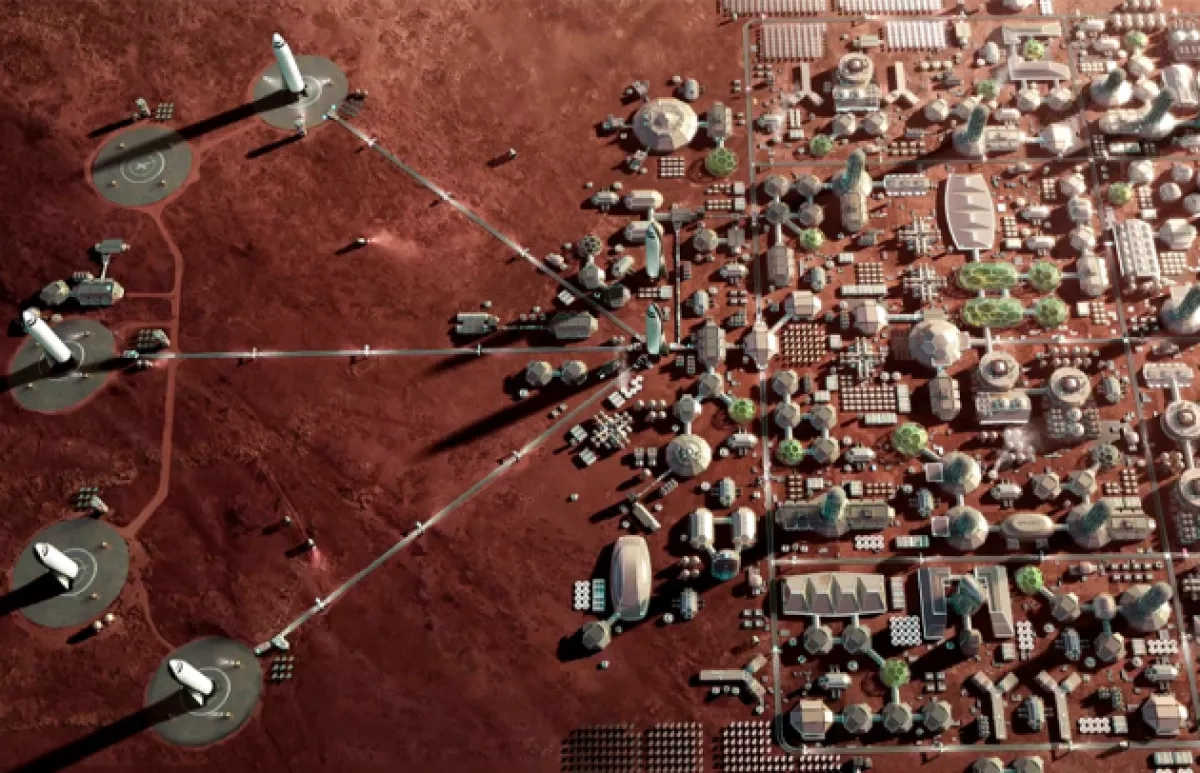
Elon Musk currently exerts significant influence over three technological fields that may have the greatest impact on humanity’s future: the internet, clean energy, and space exploration. Leveraging this potential, SpaceX, founded by Musk in May 2002, has declared its ambition to reduce the cost of space launches and ultimately establish a self-sustaining colony on Mars.
A key factor driving investor interest in SpaceX shares is not merely the company’s current operations, but the entirely new markets it could create in the future.
While the stated goal of building colonies on Mars is likely more inspirational rhetoric than an immediate business objective, investors are far more interested in the prospects of space transportation, satellite internet, defence technologies, data-transmission infrastructure, and next-generation high-tech systems powered by artificial intelligence.
At this stage, SpaceX is increasingly resembling a model that has become common across high-tech markets in recent years. The company is being valued not on the basis of its current profitability, but on the new sectors of the economy it may create in the future, effectively shaping tomorrow’s agenda.
The fact that Musk has transformed ventures once regarded as the stuff of science fiction into commercially viable businesses encourages investors to assess SpaceX beyond the framework of traditional metrics. Yet this also carries significant risks. A substantial portion of the company’s valuation is driven not by tangible achievements, but by ambitious promises that both investors and the broader public are eager to believe.
In this context, optimists view SpaceX as the defining revolutionary company of the 21st century, while more sceptical analysts warn of the risk that it could become yet another speculative bubble. The company still faces major challenges that must be overcome. Chief among them are the full implementation of the Starship programme, the development of Starlink into a profitable and sustainable global business, and the technical as well as political issues associated with operating an ever-growing constellation of satellites in Earth’s orbit.
Moreover, SpaceX’s transition to the public markets will subject the company to a new and demanding test. On the stock exchange, every quarterly result, every delay in the launch schedule, every technical malfunction, and every unsuccessful investment will be scrutinised and priced in by the market almost instantly. This will serve as a test not only of SpaceX’s technological capabilities, but also of its ability to meet investors’ expectations.
Ironically, Elon Musk’s personality and charisma are widely regarded as both one of SpaceX’s greatest strengths and one of its most significant risks. His vision, willingness to take bold risks, and influence on public policy and society have helped secure the company’s prominent position on the global stage. A considerable share of the extraordinary interest in SpaceX’s stock offering can be attributed to the power of Musk’s personal brand.
According to economist Alexander Vinogradov, “what entered the stock market was not merely a company, but a rich concentration of two decades of Musk mythology: rockets, satellite internet, artificial intelligence, Mars, defence contracts, private spaceflight, and, of course, the cult of the founder’s personality.”
Yet the same effect can work in the opposite direction. Musk’s relationships with his other companies, his political and public statements, his management style, and his simultaneous oversight of multiple major ventures raise a number of concerns among investors. As a result, SpaceX shares may prove sensitive not only to the company’s actual performance, but also to public perceptions of Musk’s decisions and actions.
SpaceX’s public offering has opened a new chapter in the history of technology and capitalism. Space — once regarded as the domain of science fiction, government programmes, and long-term engineering projects — has now become a fully fledged asset class for stock market investment and financial speculation.
However, SpaceX’s entry into the stock market cannot be interpreted solely as a success story. It also marks a new stage, one that carries high expectations and substantial risks. The company’s performance in the coming years will depend not only on how far its rockets fly, but also on the development of Starlink, the reliability of Starship, the success of commercialising artificial intelligence-related projects, and how effectively Musk manages this vast corporate structure.
Today, SpaceX is transforming from a company reaching for the skies into a force that lifts capital markets themselves toward new heights. With its public listing, dreams of Mars have, for the first time, been materialised on Wall Street’s trading screens. From this moment on, every launch, every financial report, and every new milestone will become a test watched with bated breath not only by engineers, but also by investors.