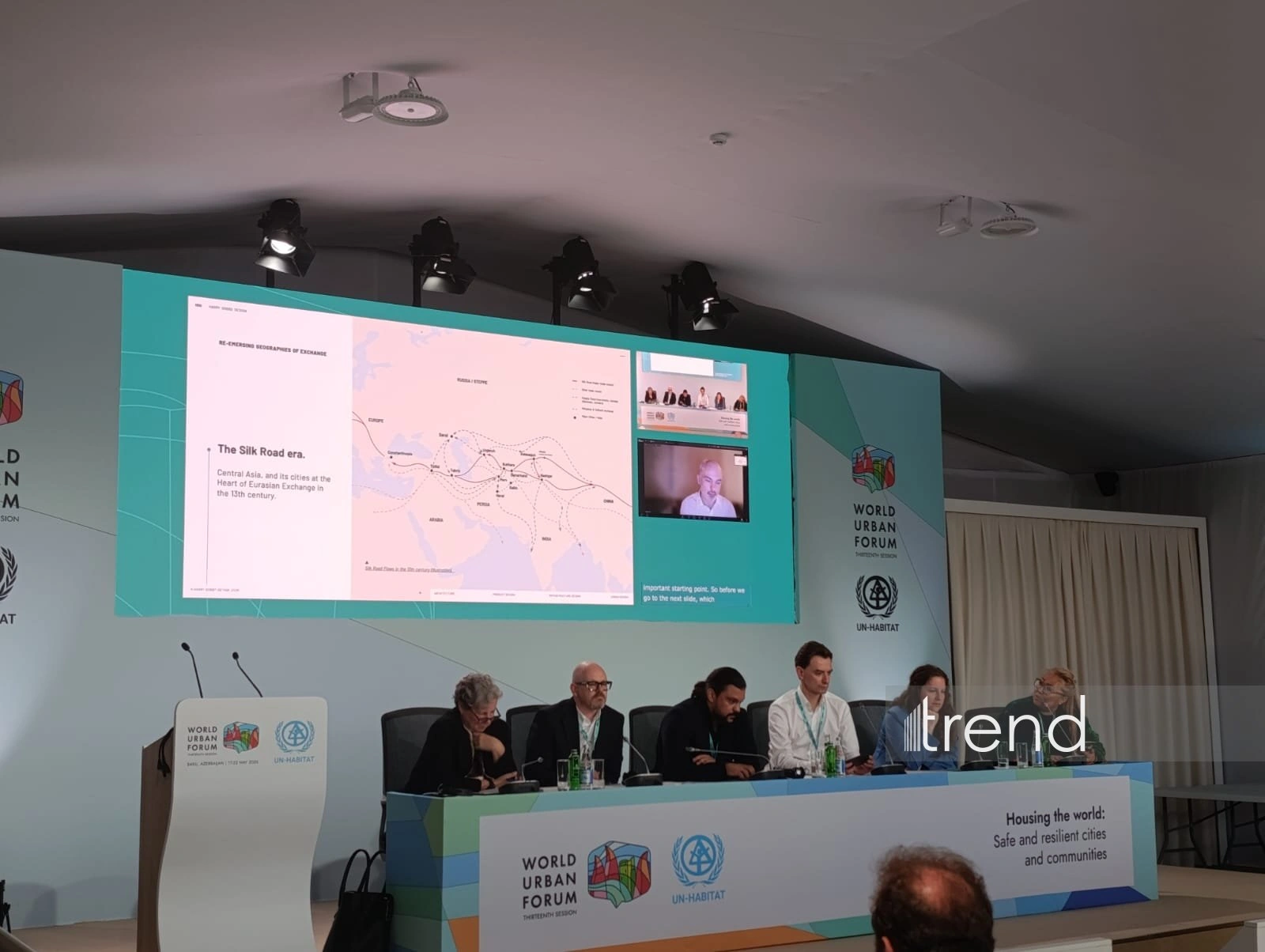
BAKU, Azerbaijan, May 22. The location of
Alatau (Kazakhstan) at the crossroads of transport routes
determines the city's logistics, British architect Harry Dobbs,
founder of Harry Dobbs Design Ltd and member of the Alatau City
Development Council, said during a session titled "New Capitals and
New Cities of Central Asia. Water-Sensitive Urban Planning and
Housing for Climate Resilience" within the framework of WUF13,
Trend reports.
According to him, Alatau leverages its position at the
intersection of trade and logistics networks, where the East–West
railway corridor connecting China and Kazakhstan passes directly
through its center.
"This is precisely what begins to determine the city's logistics
— an approach based on enterprise development and capitalising on
this advantageous position. A special economic zone framework is
being created, providing a clear regulatory, tax, and planning
environment to attract agile investments and stimulate economic
growth and opportunities. And it is this entrepreneurial approach
that shapes the four districts of the city, which are focused on
business sectors that complement neighboring Almaty and Konaev,
located further north: business, education, logistics and industry,
as well as tourism," he said.
According to him, the ambition is for all of this to come
together into a single city within an integrated master plan that
has already been developed. He also noted that the city is forming
along the North–South transport corridor, which connects Almaty
with Konaev to the north and leads further to Astana.
Meanwhile, today Baku is hosting the final day of WUF13.
On the first day of the forum, a ministerial meeting on the New
Urban Agenda, a ministerial roundtable, women’s and civil society
assemblies, business sessions, and discussions on urban well-being
took place. The forum also featured a flag-raising ceremony for the
UN and Azerbaijan.
The second day of the forum was marked by the first-ever
Leaders’ Summit. On this day, high-level discussions were held on
the global housing crisis, urbanization policy, and urban
sustainability. Also, as part of WUF13, the Mexico City pavilion
was inaugurated, presented as a key platform for expanding
cooperation with the Latin American region and preparing for
WUF14.
The third day of WUF13 was also marked by an extensive program
of events. Discussions on this day covered topics such as the
global housing crisis, the creation of safe and inclusive cities,
climate resilience, artificial intelligence and urban governance,
“green” urbanization, social equality, and sustainable
transportation.
One of the highlights of the third day was the signing of a
sister-city agreement between the Azerbaijani city of Shusha and
the Turkish city of Trabzon.
The fourth day of WUF13 featured an extensive program of events
dedicated to the themes of urbanization, climate change, inclusive
urban development, housing policy, and sustainable management.
On the fifth day of the forum, discussions continued on the
global housing crisis, the creation of safe and inclusive cities,
climate resilience, the use of artificial intelligence in urban
management, “green” urbanization, and social equality.
One of the key events of the Cities Forum of the United Nations
Special Program for the Economies of Central Asia (SPECA), held on
the fourth day, was the announcement of Almaty’s official accession
to the “Declaration of Intent on the Establishment of the SPECA
Forum on Smart Cities Resilient to Climate Change.”
Also, for the first time in WUF history, the “WUF13 NGO Forum:
Global Partnership and Decision-Making” was held at the initiative
of Azerbaijan.
The WUF13 Forum, dedicated to the theme “"Housing the world:
Safe and resilient cities and communities", brought together
governments, international organizations, experts, and civil
society representatives to strengthen global cooperation in the
field of sustainable urban development. More than 40,000 people
from 182 countries registered to participate in the forum.