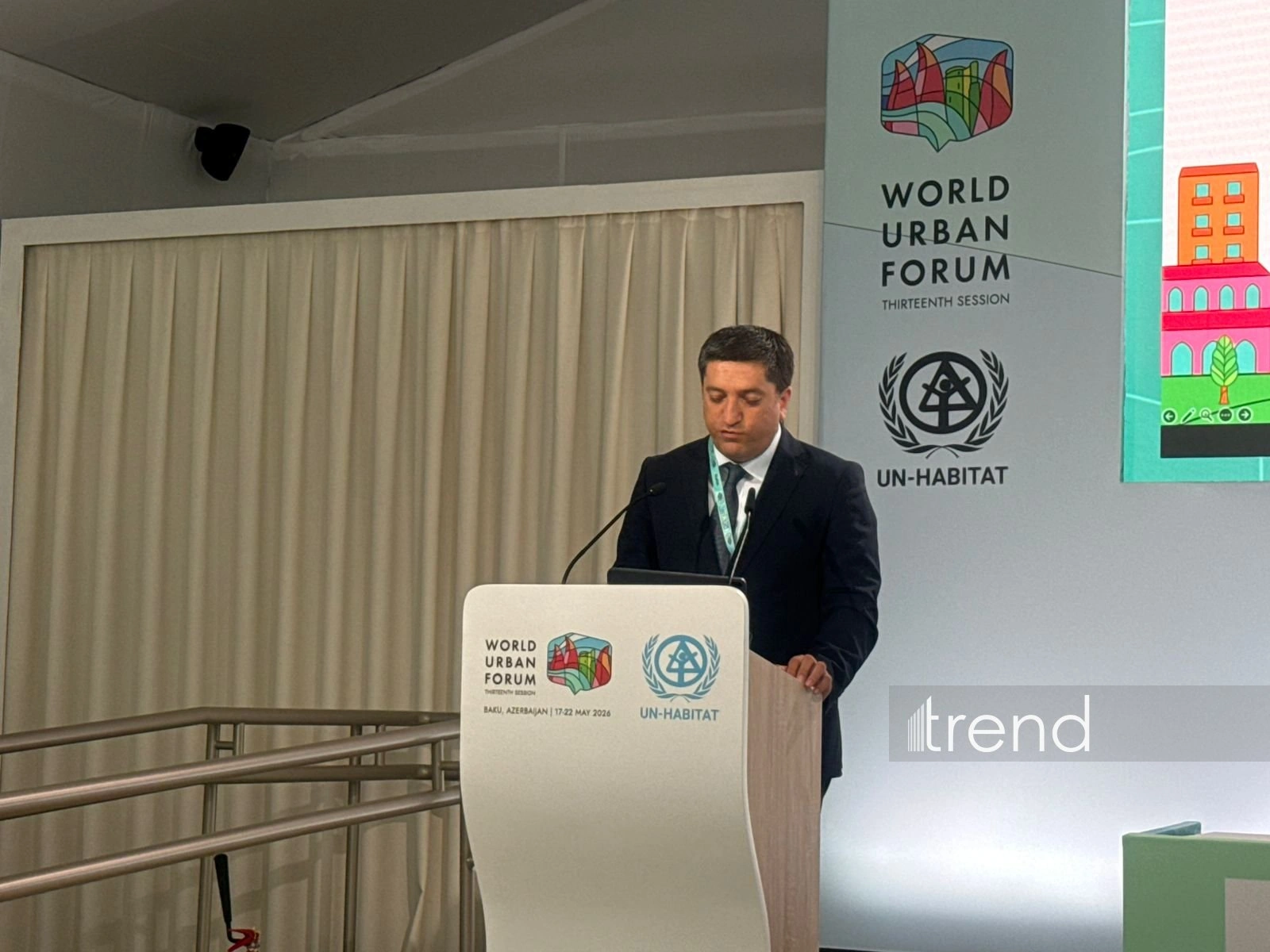
BAKU, Azerbaijan, May 22. Integrating the
Sustainable Development Goals (SDGs) into urban planning and policy
decisions is a necessity, rather than an option, Advisor to the
Minister of Economy Hasan Hasanli said at an event titled
“Strategic Environmental Assessment as a tool for achieving climate
targets in urban planning” as part of the 13th World Urban Forum
(WUF13) in Baku, Trend reports.
According to him, climate change and environmental degradation
are no longer distant risks. They are structural realities that
increasingly affect economic growth, social well-being,
infrastructure, productivity, public health, and long-term
development achievements around the world.
The adviser noted that the figures clearly show this.
"Today, 58 % of the world's population lives in cities, and this
figure is projected to reach nearly 70 % by 2050. Cities are
responsible for 70 % of global greenhouse gas emissions and 75 % of
energy consumption. From 1970 through 2021, economic losses due to
extreme weather and climate events amounted to $4.3 trillion, and
this figure continues to grow. The pressure on population, the size
of cities, and infrastructure will only increase," he
explained.
The official emphasized that sustainable development must
therefore pay equal attention to all three pillars — economic
sustainability, social inclusion, and environmental sustainability.
These directions complement each other, and cities become key
actors in the sustainable transformation towards climate
resilience.
He recalled that 83% of the global SDG targets have not yet been
fully implemented. Therefore, integrating the SDGs into urban
planning and policy decisions is no longer an option — it's a
necessity.
"Azerbaijan has submitted four Voluntary National Reports to
date, aligned more than 50 state programs and strategies with the
SDG targets, and formed institutional coordination mechanisms at
the international level. Currently, Azerbaijan is among the top 10
countries among 193 countries that have submitted four Voluntary
National Reports to the UN system, and has assumed this
responsibility at the global level," he said.
Hasanli added that one of the most important points is the
launch of a structured process for localizing the SDGs in cities
such as Shusha and Nakhchivan.
"This translates global commitments into local results — through
more inclusive urban planning, vision-based local governance,
better infrastructure, enhanced climate resilience, and improved
public services," added the official.
Today marks the final day of the 13th session of the World Urban
Forum (WUF13).
The first day included a ministerial meeting dedicated to the
New Urban Agenda, a ministerial roundtable, assemblies for women
and civil society, business sessions, and discussions on urban
prosperity. An official ceremony marking the raising of the UN and
Azerbaijani flags also took place.
The second day stood out for the inaugural Leaders' Summit,
featuring high-level discussions on the global housing crisis,
urbanization policy, and urban resilience. Concurrently, the
opening of the Mexico City pavilion took place, serving as a
significant platform for expanding cooperation with the Latin
American region and preparing for WUF14.
The third day of WUF13 featured a comprehensive program of
events covering the global housing crisis, the formation of safe
and inclusive cities, climate resilience, artificial intelligence
and urban governance, green urbanization, social equity, and
sustainable transport.
One of the highlights of the third day was the signing of a
sister-city memorandum between the Azerbaijani city of Shusha and
the Turkish city of Trabzon.
The fourth day of WUF13 featured a broad program of events
dedicated to urbanization, climate change, inclusive urban
development, housing policy, and sustainable governance.
The fifth day of WUF13 continued discussions on the global
housing crisis, the creation of safe and inclusive cities, climate
resilience, the use of artificial intelligence in urban management,
green urbanization, and social equality.
One of the important events of the UN Special Programme for the
Economies of Central Asia (SPECA) Cities Forum, held on the fourth
day, was the announcement of Almaty’s official accession to the
“Declaration of Intent on the Establishment of the SPECA Smart
Climate-Resilient Cities Forum.”
Also, for the first time in WUF history and at Azerbaijan’s
initiative, the “WUF13 NGO Forum: Global Partnership and
Decision-Making” was held.
WUF13, which has attracted more than 40,000 registered
participants from 182 countries, will continue until May 22. Held
under the theme “Housing the world: Safe and resilient cities and
communities,” the forum brings together governments, international
organizations, experts, and representatives of civil society to
strengthen global cooperation in the field of sustainable urban
development.