BAKU, Azerbaijan, May 21. Azerbaijan is
demonstrating a comprehensive approach to sustainable urban
development, focusing not only on environmental issues but also on
inclusivity and the collaborative development of solutions,
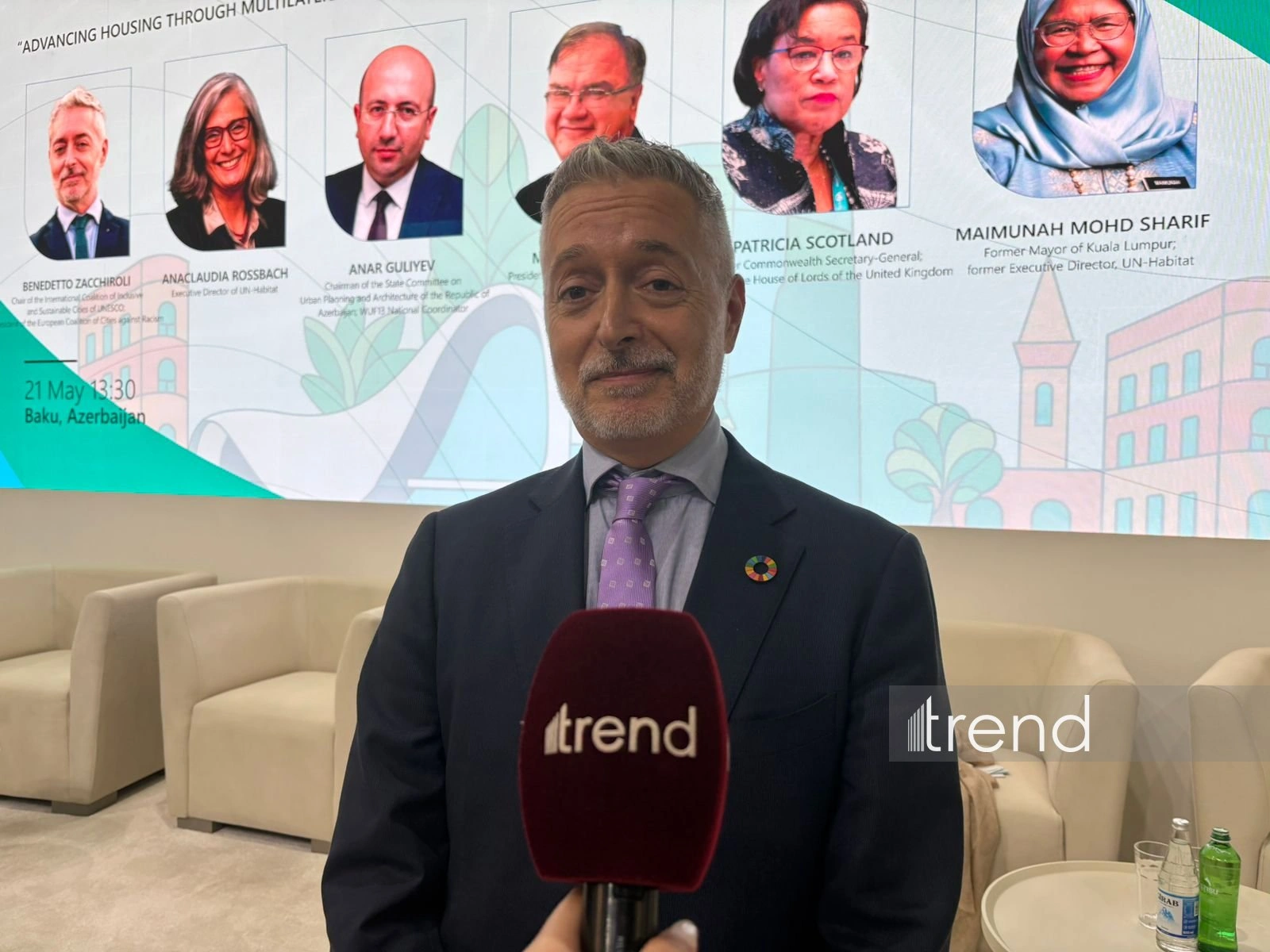
Benedetto Zacchiroli, the Chair of UNESCO's International Coalition
of Inclusive and Sustainable Cities (ICCAR) and the President of
the European Coalition of Cities Against Racism (ECCAR), told
Trend on the margins
of the 13th World Urban Forum (WUF13) in Baku.
According to him, sustainable development must go hand in hand
with social inclusion.
“It is very interesting to observe what Azerbaijan is doing in
this area, especially in the context of sustainable development.
However, it is important to remember that sustainability must
always be combined with inclusivity and the joint design of
solutions,” he noted.
Speaking about the lessons Azerbaijan can learn from European
experience in combating urban inequality and segregation,
Zacchiroli emphasized the importance of diversity.
“Diversity is a source of wealth and true strength. Our motto in
Europe is ‘Unity in Diversity.’ We don’t need to be the same. It is
precisely diversity that can become a strength. This is Europe’s
secret, and it can become Azerbaijan’s secret,” he said.
He also noted that the international community might find
Azerbaijan’s approach to openness and engagement of interest.
“Every country can serve as an example of how to manage
processes and remain open to the world. For me, Azerbaijan is an
example of a willingness to listen to others and act accordingly.
That is our shared secret,” Zacchiroli added.
Today marks the fifth day of WUF13 in Baku.
The first day included a ministerial meeting dedicated to the
New Urban Agenda, a ministerial roundtable, assemblies for women
and civil society, business sessions, and discussions on urban
prosperity. An official ceremony marking the raising of the UN and
Azerbaijani flags also took place.
The second day stood out for the inaugural Leaders' Summit,
featuring high-level discussions on the global housing crisis,
urbanization policy, and urban resilience. Concurrently, the
opening of the Mexico City pavilion took place, serving as a
significant platform for expanding cooperation with the Latin
American region and preparing for WUF14.
The third day of WUF13 featured a comprehensive program of
events covering the global housing crisis, the formation of safe
and inclusive cities, climate resilience, artificial intelligence
and urban governance, green urbanization, social equity, and
sustainable transport.
One of the highlights of the third day was the signing of a
sister-city memorandum between the Azerbaijani city of Shusha and
the Turkish city of Trabzon.
The fourth day of WUF13 featured a broad program of events
dedicated to urbanization, climate change, inclusive urban
development, housing policy, and sustainable governance.
One of the important events of the UN Special Program for the
Economies of Central Asia (SPECA) Cities Forum, held on the fourth
day, was the announcement of Almaty’s official accession to the
“Declaration of Intent on the Establishment of the SPECA Smart
Climate-Resilient Cities Forum.”
Also, for the first time in WUF history and at Azerbaijan’s
initiative, the “WUF13 NGO Forum: Global Partnership and
Decision-Making” was held.
WUF13, which has attracted more than 40,000 registered
participants from 182 countries, will continue until May 22. Held
under the theme “Housing the world: Safe and resilient cities and
communities,” the forum brings together governments, international
organizations, experts, and representatives of civil society to
strengthen global cooperation in the field of sustainable urban
development.