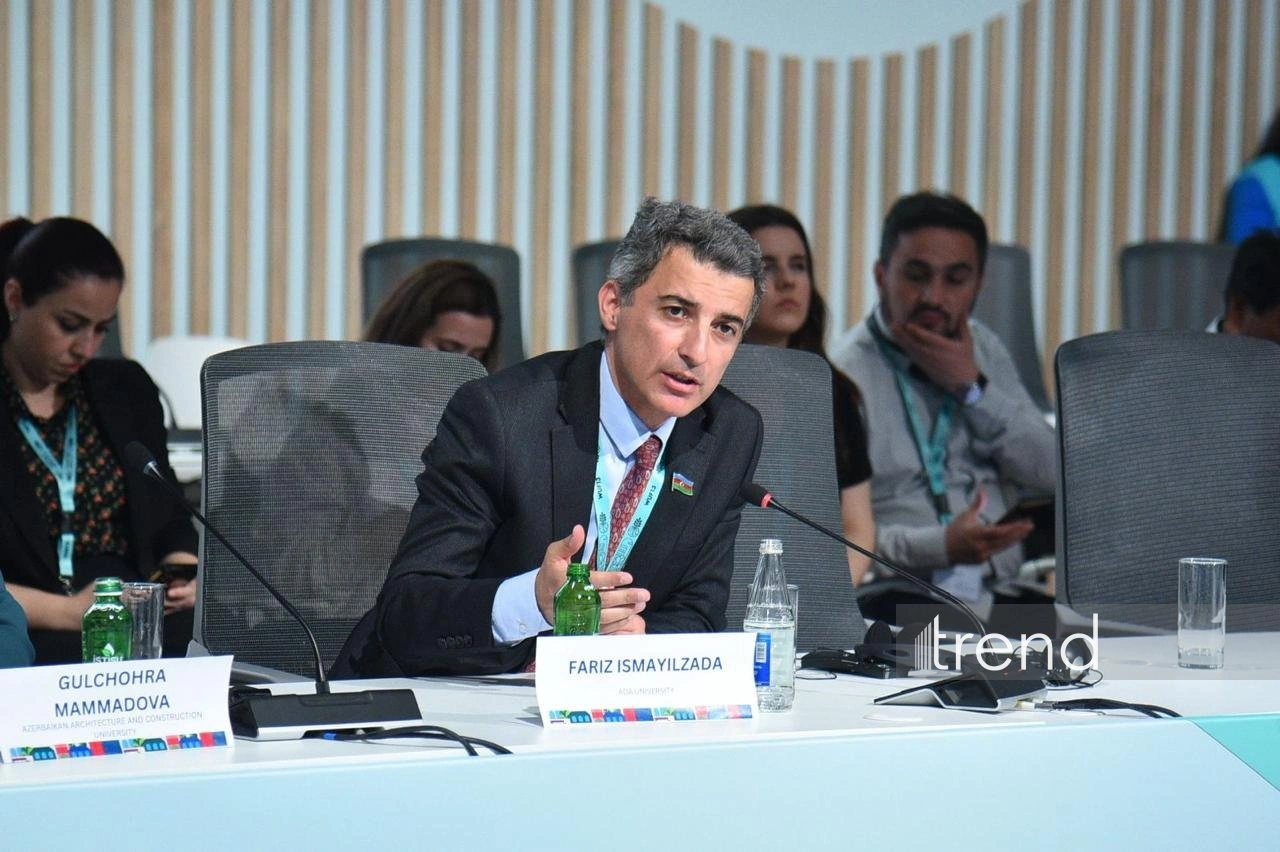
BAKU, Azerbaijan, May 21. The Caspian Sea and
its water resources will determine the future development of Baku,
Vice-Rector of ADA University Fariz Ismailzade said at an
international roundtable discussion titled "Education and
Professional Training" within the framework of the 13th session of
the UN World Urban Forum (WUF13), Trend
reports.
He noted that the main factors that will affect the urban
development of Baku and Azerbaijan in general will be environmental
changes, technological innovations, and demographic processes.
According to him, one of the main challenges for Baku in the
coming years will be environmental issues.
"In particular, the decline in the level of the Caspian Sea, the
difficulties faced by the ports operating in Baku, and the issues
of drinking water supply will have a serious impact on the
development of the city. Since Azerbaijan receives a significant
part of its water resources from neighboring countries, there is a
certain dependence in this area. These factors will also determine
the future directions of housing construction and urbanization
processes.
For this reason, new research programs are being created at our
university on water resources, drinking water security, and the
future of the Caspian Sea. These issues will have a significant
impact on the development trajectory of our cities," he
emphasized.
The vice-rector added that technological changes and innovations
are also one of the main driving forces of urban development.
"Currently, Azerbaijan pays special attention to the development
of renewable energy sources. At the same time, work is being
carried out to apply "smart" solutions and modern technologies in
urban management, transport, and everyday life," Ismailzade
mentioned.
The vice-rector pointed out that ADA University is expanding
international cooperation in research on the future of cities.
"The fields of technology, ecology, and demography constitute
the main directions of ADA University's research activities on
urban planning and development.
Solving the problems faced by modern cities is impossible
without international cooperation. Azerbaijan is a relatively small
country, and cooperation with neighboring states is important,
especially in solving problems related to water resources, the
environment, and the Caspian Sea. At the same time, it is necessary
to work together with international organizations and raise global
awareness on these issues," he noted.
Ismailzade highlighted that the university is also expanding
cooperation with international partners in the direction of
technological transformation.
"It's important to benefit from the experience of advanced
economies in technological matters. Artificial intelligence, big
data analysis, and the application of smart technologies will play
an important role in shaping the cities of the future," he
stressed.
According to the vice-rector, ADA University is developing both
local research in these areas and trying to learn from the
experience of other countries through international scientific
networks and partnerships.
"Our goal is to bring global experience to Azerbaijan and at the
same time share the experience of our country on international
platforms," Ismailzade concluded.
Today marks the fifth day of WUF13 in Baku.
The first day included a ministerial meeting dedicated to the
New Urban Agenda, a ministerial roundtable, assemblies for women
and civil society, business sessions, and discussions on urban
prosperity. An official ceremony marking the raising of the UN and
Azerbaijani flags also took place.
The second day stood out for the inaugural Leaders' Summit,
featuring high-level discussions on the global housing crisis,
urbanization policy, and urban resilience. Concurrently, the
opening of the Mexico City pavilion took place, serving as a
significant platform for expanding cooperation with the Latin
American region and preparing for WUF14.
The third day of WUF13 featured a comprehensive program of
events covering the global housing crisis, the formation of safe
and inclusive cities, climate resilience, artificial intelligence
and urban governance, green urbanization, social equity, and
sustainable transport.
One of the highlights of the third day was the signing of a
sister-city memorandum between the Azerbaijani city of Shusha and
the Turkish city of Trabzon.
The fourth day of WUF13 featured a broad program of events
dedicated to urbanization, climate change, inclusive urban
development, housing policy, and sustainable governance.
One of the important events of the UN Special Programme for the
Economies of Central Asia (SPECA) Cities Forum, held on the fourth
day, was the announcement of Almaty’s official accession to the
“Declaration of Intent on the Establishment of the SPECA Smart
Climate-Resilient Cities Forum.”
Also, for the first time in WUF history and at Azerbaijan’s
initiative, the “WUF13 NGO Forum: Global Partnership and
Decision-Making” was held.
WUF13, which has attracted more than 40,000 registered
participants from 182 countries, will continue until May 22. Held
under the theme “Housing the world: Safe and resilient cities and
communities,” the forum brings together governments, international
organizations, experts, and representatives of civil society to
strengthen global cooperation in the field of sustainable urban
development.