BAKU, Azerbaijan, May 21. Real estate taxation
functions as the primary financial foundation for the resilient
development of municipalities and the sustained underwriting of
critical urban infrastructure pipelines, said Irina Ilina,
representative of the HSE University (National Research University
Higher School of Economics), Trend reports.
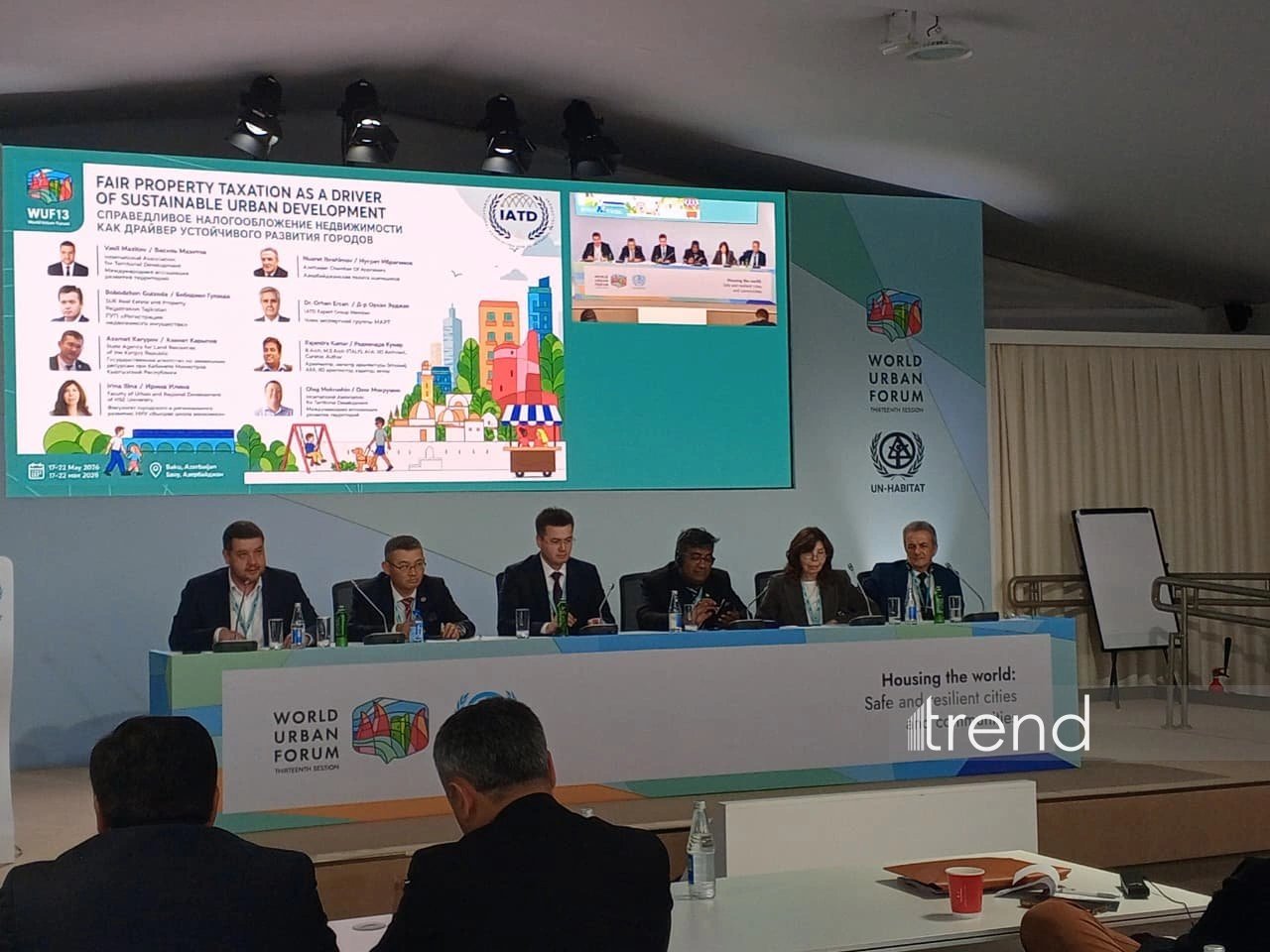
The academic made the remarks during a panel discussion titled
"Fair Property Taxation as a Driver of Sustainable Urban
Development," held within the framework of the 13th session of the
World Urban Forum (WUF13) in Baku.
According to her, the structural configuration of a property tax
system exerts a direct, unyielding impact on the aggregate quality
of the municipal environment and baseline indicators of social
equality. "If property taxes undergo collection via a flat, uniform
rate that fails to account for the physical quality and geographic
location of the housing stock, it can trigger severe socioeconomic
disparities across communities," Ilina pointed out.
She emphasized that asset-based taxes represent one of the most
vital revenue pipelines for local authorities, directly enabling
the physical expansion and modernization of cities and municipal
settlements.
"Without robust property tax streams, local governance
structures cannot construct roads, schools, universities, medical
centers, and other essential infrastructure assets. These fiscal
resources directly secure the continuous existence and maintenance
of vital public goods," the HSE representative stated.
Ilina cited the Russian real estate taxation architecture as an
active operational example, noting that the country utilizes a
multi-tiered fiscal model wherein property taxes undergo statutory
classification strictly as local municipal levies.
According to her, the Russian property tax framework
comprehensively integrates three distinct core pillars: the land
tax, the property tax on physical individuals, and the corporate
property tax on commercial organizations. She concurrently reported
that the national tax code undergoes continuous regulatory
refinement, with active tax rate calculations pegged directly to
the official cadastral (assessed) value of the real estate
asset.
"In strict compliance with statutory legislation, the cadastral
valuation of real estate assets undergoes systematic re-evaluation
every four years. However, across the largest metropolitan
economies, such as Moscow and St. Petersburg, this calibration
cycle accelerates to once every two years to accurately reflect
shifting market realities," Ilina concluded.
Today marks the fifth day of WUF13 in Baku.
The first day included a ministerial meeting dedicated to the
New Urban Agenda, a ministerial roundtable, assemblies for women
and civil society, business sessions, and discussions on urban
prosperity. An official ceremony marking the raising of the UN and
Azerbaijani flags also took place.
The second day stood out for the inaugural Leaders' Summit,
featuring high-level discussions on the global housing crisis,
urbanization policy, and urban resilience. Concurrently, the
opening of the Mexico City pavilion took place, serving as a
significant platform for expanding cooperation with the Latin
American region and preparing for WUF14.
The third day of WUF13 featured a comprehensive program of
events covering the global housing crisis, the formation of safe
and inclusive cities, climate resilience, artificial intelligence
and urban governance, green urbanization, social equity, and
sustainable transport.
One of the highlights of the third day was the signing of a
sister-city memorandum between the Azerbaijani city of Shusha and
the Turkish city of Trabzon.
The fourth day of WUF13 featured a broad program of events
dedicated to urbanization, climate change, inclusive urban
development, housing policy, and sustainable governance.
One of the important events of the UN Special Programme for the
Economies of Central Asia (SPECA) Cities Forum, held on the fourth
day, was the announcement of Almaty’s official accession to the
“Declaration of Intent on the Establishment of the SPECA Smart
Climate-Resilient Cities Forum.”
Also, for the first time in WUF history and at Azerbaijan’s
initiative, the “WUF13 NGO Forum: Global Partnership and
Decision-Making” was held.
WUF13, which has attracted more than 40,000 registered
participants from 182 countries, will continue until May 22. Held
under the theme “Housing the world: Safe and resilient cities and
communities,” the forum brings together governments, international
organizations, experts, and representatives of civil society to
strengthen global cooperation in the field of sustainable urban
development.