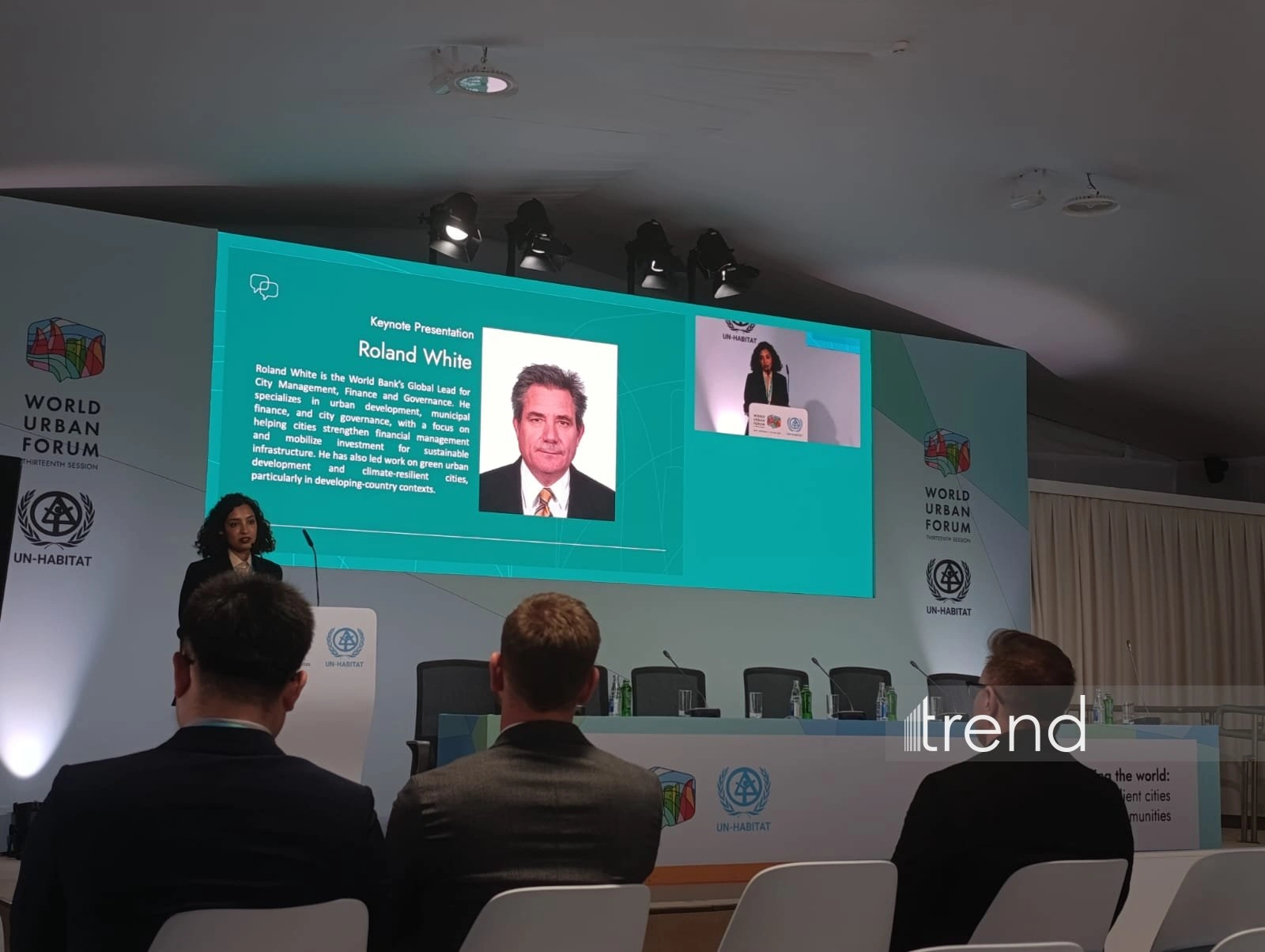
BAKU, Azerbaijan, May 21. A high-level
international session titled "Beyond External Finance - Can Cities
Scale Their Own Revenues While Delivering Housing Solutions"
convened within the framework of the 13th session of the World
Urban Forum (WUF13) in Baku, Trend reports.
The specialized networking and policy-alignment event is jointly
organized by the National Association of Municipalities of Cape
Verde (ANMCV), the Lincoln Institute of Land Policy, e-Gov India,
and UN-Habitat. The multilateral initiative aims to construct
robust institutional networks capable of driving the broader
Own-Source Revenue (OSR) reform agenda past marginal, incremental
changes toward resilient, systemic overhauls. These structural
improvements target reinforcing the long-term fiscal capacity of
municipal authorities to consistently supply adequate, accessible
housing frameworks on a nationwide scale.
The technical session directs sharp analytical focus toward
actionable methodologies enabling municipal governments to
transition from basic, small-scale OSR adjustments into
large-scale, sustainable revenue multiplication loops. Panelists
and public finance experts are evaluating various strategic tools
to accelerate this fiscal transition, including the deployment of
rapid financial diagnostics, integration of cutting-edge civic
technologies, execution of comprehensive regulatory reforms,
application of innovative land value capture instruments, and the
optimized commercial and civic utilization of existing public
property assets.
The international forum is showcasing a series of empirical
success stories in localized OSR expansion, while delegates engage
in cross-border technical exchanges to evaluate the operational
scalability and direct applicability of these financial
methodologies within low-income urban jurisdictions.
Today marks the fifth day of WUF13 in Baku.
The first day included a ministerial meeting dedicated to the
New Urban Agenda, a ministerial roundtable, assemblies for women
and civil society, business sessions, and discussions on urban
prosperity. An official ceremony marking the raising of the UN and
Azerbaijani flags also took place.
The second day stood out for the inaugural Leaders' Summit,
featuring high-level discussions on the global housing crisis,
urbanization policy, and urban resilience. Concurrently, the
opening of the Mexico City pavilion took place, serving as a
significant platform for expanding cooperation with the Latin
American region and preparing for WUF14.
The third day of WUF13 featured a comprehensive program of
events covering the global housing crisis, the formation of safe
and inclusive cities, climate resilience, artificial intelligence
and urban governance, green urbanization, social equity, and
sustainable transport.
One of the highlights of the third day was the signing of a
sister-city memorandum between the Azerbaijani city of Shusha and
the Turkish city of Trabzon.
The fourth day of WUF13 featured a broad program of events
dedicated to urbanization, climate change, inclusive urban
development, housing policy, and sustainable governance.
One of the important events of the UN Special Programme for the
Economies of Central Asia (SPECA) Cities Forum, held on the fourth
day, was the announcement of Almaty’s official accession to the
“Declaration of Intent on the Establishment of the SPECA Smart
Climate-Resilient Cities Forum.”
Also, for the first time in WUF history and at Azerbaijan’s
initiative, the “WUF13 NGO Forum: Global Partnership and
Decision-Making” was held.
WUF13, which has attracted more than 40,000 registered
participants from 182 countries, will continue until May 22. Held
under the theme “Housing the world: Safe and resilient cities and
communities,” the forum brings together governments, international
organizations, experts, and representatives of civil society to
strengthen global cooperation in the field of sustainable urban
development.