BAKU, Azerbaijan, May 21. Azerbaijan has
learned by implementing the process of rebuilding the liberated
territories, Special Representative of the President of Azerbaijan
in the Shusha district, Aydin Karimov said, Trend reports.
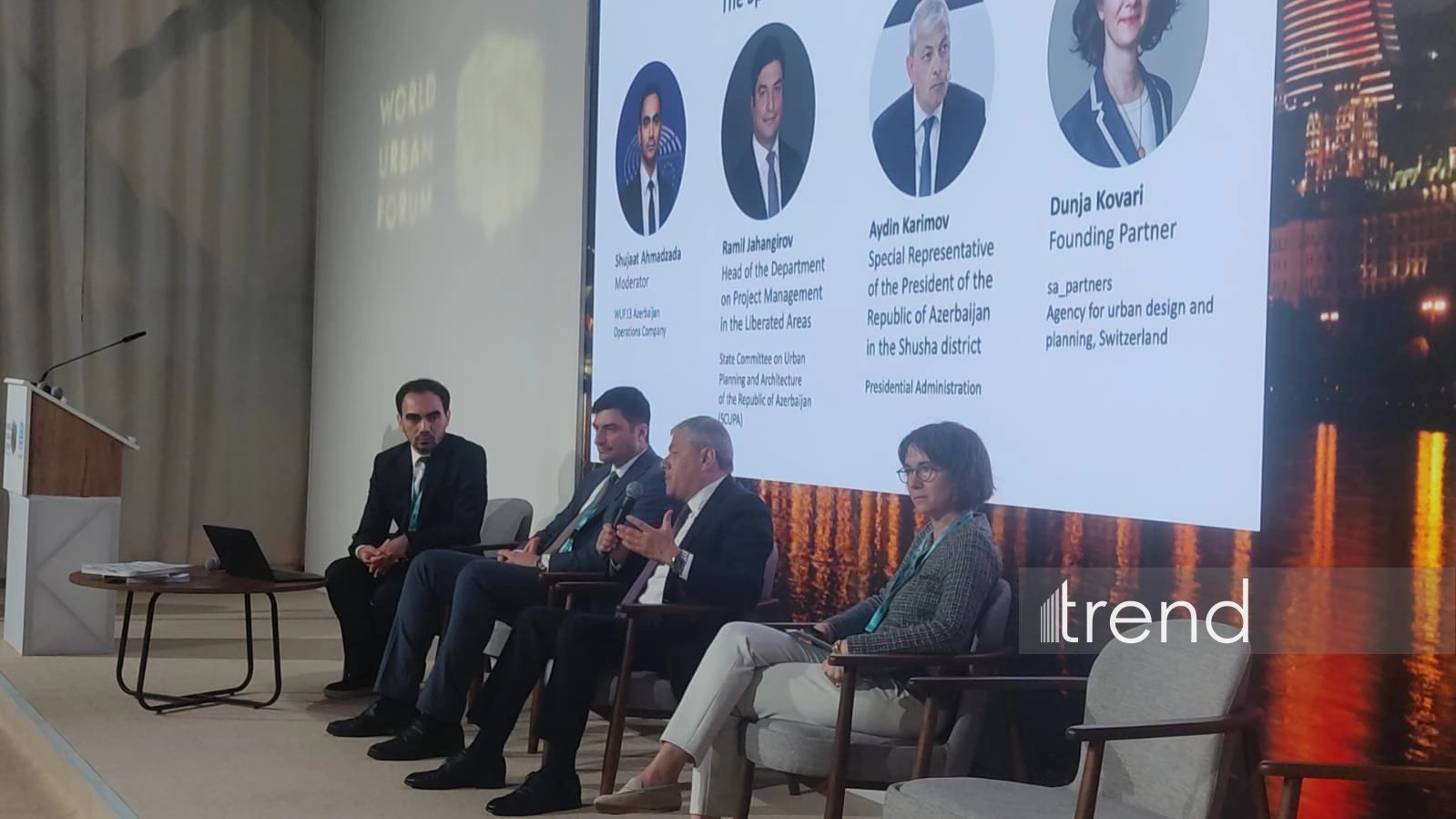
He made the remark at a session titled "Building Back Better How
Urban Reconstruction Created an Innovation Lab for Urban
Transformation in Azerbaijan" within the framework of the 13th
session of the World Urban Forum (WUF13) in Baku.
Karimov noted that the development of master plans typically
requires long hours, days, and sometimes months of discussions,
brainstorming, and intensive collaboration with the international
community to determine the most appropriate approach.
According to him, due to the time constraints in the post-war
rehabilitation and reconstruction of the liberated territories,
Azerbaijan has learned and gained experience in the process by
implementing it simultaneously.
"In this regard, some mechanisms implemented by President Ilham
Aliyev and the government from the very beginning were very useful
for the correct direction of the process. First, a special body was
created - the Coordination Headquarters, headed by the Head of the
Presidential Administration.
This headquarters included almost all ministers and heads of
state agencies, and it functioned as a parallel management
mechanism that controlled all processes carried out in the
liberated territories.
This structure wasn't just a formal coordination structure. On
the contrary, it was a very lively mechanism that brought together
various working groups and continues to cooperate today. This
entire system was formed in a very short period of time.
At the same time, a very operational coordination mechanism was
created between planners, architects and executive bodies - both
state and private companies involved in the construction
process.
Karimov said that in parallel, special attention was paid to
making this process as transparent as possible.
"Open tender procedures were applied, numerous media
representatives and visitors visited the regions. Shusha was one of
the first cities to receive wide attention in this regard.
Meeting the requirements for the protection of national heritage
was one of the main priorities, and this also included the
architectural style. If you look at the residential complexes in
Shusha, you will see that a completely different and interesting
architectural approach is applied to the facades of the buildings.
Here, stones obtained from local quarries were used, which were not
easy to find.
"At the same time, certain experiments were also conducted in
this direction, and this was more related to the design approach.
In order to make the facades look more aesthetic, new standards
were developed with the support of the Urban Planning and
Architecture Committee and are already being successfully
implemented. As a result, the buildings look both aesthetically
attractive and create a functional living environment. These areas
are visited by high-level guests, and residents are satisfied with
their living conditions, leading a comfortable and relaxed life
there," he pointed out.
Today marks the fifth day of WUF13 in Baku.
The first day included a ministerial meeting dedicated to the
New Urban Agenda, a ministerial roundtable, assemblies for women
and civil society, business sessions, and discussions on urban
prosperity. An official ceremony marking the raising of the UN and
Azerbaijani flags also took place.
The second day stood out for the inaugural Leaders' Summit,
featuring high-level discussions on the global housing crisis,
urbanization policy, and urban resilience. Concurrently, the
opening of the Mexico City pavilion took place, serving as a
significant platform for expanding cooperation with the Latin
American region and preparing for WUF14.
The third day of WUF13 featured a comprehensive program of
events covering the global housing crisis, the formation of safe
and inclusive cities, climate resilience, artificial intelligence
and urban governance, green urbanization, social equity, and
sustainable transport.
One of the highlights of the third day was the signing of a
sister-city memorandum between the Azerbaijani city of Shusha and
the Turkish city of Trabzon.
The fourth day of WUF13 featured a broad program of events
dedicated to urbanization, climate change, inclusive urban
development, housing policy, and sustainable governance.
One of the important events of the UN Special Programme for the
Economies of Central Asia (SPECA) Cities Forum, held on the fourth
day, was the announcement of Almaty’s official accession to the
“Declaration of Intent on the Establishment of the SPECA Smart
Climate-Resilient Cities Forum.”
Also, for the first time in WUF history and at Azerbaijan’s
initiative, the “WUF13 NGO Forum: Global Partnership and
Decision-Making” was held.
WUF13, which has attracted more than 40,000 registered
participants from 182 countries, will continue until May 22. Held
under the theme “Housing the world: Safe and resilient cities and
communities,” the forum brings together governments, international
organizations, experts, and representatives of civil society to
strengthen global cooperation in the field of sustainable urban
development.