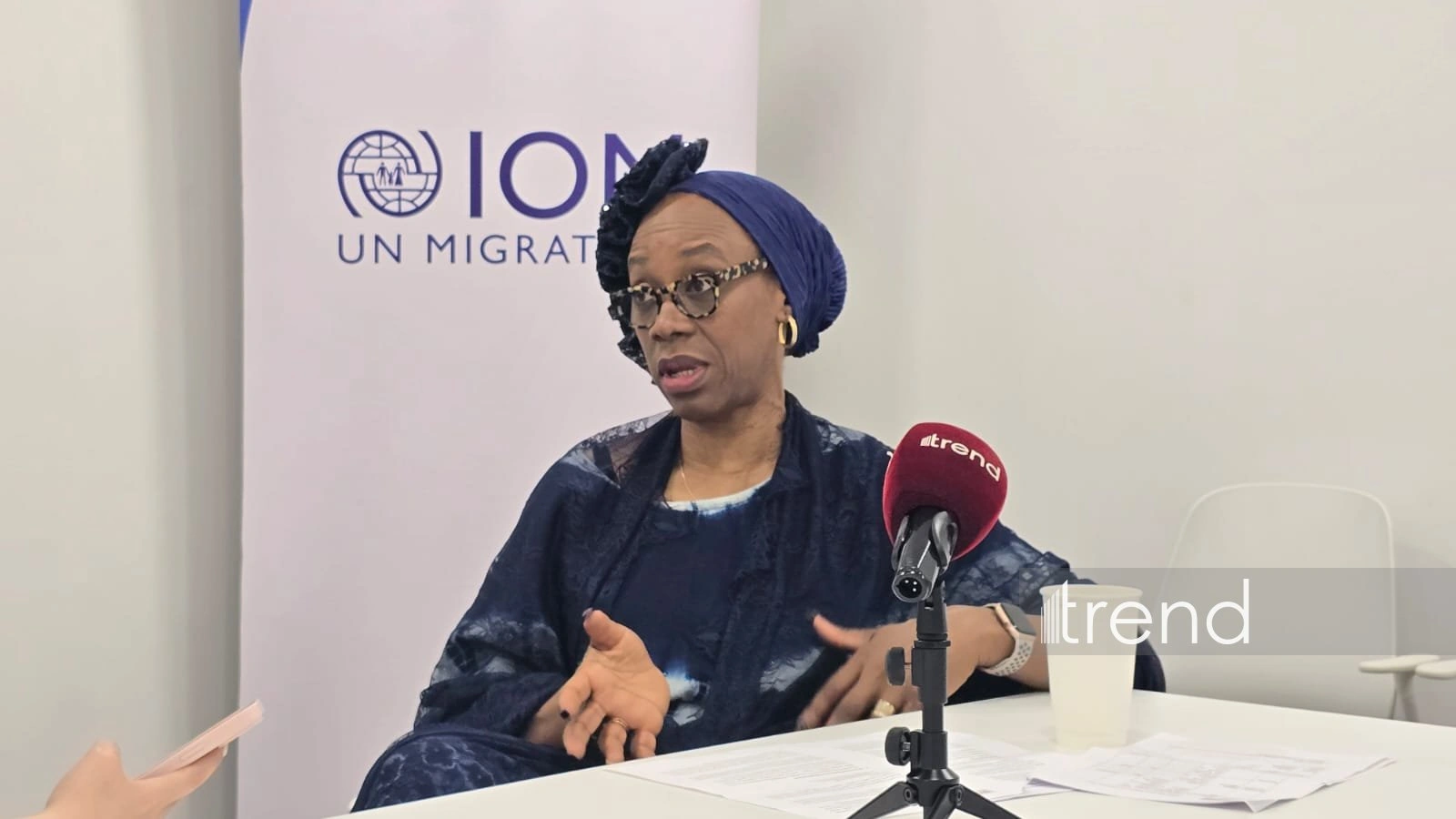
BAKU, Azerbaijan, May 21. The International
Organization for Migration (IOM) is working with Azerbaijan on
linking housing with livelihoods, Deputy Director-General of the
IOM Ugochi Daniels said in an exclusive interview with Trend on the sidelines
of the 13th session of the World Urban Forum (WUF13) in Baku.
“We help cities and governments with long-term solutions to
displacement. Our work supports dealing with the immediate issue of
the displacement, but how do you go from being displaced to having
a long-term solution. What does that look like? We know that it has
to do with housing and with livelihoods. These two things are
particularly important for IDPs, for migrants, to have long-term
solutions, so that the cities as well as the migrants and IDPs
themselves, can deal with the impacts of climate.
Here in Azerbaijan, we're doing a lot of work in cooperation
with the government around housing and the services needed for
housing and linking housing with livelihoods and planning for the
impact of climate. We have a big project that IOM and UN Habitat
are doing here with the government on adaptation. Azerbaijan is a
country that is dealing with the impacts of climate and needs to be
able to adapt. In partnership with UN Habitat, we're supporting the
government with that,” she said.
Daniels recalled that the recent report from the Internal
Displacement Monitoring Center (IDMC) showed that last year, there
were a total of over 82 million people globally who were displaced
due to conflict or climate.
“We know that many of them are displaced to cities. It means
that displacement is fundamentally becoming an urban issue. The
link between migration and urban development is very important for
us as IOM. We work with governments, our partners, distributing
agencies, local authorities, so that when they're planning cities,
they also include migration in their urban planning. It's very
important to not think of migration separate from urbanization. If
cities plan for this, they can get the benefits of having migrants
in their communities, because migrants bring innovation,
creativity, they set up the businesses, they can contribute if
they're a part of the process.
For IOM, and given the global environment, being at WUF13 was
very important, not only in terms of delivering the message, but
also in terms of sharing examples about how different cities in
different countries are doing this,” she added.
In the mean time, today marks the fifth day of WUF13 in
Baku.
The first day included a ministerial meeting dedicated to the
New Urban Agenda, a ministerial roundtable, assemblies for women
and civil society, business sessions, and discussions on urban
prosperity. An official ceremony marking the raising of the UN and
Azerbaijani flags also took place.
The second day stood out for the inaugural Leaders' Summit,
featuring high-level discussions on the global housing crisis,
urbanization policy, and urban resilience. Concurrently, the
opening of the Mexico City pavilion took place, serving as a
significant platform for expanding cooperation with the Latin
American region and preparing for WUF14.
The third day of WUF13 featured a comprehensive program of
events covering the global housing crisis, the formation of safe
and inclusive cities, climate resilience, artificial intelligence
and urban governance, green urbanization, social equity, and
sustainable transport.
One of the highlights of the third day was the signing of a
sister-city memorandum between the Azerbaijani city of Shusha and
the Turkish city of Trabzon.
The fourth day of WUF13 featured a broad program of events
dedicated to urbanization, climate change, inclusive urban
development, housing policy, and sustainable governance.
One of the important events of the UN Special Programme for the
Economies of Central Asia (SPECA) Cities Forum, held on the fourth
day, was the announcement of Almaty’s official accession to the
“Declaration of Intent on the Establishment of the SPECA Smart
Climate-Resilient Cities Forum.”
Also, for the first time in WUF history and at Azerbaijan’s
initiative, the “WUF13 NGO Forum: Global Partnership and
Decision-Making” was held.
WUF13, which has attracted more than 40,000 registered
participants from 182 countries, will continue until May 22. Held
under the theme “Housing the world: Safe and resilient cities and
communities,” the forum brings together governments, international
organizations, experts, and representatives of civil society to
strengthen global cooperation in the field of sustainable urban
development.