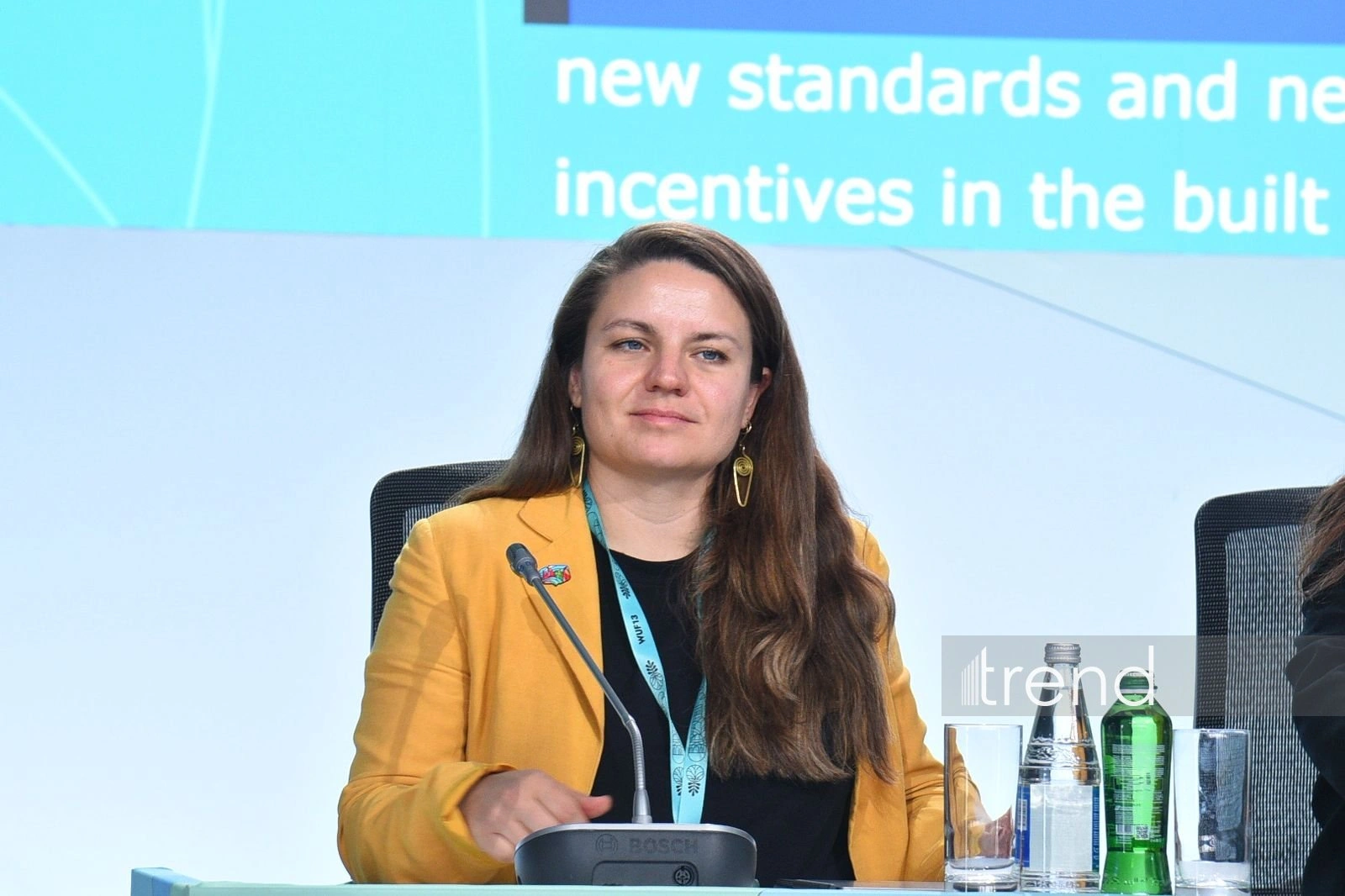
BAKU, Azerbaijan, May 20. Housing lies at the
intersection of climate ambitions and everyday reality, Lea
Ranalder, the Programme Management Officer for Multilevel Climate
Action at UN-Habitat, said, Trend reports.
She made the remark during a session, “Decarbonizing housing and
buildings at the City-Industry-Climate Nexus” as part of WUF13.
"We talk a lot about housing as the center of all processes and
as a key factor in solving many of the problems cities face. But I
would like to emphasize that housing lies at the intersection of
climate ambitions and everyday reality. And if we consider the
housing crisis and the climate crisis together, it is truly a
‘perfect match’ from which everyone can benefit,” she said.
Ranalder noted that housing is the place where climate risks are
felt most acutely, but also the space where solutions can be
implemented on the largest scale.
“We have already discussed the need to consider both existing
and new buildings, but I would also like to highlight those
buildings that still do not meet basic standards. Today, more than
one billion people live in informal settlements, and even more in
substandard housing. That is why it is important to take this
aspect into account when discussing the link between housing and
climate in cities, and to think about how our actions can truly
serve the communities that need it most," she said.
Today, the fourth day of the WUF13 conference is taking place in
Baku.
The first day included a ministerial meeting dedicated to the
New Urban Agenda, a ministerial roundtable, assemblies for women
and civil society, business sessions, and discussions on urban
prosperity. An official ceremony marking the raising of the UN and
Azerbaijani flags also took place.
The second day stood out for the inaugural Leaders' Summit,
featuring high-level discussions on the global housing crisis,
urbanization policy, and urban resilience. Concurrently, the
opening of the Mexico City pavilion took place, serving as a
significant platform for expanding cooperation with the Latin
American region and preparing for WUF14.
The third day of WUF13 featured a comprehensive program of
events covering the global housing crisis, the formation of safe
and inclusive cities, climate resilience, artificial intelligence
and urban governance, green urbanization, social equity, and
sustainable transport.
WUF13, which has attracted more than 40,000 registered
participants from 182 countries, will continue until May 22. Held
under the theme “Housing the world: Safe and resilient cities and
communities,” the forum brings together governments, international
organizations, experts, and representatives of civil society to
strengthen global cooperation in the field of sustainable urban
development.