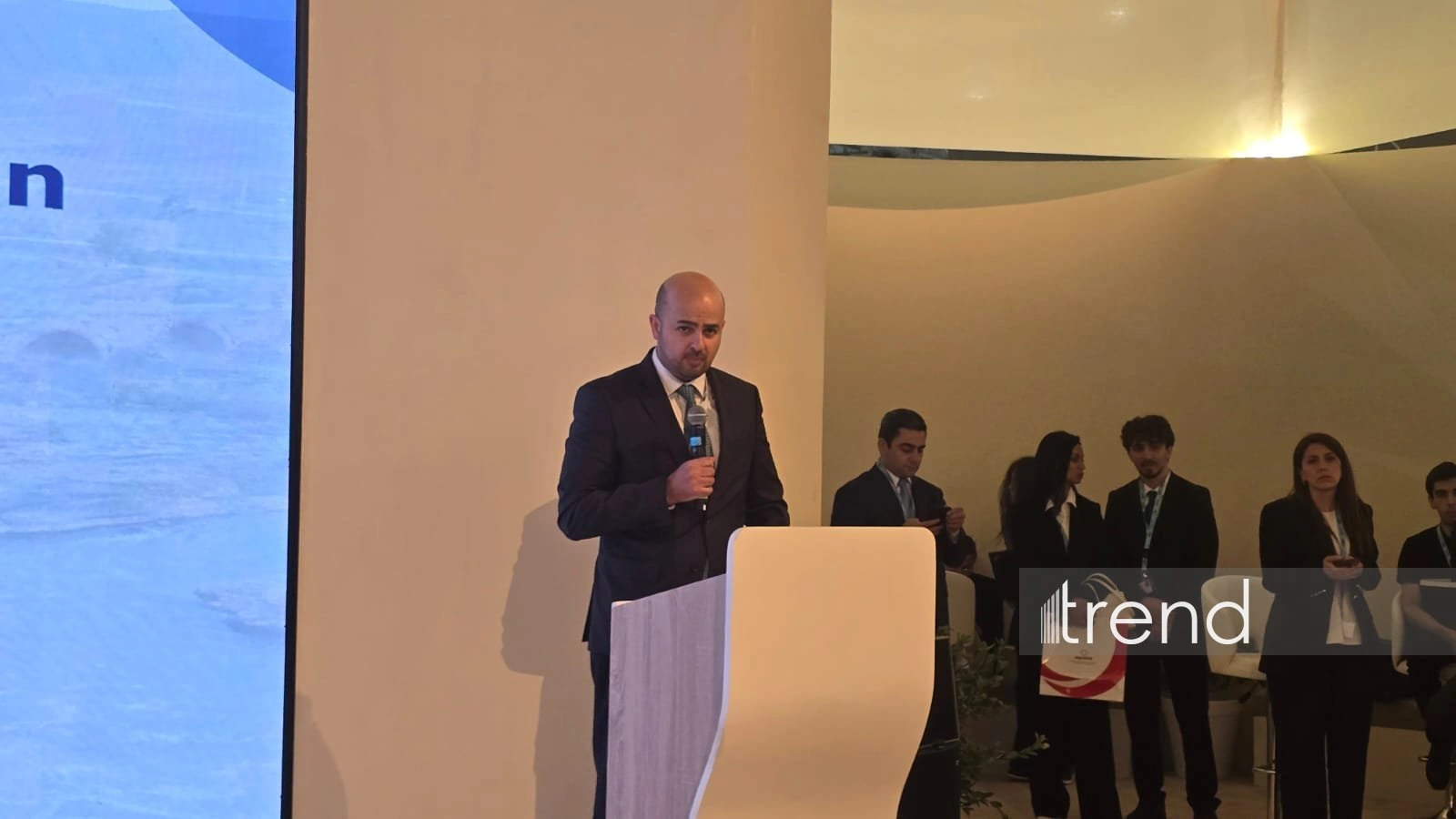
BAKU, Azerbaijan, May 20. "Smart villages" are
being built in the liberated territories of Azerbaijan based on the
principles of sustainable settlement, Special Representative of the
President in Jabrayil, Gubadli, and Zangilan districts, Vahid
Hajiyev, said at an event entitled "Delivering Smart and
Sustainable Urban Projects in Azerbaijan within the framework of
the 13th session of the World Forum of Cities (WUF13) in Baku,
Trend reports.
He noted that under the leadership of President Ilham Aliyev,
Azerbaijan continues to work towards sustainable development and
sustainable reconstruction.
Hajiyev pointed out that immediately after the liberation of the
territories from occupation in 2020, large-scale restoration and
reconstruction work began in Karabakh and East Zangezur.
"One of the first initiatives implemented was the Great Return
Program covering 2022-2026. This program combines numerous measures
and goals to ensure the sustainable return of former internally
displaced persons," he said.
According to him, the main priorities within the program are the
construction of residential houses, development of territories,
construction of roads and railways, as well as other necessary
infrastructure, as well as the creation of investment opportunities
in the region.
"Our goal is not only to reconstruct houses, but also to create
safe, sustainable, and livable communities where former internally
displaced persons can return with dignity and long-term
confidence," Hajiyev emphasized.
He noted that projects such as Aghali, Mammadbayli, and Horovlu
villages have already been implemented.
"These villages were completely destroyed during the occupation.
Currently, smart cities and smart villages with new designs are
being built in accordance with the UN Sustainable Development
Goals," he said.
Hajiyev added that the villages were designed based on
energy-efficient technologies, sustainable materials, smart
infrastructure, and digital solutions.
"From housing to public services, from infrastructure to green
zones, all elements serve one purpose - to create comfortable,
environmentally sustainable and economically efficient communities
for the future," he noted.
According to him, the modern urban planning approach is designed
to meet the daily needs of residents in a safe, practical, and
effective way.
Hajiyev said that the Horadiz-Aghband automobile and railway
projects play an important role in strengthening the region's
transport links.
"These roads connect us directly to Aghbend and Nakhchivan," he
stressed.
He noted that educational and healthcare institutions, public
service facilities, hotels, and other social infrastructure have
been created within the framework of the projects.
"There is a lake in the region where river waters are diverted
and a hydropower system built on the basis of these water
resources. This system is currently sufficient to meet the energy
needs of two villages, where about 500 families live," Hajiyev
said.
He added that construction work is continuing in Horovlu village
with the application of similar smart solutions.
Hajiyev emphasized that the main goal is not only to build
settlements, but also to ensure their effective management.
"For this purpose, a smart management system based on the GIS
platform is being implemented. The system integrates the master
plans of villages and cities on a single platform," he
explained.
According to him, all land plots, buildings, roads, utility
networks, energy, gas, water, and communication lines are reflected
in that management system.
"The platform allows for real-time monitoring of construction
and infrastructure processes, faster decision-making, and more
efficient management of future development," Hajiyev concluded.
Today marks the fourth day of WUF13 in Baku.
The first day included a ministerial meeting dedicated to the
New Urban Agenda, a ministerial roundtable, assemblies for women
and civil society, business sessions, and discussions on urban
prosperity. An official ceremony marking the raising of the UN and
Azerbaijani flags also took place.
The second day stood out for the inaugural Leaders' Summit,
featuring high-level discussions on the global housing crisis,
urbanization policy, and urban resilience. Concurrently, the
opening of the Mexico City pavilion took place, serving as a
significant platform for expanding cooperation with the Latin
American region and preparing for WUF14.
The third day of WUF13 featured a comprehensive program of
events covering the global housing crisis, the formation of safe
and inclusive cities, climate resilience, artificial intelligence
and urban governance, green urbanization, social equity, and
sustainable transport.
WUF13, which has attracted more than 40,000 registered
participants from 182 countries, will continue until May 22. Held
under the theme “Housing the world: Safe and resilient cities and
communities,” the forum brings together governments, international
organizations, experts, and representatives of civil society to
strengthen global cooperation in the field of sustainable urban
development.