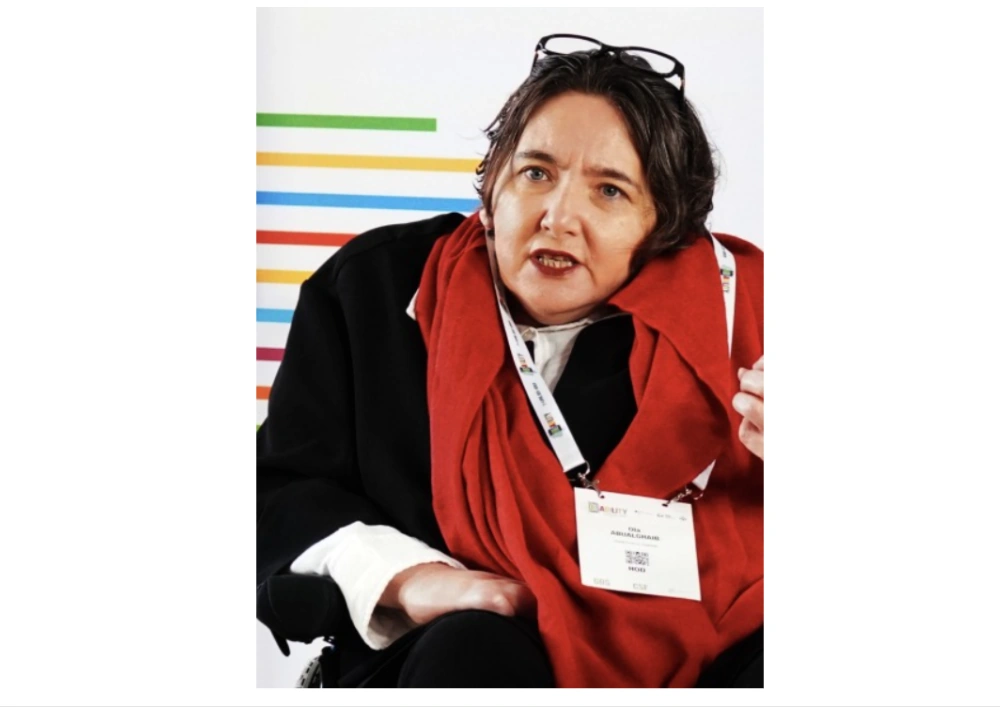
BAKU, Azerbaijan, May 20. Azerbaijan’s role as
a host of the 13th session of the World Urban Forum (WUF13) creates
an opportunity to demonstrate leadership on inclusive urban
development, Director of the Global Disability Fund Secretariat at
the United Nations Development Programme Ola Abualghaib said in an
exclusive interview with Trend on the sidelines of the forum.
"Azerbaijan’s role as host of WUF13 creates an important
opportunity to demonstrate leadership on inclusive and accessible
urban development. As the Forum brings global attention to safe and
resilient cities and communities, there is a strong opportunity to
position disability inclusion as central to that agenda, not
separate from it. Cooperation could focus on practical areas such
as accessible housing, inclusive public transport, universal design
in public spaces, disability-inclusive disaster preparedness,
accessible digital city services, and capacity building for urban
planners and municipal authorities. It could also include
structured engagement with organizations of persons with
disabilities to ensure that urban solutions reflect real
experiences and priorities," she said.
Abualghaib believes that there is also an opportunity to use
WUF13 as a platform for peer learning between cities.
"Azerbaijan and other countries can exchange lessons on what
works, identify scalable solutions, and build partnerships with
development actors, technical institutions and financing partners.
Most importantly, cooperation should aim to leave a legacy beyond
the Forum. That legacy could be a stronger commitment to accessible
urban planning, practical demonstration projects, improved
standards, and long-term collaboration to make cities safer, more
inclusive and more resilient for everyone," she added.
Abualghaib went on to add that at WUF13, her key message is that
disability inclusion must be treated as a core condition for safe,
resilient and sustainable cities, not as a separate social issue or
an optional add-on.
"The theme of WUF13, “Housing the World: Safe and Resilient
Cities and Communities,” is especially relevant because housing,
transport, public spaces, services, disaster preparedness and
climate resilience all directly affect the daily lives, safety and
dignity of persons with disabilities. From the experience of the
Global Disability Fund, one of the clearest lessons is that cities
become more resilient when they are designed with persons with
disabilities, not merely for them. This means involving
organizations of persons with disabilities in urban planning,
budgeting, implementation and monitoring from the beginning," she
said.
Abualghaib said that her priorities are to highlight three
messages: first, accessibility is an investment in better cities
for everyone; second, resilience cannot be achieved if persons with
disabilities are excluded from housing, infrastructure, early
warning systems and emergency response; and third, financing
mechanisms must move from commitments to practical delivery at city
level.
"Through the Resilient and Inclusive Cities Hub, the Global
Disability Fund is already working to support accessible, equitable
and future-ready cities. Cities need to move from policy statements
to implementation systems. In practical terms, this begins with
applying universal design standards across housing, transport,
schools, health facilities, public buildings, digital services and
public spaces. Accessibility should be built into procurement
rules, building codes, infrastructure contracts and urban
investment plans, rather than being corrected later at higher cost.
Second, cities should work directly with persons with disabilities
and their representative organizations. Their lived experience
helps identify barriers that technical teams may miss, such as
unsafe crossings, inaccessible shelters, lack of sign language
interpretation, poor wayfinding, inaccessible public information,
or evacuation plans that do not account for people with different
support needs.
Third, accessibility must be linked to resilience. This includes
inclusive early warning systems, accessible shelters,
disability-inclusive disaster risk reduction, climate adaptation
planning, and services that remain reachable during crises. The
Global Disability Fund’s work through the Resilient and Inclusive
Cities Hub is based on the idea that cities must be accessible,
equitable and prepared for future challenges. Finally, cities need
measurable targets. For example: the percentage of public buildings
audited for accessibility, the number of transport routes upgraded,
the share of emergency shelters that are accessible, and whether
persons with disabilities are represented in urban decision-making
bodies. What gets measured is more likely to be financed and
delivered," he said.
Abualghaib pointed out that the biggest gap is not only the lack
of funding, but the lack of disability inclusion within mainstream
financing.
"Too often, disability inclusion is funded through small,
short-term projects instead of being integrated into national
budgets, municipal investment plans, climate finance, housing
programmes, infrastructure loans and disaster risk reduction
financing. Another major gap is that accessibility is often
considered too late. When roads, housing, transport systems or
public buildings are designed without accessibility from the start,
retrofitting becomes more expensive and less effective. This is why
the Global Disability Fund emphasizes early integration of
inclusion into planning, design and financing. There is also a
capacity gap. Many governments and cities are committed to
inclusion but need practical tools, technical assistance, data,
standards and partnerships to translate commitments into
implementation. This includes better disability-disaggregated data,
stronger accountability mechanisms, and more direct engagement with
organizations of persons with disabilities.
Finally, there is a scale gap. Good pilots exist, but they often
remain isolated. The challenge now is to move from individual
projects to system-wide change. This is why initiatives such as the
Resilient and Inclusive Cities Hub are important: the Hub aims to
invest USD 250 million in 50 cities by 2030 to advance resilient
and inclusive urban development," she explained.
She noted that the Global Disability Fund supports countries by
helping them translate disability rights commitments into practical
development action.
"This includes technical assistance, policy advice, catalytic
financing, partnership building and support for implementation at
both national and local levels. In the urban context, the Fund
works to ensure that disability inclusion is integrated into areas
such as housing, infrastructure, public services, disaster risk
reduction, climate resilience and urban governance. Through the
Resilient and Inclusive Cities Hub, the Fund promotes stakeholder
engagement, collaborative learning and solutions delivery to
support inclusive and resilient urban development. A key part of
this work is connecting governments, cities, organizations of
persons with disabilities, development partners, technical experts
and financiers. The Fund helps create the conditions for disability
inclusion to be embedded in planning systems, budgets, monitoring
frameworks and investment decisions. The Fund also supports
countries to move beyond compliance and toward transformation. This
means not only asking whether persons with disabilities are
mentioned in a strategy, but whether they can access housing, move
safely through the city, participate in decisions, receive
information during emergencies, and benefit equally from public
investment," Abualghaib added.