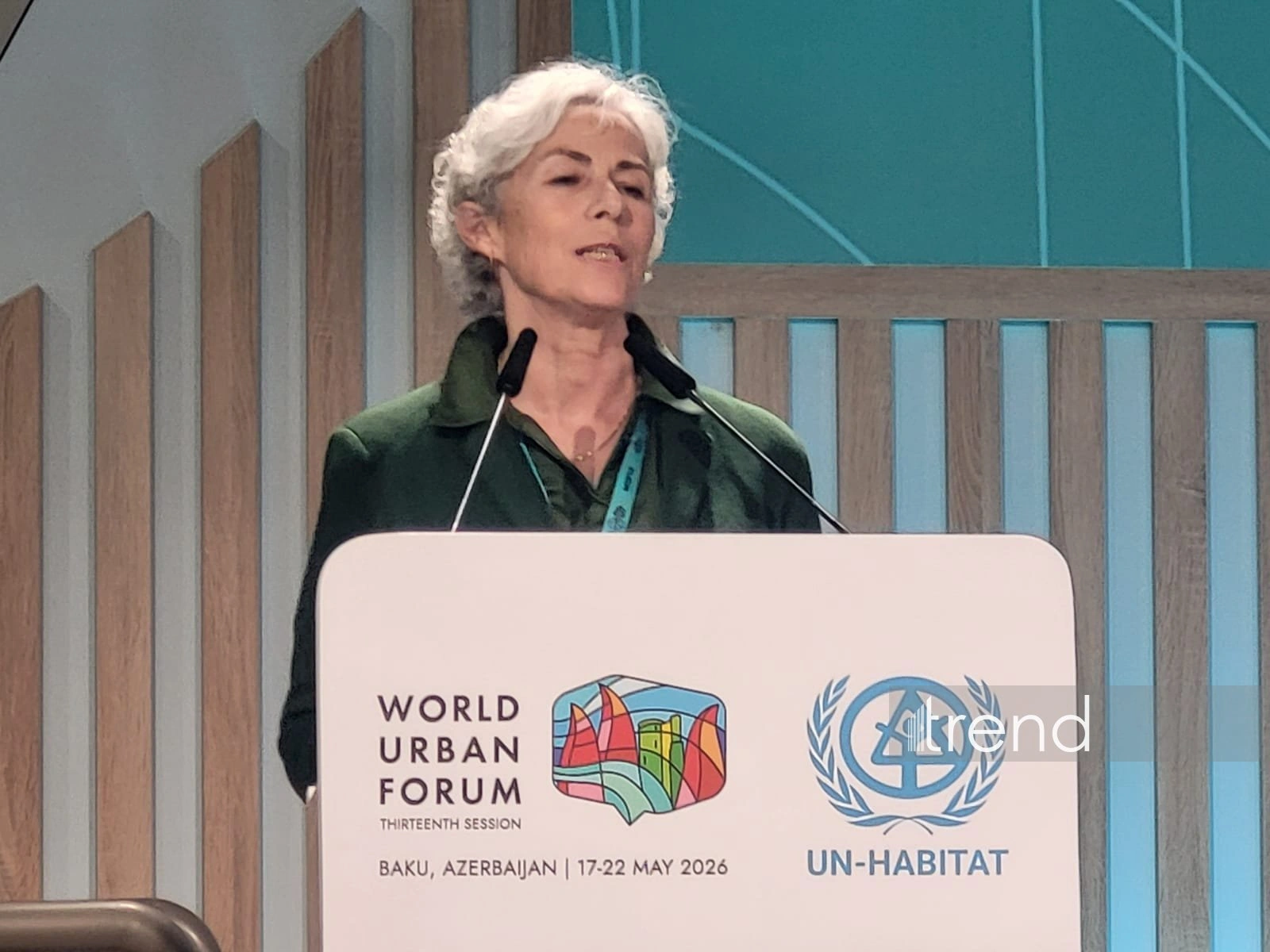
BAKU, Azerbaijan, May 19. Housing policy must
be formulated by taking into account the actual role of
metropolitan areas, as modern housing systems, transport, and
infrastructure function far beyond the administrative boundaries of
individual municipalities, said Fiona McCluney, Head of the Policy
and Legislation Section of the Global Solutions Division at
UN-Habitat, Trend
reports.
She made the remark during a panel discussion titled "Launching
the Barcelona Metropolitan Declaration: Bold Commitments to
Addressing the Housing Crisis at a Metropolitan Scale" held within
the framework of the 13th session of the World Urban Forum (WUF13)
in Baku.
"People live, work, and move across municipal borders daily,
while housing markets, transport systems, infrastructure networks,
and land issues are not confined to administrative frameworks," she
said.
According to McCluney, existing governance mechanisms,
financing, and institutional mandates remain fragmented and do not
correspond to the scale of contemporary urban challenges.
"Metropolitan governance is important because it allows for
bridging the gap between housing supply and demand, as well as
reducing unequal access to services and infrastructure," she
noted.
She emphasized that a lack of coordination at the metropolitan
level contributes to urban sprawl, rising housing prices, and
increased spatial inequality.
"Addressing these issues at the metropolitan level is not
additional bureaucracy, but a mechanism for better coordination,
integration, and long-term territorial planning," McCluney
stated.
According to her, metropolitan areas must participate not only
in the implementation of housing policy but also in its
formulation, including matters of planning, land management,
financing, and project implementation mechanisms.
McCluney also informed that within the framework of the Metro
Hub Global Programme, UN-Habitat supports the development of
metropolitan governance, strategic planning, legislation, and
financing mechanisms across Africa, Latin America, Asia, and
Europe.
"Integrated approaches that unite housing policy with land
management, mobility, infrastructure, climate resilience, and
service delivery are becoming increasingly important," she
added.
She noted that the Barcelona Metropolitan Declaration is a
timely initiative because it shifts the discussion on the housing
crisis from diagnosing problems to the practical implementation of
solutions.
Meanwhile, the third day of the 13th session of the World Urban
Forum (WUF13) is underway in Baku.
On the first day, a ministerial meeting dedicated to the New
Urban Agenda, a roundtable of ministers, assemblies of women and
civil society, business sessions, and discussions on urban
well-being were held. A ceremony for raising the flags of the
United Nations and Azerbaijan also took place within the framework
of the forum.
The second day of the forum drew attention with the first-ever
Leaders Summit. High-level discussions on the global housing
crisis, urbanization policy, and urban resilience were held that
day. At the same time, the Mexico City pavilion was inaugurated
within the framework of WUF13. The pavilion was presented as an
important platform for expanding cooperation with the Latin
American region and preparing for WUF14.
WUF13, which has attracted more than 40,000 registered
participants from 182 countries, will continue until May 22. Held
under the theme “Housing the world: Safe and resilient cities and
communities,” the forum brings together governments, international
organizations, experts, and representatives of civil society to
strengthen global cooperation in the field of sustainable urban
development.