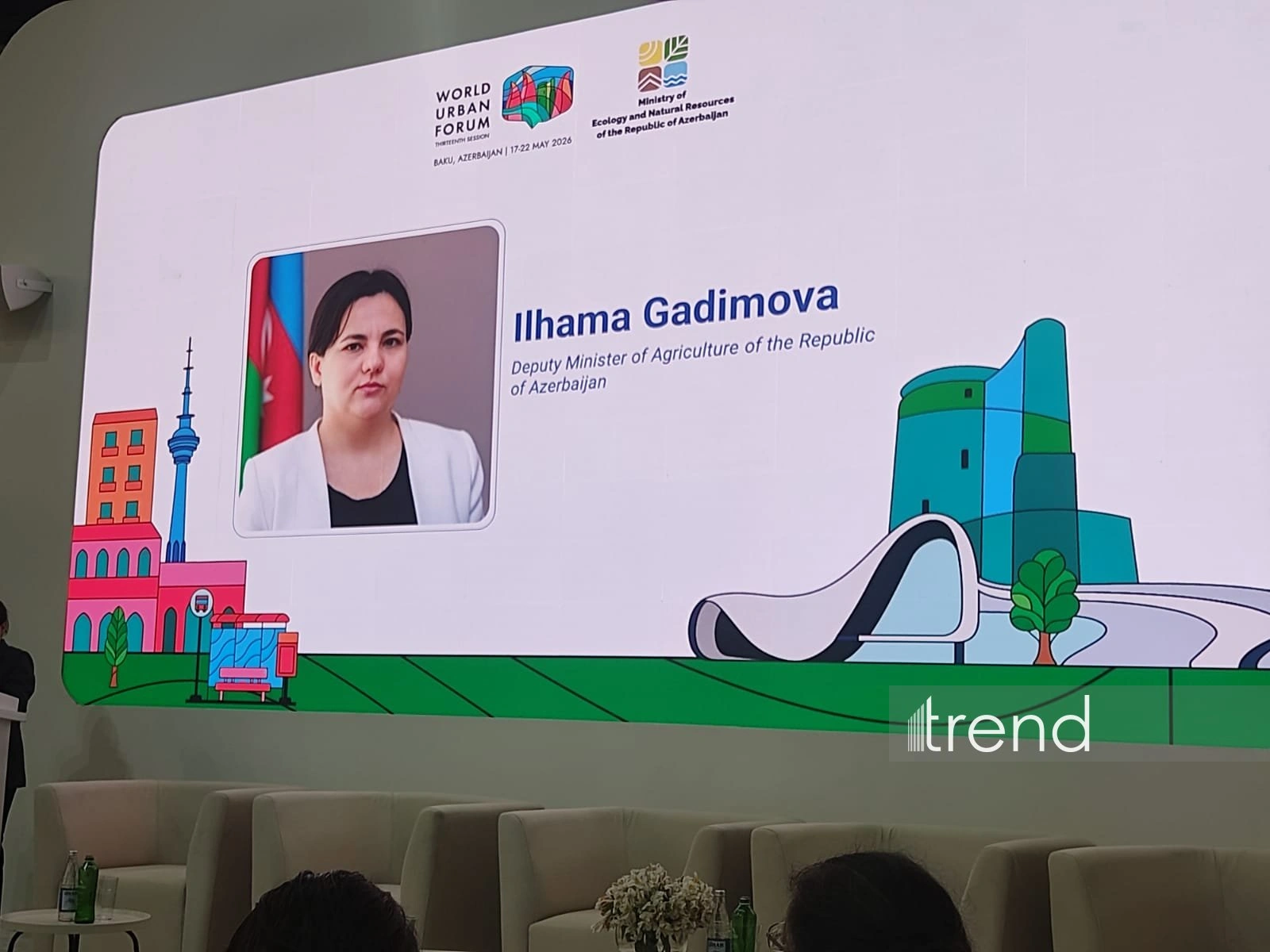
BAKU, Azerbaijan, May 19. Climate change has
evolved beyond an environmental issue into a fundamental factor
shaping global economic development, food security, urbanization
policy, water management and the future of agriculture, Ilhama
Gadimova, Azerbaijan’s deputy agriculture minister, said during a
panel discussion at the World Urban Forum (WUF13) in Baku, Trend reports.
Speaking at an event titled “Early Warning Systems and
Climate-Resilient Cities,” Gadimova said rising global
temperatures, drought conditions, declining freshwater resources
and other extreme hydrometeorological events are creating new risks
for Azerbaijan.
“The agricultural sector is the most vulnerable to these
threats,” she said. “Since agriculture is directly dependent on
climate conditions and plays a strategic role in ensuring
macroeconomic stability and food security, increasing resilience in
this area is a priority.”
According to Gadimova, establishing early warning systems has
become critically important for Azerbaijan.
“Early warning mechanisms are not simply tools for informing
about threats,” she said. “They are essential for forecasting
risks, making effective management decisions, protecting natural
resources and ensuring overall productivity.”
Gadimova highlighted the integration of accurate
agrometeorological forecasts into Azerbaijan’s Electronic
Agriculture Information System (EKTIS) as a major strategic
step.
She said the system enables farmers to receive operational data
that helps them scientifically plan planting, irrigation and
harvesting processes, while also taking preventive measures against
frost, drought, hail and other climate-related risks.
As a result, she said, crop losses are minimized, financial
sustainability in agriculture is strengthened and the country’s
food supply stability is reinforced.
Gadimova also emphasized the growing role of artificial
intelligence in agricultural resource management.
“Our strategy’s next key direction is the application of
AI-based systems for the efficient management of agricultural
resources,” she said.
According to Gadimova, Azerbaijan’s “Agricultural Artificial
Intelligence” project for 2024–2026 continues to introduce modern
technological solutions across the sector.
She said data from more than 180 climate stations, satellite
imagery and soil analyses have already been integrated into a
unified system, allowing the analysis of information covering more
than 315,000 farmers and over 636,000 hectares of land.
Under the project, 14 of 33 AI-based models focused on crop
productivity forecasting, plant health and irrigation management
have already entered the integration phase, while the remaining
models are expected to be completed by the end of the year.
Gadimova said farmers in four regions are already receiving pest
and disease warning notifications for four fruit varieties up to
three days in advance.
“This directly supports reducing crop losses, saving resources
and improving subsidy policy,” she added.
She also noted that integration of the system into the e-Agro,
EKTIS and Yonca platforms is nearing completion.
WUF13 is being held in Baku from May 17 to 22 under cooperation
between the United Nations Human Settlements Programme (UN-Habitat)
and the Azerbaijani government.
Held under the theme “Housing for All: Safe and Sustainable
Cities and Human Settlements,” the forum brings together
governments, experts, communities and international partners to
discuss sustainable urban development and housing challenges.