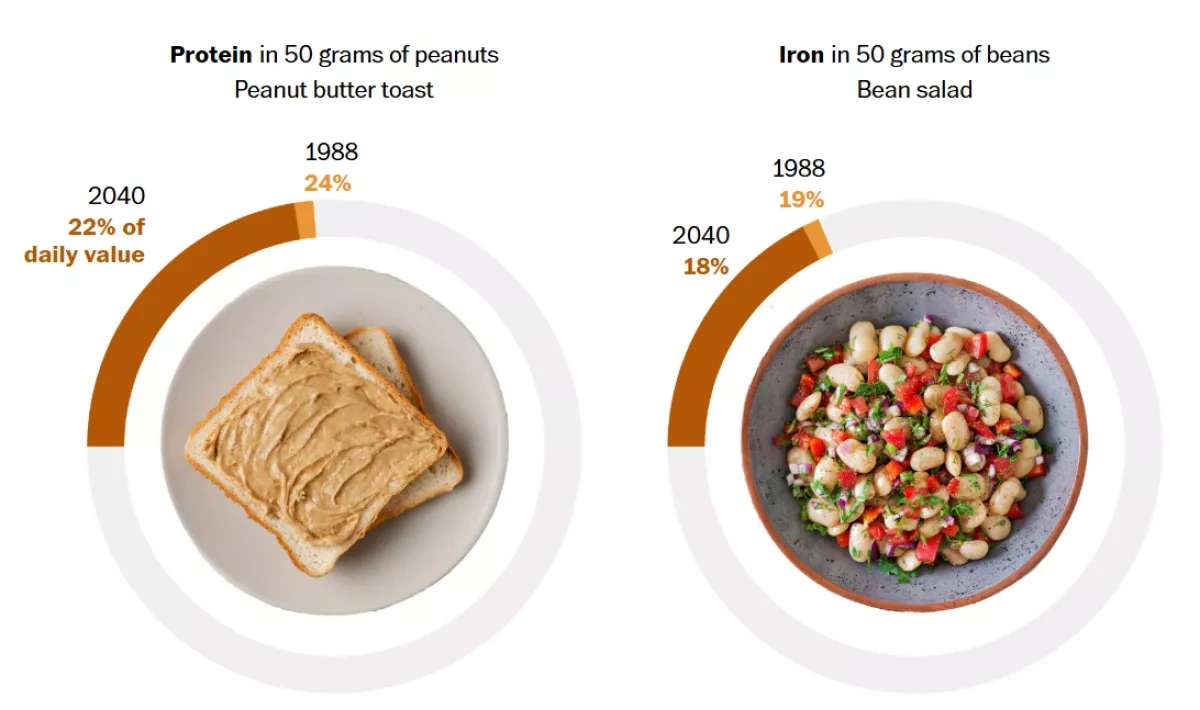
Many of humanity’s most important crops — including wheat, potato, and bean — now contain fewer vitamins and minerals than they did a generation ago. Scientists say the surprising driver behind this decline is rising carbon dioxide pollution.
Soaring concentrations of carbon dioxide in the atmosphere — largely caused by the burning of fossil fuels — are significantly altering the way plants grow, increasing sugar content while depleting essential nutrients such as zinc and iron, according to an article by The Washington Post
Researchers warn that the deterioration of the global food supply could contribute to an epidemic of “hidden hunger,” in which people consume enough calories but still fail to get the nutrients needed to remain healthy.
“The diets we eat today have less nutritional density than what our grandparents ate, even if we eat exactly the same thing,” said Kristie Ebi, a professor at the University of Washington’s Center for Health and the Global Environment.
Experts say wealthier countries with stronger healthcare systems may be better equipped to adapt to the changes. But for poorer and more vulnerable populations, the consequences could be severe.
One study cited in the article estimated that by mid-century, declining nutrient levels could leave more than a billion additional women and children at risk of iron-deficiency anaemia — a condition linked to pregnancy complications, developmental disorders and even death. At the same time, around 2 billion people already suffering from nutrient deficiencies could see their health problems worsen further.
Closer inspection reveals alarming findings
Although plants rely on carbon dioxide for photosynthesis, scientists stress that more carbon in the atmosphere does not necessarily make them healthier.
A major review examining 32 compounds across 43 crops found that rising CO2 levels negatively affected nearly every plant humans consume.
“As a scientist, it’s really interesting,” said Sterre F. ter Haar, lead author of the November study and an environmental scientist at Leiden University in the Netherlands. “As a person … you don’t want to see such a shift, because it’s so negative.”
Over several years, ter Haar and her colleagues compiled a vast database of research on how increasing carbon dioxide levels affect nutrients in crops. The team analysed hundreds of studies ranging from laboratory experiments to large-scale real-world agricultural data.
Using that dataset, researchers calculated how the nutritional density of crops changes under varying CO2 levels and projected how those trends may continue in the future.
On average, they found that nutrient levels across all plants have already declined by about 3.2% since the late 1980s, when atmospheric carbon dioxide concentrations were around 350 parts per million.
While that reduction may appear relatively small, ter Haar noted that even modest nutritional losses could push millions more people into health crises because so many populations already live close to nutrient insufficiency.
Burning of fossil fuels accelerates depletion
Scientists are still investigating the precise mechanisms behind the shift. One leading explanation is that excess carbon dioxide allows plants to produce more carbohydrates — including cellulose in leaves and stems and starches found in grains.
Supporters of continued fossil fuel use often cite this effect by arguing that carbon dioxide acts as “plant food,” ter Haar noted. However, increased growth does not come with a matching rise in mineral absorption, meaning plants fail to produce sufficient proteins, acids and other nutrients.
The result, researchers say, is that crops may grow larger and faster while becoming less nutritious, containing more sugars and fewer essential minerals.
Climate change may also interfere with how nutrients move through soil. Studies suggest warmer conditions can stimulate microbes that consume available nitrogen, depriving plants of a key building block for proteins. Rising temperatures may additionally increase the solubility of arsenic in water, causing crops such as rice to absorb higher levels of the toxic heavy metal.
By Nazrin Sadigova