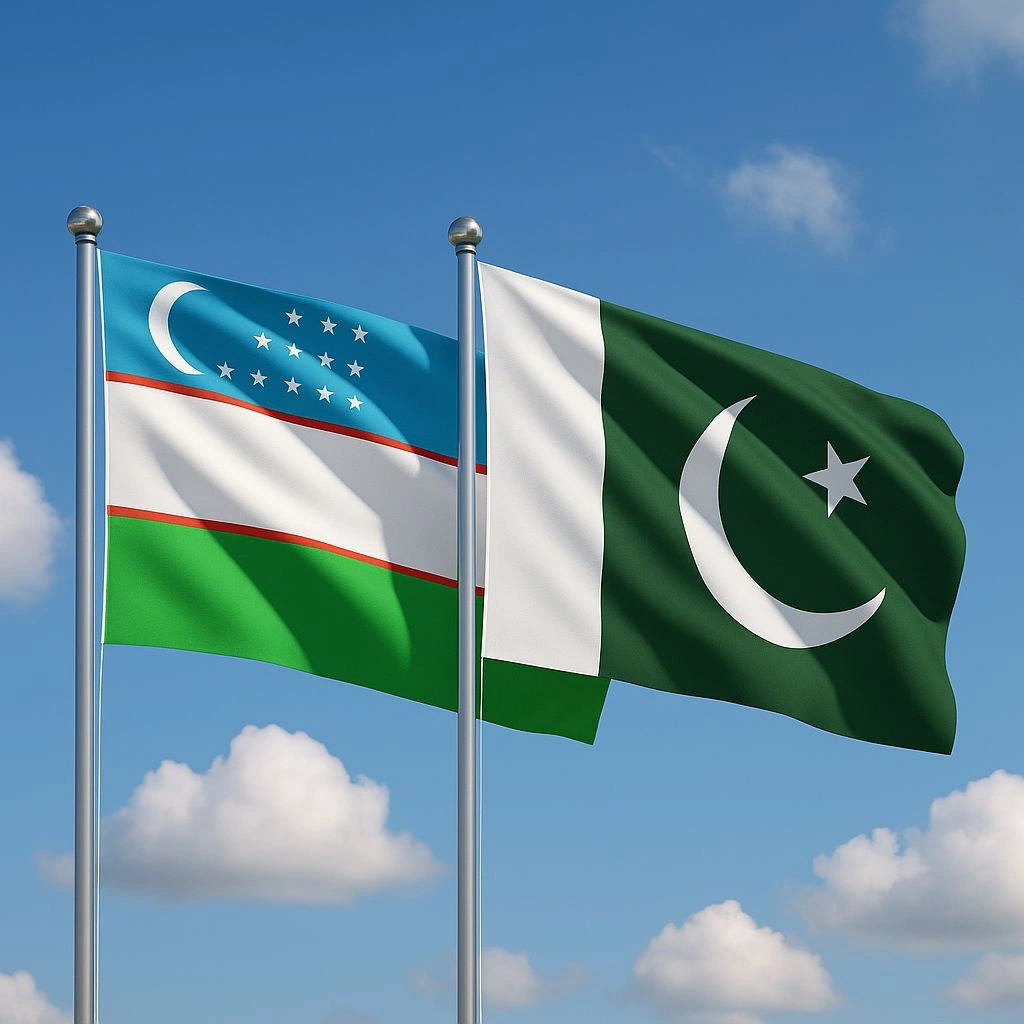
BAKU, Azerbaijan, January 27. In February 2026,
President of Uzbekistan Shavkat Mirziyoyev will pay a visit to
Pakistan, and the Uzbek-Pakistani Business Forum will take place in
Islamabad on February 5–6. These events signal a fresh chapter in
the partnership between the two countries.
The intensification of interaction is driven by two key factors.
On the one hand, there is significant yet still underutilized
potential for trade and economic growth. On the other hand,
progress is being made on a major transport project capable of
giving bilateral relations additional momentum and creating a
sustainable foundation for expanded cooperation.
For Uzbekistan, a landlocked country, access to external markets
directly depends on the efficiency of transport corridors. High
tariffs, lengthy delivery times, and dependence on transit routes
remain key constraints on exports and investment activity. Under
these conditions, the development of shorter and more
cost-effective routes is of strategic importance.
In this scenario, the goals of Uzbekistan and Pakistan are
largely on the same page. Pakistan has access to the Arabian Sea
and a developed port infrastructure, making it one of the most
promising routes for Uzbek goods to reach global markets. For
Pakistan, expanding ties with Uzbekistan means increased transit
flows, greater port utilization, and a strengthened role as a
regional logistics hub between Central and South Asia.
The key project within this framework is the Trans-Afghan
railway. It is intended to connect Uzbekistan with Pakistani ports
through Afghanistan and establish a direct overland corridor
between Central and South Asia.
On July 17, 2025, Uzbekistan, Pakistan, and Afghanistan signed a
framework agreement to develop a feasibility study for the project.
The railway, approximately 647 kilometers long, is planned to run
along the Termez–Naibabad–Maidanshahr–Logar–Kharlachi route and
connect with Pakistan’s railway network leading to the ports of
Karachi and other maritime terminals. The preliminary cost of the
project is estimated at $4.6 billion.
“The Trans-Afghan railway linking Uzbekistan, Afghanistan, and
Pakistan is of strategic importance for the entire Eurasian region.
This corridor will improve trade, support Afghanistan’s economic
recovery, and open new routes to global markets through southern
ports,” Uzbekistan’s Minister of Foreign Affairs Bakhtiyor Saidov
said following the signing of the agreement.
The implementation of the Trans-Afghan railway is set to cut
cargo delivery times from the current 35-40 days down to just 3-5
days, while also slashing transport costs significantly.
Uzbekistan’s Ministry of Transport forecasts that by 2035-2040,
freight volumes along the route could reach 15-20 million tons per
year. This would create favorable conditions for trade growth, the
development of logistics infrastructure, and increased investment
in related sectors.
At the same time, the project is associated with a number of
risks. The key factor remains the security situation in
Afghanistan, through which the main section of the route will pass.
Ensuring stability, infrastructure protection, and uninterrupted
transit will directly affect construction timelines and the future
operation of the railway.
Additional challenges relate to project financing and the
allocation of risks among participants. The overall cost of
construction requires the attraction of external capital, including
from international financial institutions, as well as political and
commercial risk insurance mechanisms. Experts also point to the
need to harmonize technical standards, tariff policies, and customs
procedures among the three countries, without which the benefits of
reduced delivery times could be partially offset.
Against the backdrop of the transport agenda, trade and economic
cooperation continue to develop. In recent years, bilateral trade
between Uzbekistan and Pakistan has shown steady growth. In 2024,
trade turnover reached approximately $407 million, increasing to
$445 million in 2025. Uzbekistan has become Pakistan’s largest
trading partner in Central Asia. At the same time, both sides are
on the same page, recognizing that the current numbers don't tell
the whole story of their economies' potential.
One of the key topics of the upcoming visit and business forum
will be increasing bilateral trade to $2 billion. To achieve this
goal, the parties plan to expand the list of goods eligible for
preferential customs treatment, as well as simplify and harmonize
customs and inspection procedures. These measures are expected to
reduce delivery times and business costs, particularly in
agriculture, textiles, and light industry.
Industrial cooperation also occupies an important place on the
bilateral agenda. Projects are being discussed in pharmaceuticals,
agriculture, mining, electrical engineering, textiles, and leather
production. For Uzbekistan, this represents a shift from simple
trade toward joint production and localization. For Pakistan, it
offers an opportunity to expand its presence in Central Asia and
use Uzbekistan as a production and export platform.
Special attention is being paid to the pharmaceutical sector.
Uzbekistan’s annual imports of pharmaceutical products exceed $3
billion, making localization a key priority. Pakistani companies
have expressed interest in establishing production facilities in
Uzbekistan, including within specialized pharmaceutical
clusters.
The mining sector also remains a promising area of cooperation.
A Pakistani delegation visited the Almalyk Mining and Metallurgical
Complex to assess opportunities for technological partnership in
copper mining. In addition, projects in agricultural machinery and
electrical equipment manufacturing are under discussion, targeting
both domestic markets and exports.
Expectations surrounding the upcoming visit of Uzbekistan’s
president and the business forum in Islamabad are primarily linked
to advancing the transport agenda and moving toward concrete
decisions. For markets, this will serve as an indication that
cooperation between Uzbekistan and Pakistan is entering a more
mature and practical phase.
Overall, bilateral relations are increasingly structured around
the nexus of transport, trade, and industrial cooperation. The
successful implementation of major infrastructure projects,
particularly the Trans-Afghan railway, could give this partnership
a long-term character and significantly strengthen the positions of
both Uzbekistan and Pakistan in the regional economy.
Stay up-to-date with more news on Trend News
Agency's WhatsApp channel