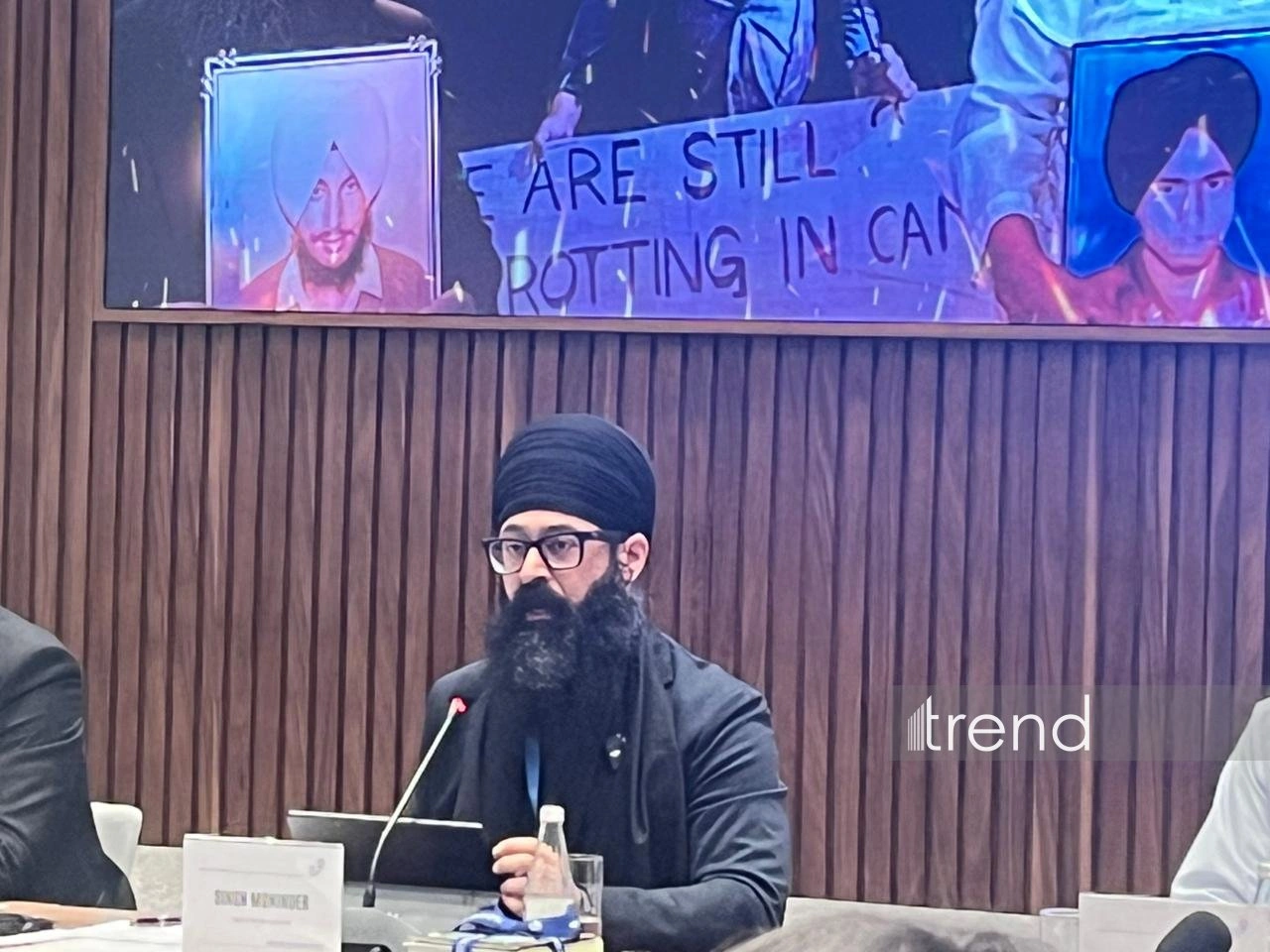
BAKU, Azerbaijan, January 16. India commits
brutal violence against men, women, and children of the Sikh faith,
Sikh Federation Chairman Bhai Moninder Singh said at an
international conference titled “Racism and Violence Against Sikhs
and Other National Minorities in India: Current Realities” in Baku
today, Trend
reports.
"It's also important to remember that India was created as a
British colonial project, but as we stand here in solidarity, we
cannot help but remember other peoples of diverse origins.
"From the Dalits, who have been subjected to caste-based
discrimination for thousands of years in India, to Muslims who have
faced communal violence for decades at the hands of right-wing
Hindutva groups, to the occupation of Kashmir, the world's most
militarized region, and Christians who are regularly targeted for
their religious beliefs across India – all of these are denied
under India's constitution, which claims to ensure equal
protection. While these rights might be guaranteed on paper, in
practice, these assurances are seriously lacking," he added.
Singh noted that Sikhs bear an especially heavy burden among
these communities:
"To understand the 1984 tragedy, we must look at its roots. The
violence against Sikhs stems from political opportunism, state
repression, and a denial of Sikh identity and aspirations. A look
at Article 25B of the Indian Constitution is enough to understand
this. In that article, Sikhs, Buddhists, and Jains are not
recognized as separate entities, but rather are presented as
branches of the Hindu religion. This amounts to a complete erasure
of identity under constitutional law. At the same time, the
implementation of Article 25B has been accompanied by extreme
violence against the Sikh people over the past few decades," he
explained.
He emphasized that, instead of prioritizing dialogue and a
constructive approach, the Indian state responds with
militarization, human rights violations, massacres, and brutal
violence against Sikh men, women, and children.
"During the 'Blue Star' operation in 1984, the Indian army's
attack on the Golden Temple, the holiest shrine of the Sikh
community, left deep psychological scars on the Sikh population.
This event sparked a greater demand for greater autonomy for Punjab
and led to the creation of the Khalistan movement for full freedom
and sovereignty.
The murder of Prime Minister Indira Gandhi on October 31, 1984,
became an excuse for the subsequent violence. In the following
days, Delhi and other cities were engulfed by genocide. Armed mobs,
provided with selective lists by politicians, attacked Sikh homes,
burned Sikh men alive, killed Sikh children, and raped Sikh women.
This was a large-scale attempt by the Indian state to complete the
genocide it had started," Singh also said.
The federation chairman pointed out that, even after more than
40 years since the events, those responsible for the violence have
remained unpunished. Many of them currently hold the highest
positions in the Indian government.
"The Indian state has not taken any responsibility for ensuring
justice for the victims of the 1984 genocide. The portrayal of
these events presented to the world does not reflect the truth.
Officially, these events are referred to as 'riots.' However, a
riot implies a confrontation between two equal sides. In this case,
a powerful state mobilized all its mechanisms: selective lists were
distributed to mobs, the police either stood by or participated in
the violence, and for days, no army, military, or security forces
intervened to restore peace. Conditions were deliberately created
to allow the violence to continue," he concluded.
Stay up-to-date with more news on Trend News
Agency's WhatsApp channel