World leaders will gather in New York next week for the 81st session of the United Nations General Assembly. While some have opted to send a delegation made up of senior-ranking officials and diplomats, as is the case with Azerbaijan this year, others will be represented by their heads of state.
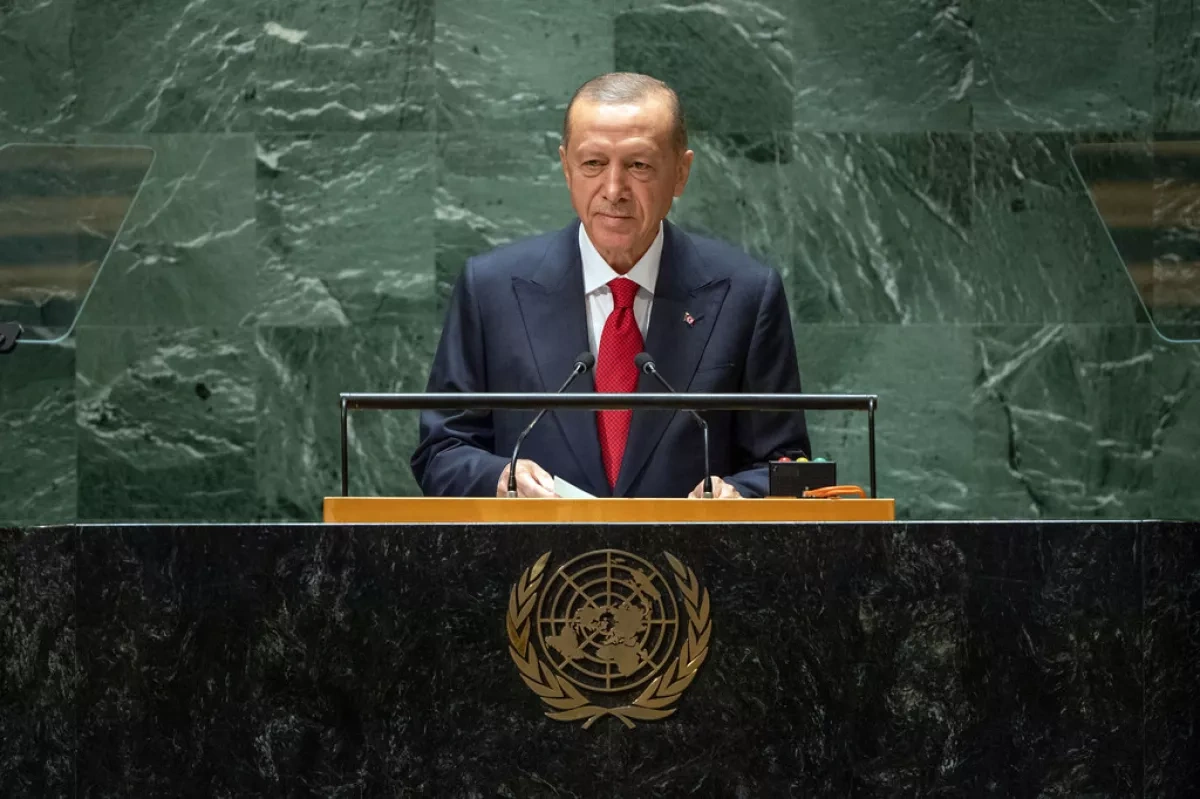
President Recep Tayyip Erdoğan is set to address the General Assembly for the 16th time in his long-running career, as Turkish media outlets note.
He is expected to outline Türkiye’s positions on global conflicts and regional crises on the first day of the six-day summit, while renewing his longstanding call for reform of the international system.
The 81st session’s General Debate will be held under the theme “Restoring trust, managing transformation: A United Nations that delivers for all.”
Erdoğan’s latest appearance will add to more than two decades of speeches at the UN, during which he has repeatedly called for changes to the international system while addressing issues including Palestine, Syria, terrorism, migration, the Russia-Ukraine war and Cyprus.
Loyal to principles
Erdoğan first addressed the General Assembly as prime minister in 2005, calling for a more democratic and transparent UN capable of better representing the will of its members.
“First and foremost, a renewed, more democratic and transparent United Nations that is capable of representing the common will of all its members ... is in the common interest of humanity,” Erdoğan said at the time, as recalled by the Daily Sabah.
He also called for stronger international cooperation against terrorism, describing terrorism anywhere in the world as a crime against humanity.
By 2009, UN reform, particularly reform of the Security Council, had become a central theme of Erdoğan’s addresses.
He argued that strengthening the organization’s representative capacity was essential for global peace and stability and said broader UN reform could not be complete without changes to the Security Council.
At the 2014 General Assembly, Erdoğan criticized the international system’s response to conflicts in Syria and Palestine and argued that decisions affecting the international community should not depend on the positions of five countries.
“The world is bigger than five,” Erdoğan reiterated, arguing that the permanent members’ ability to block action was incompatible with what he described as the demands of the global conscience.
The slogan has since remained a recurring element of Türkiye’s calls for UN reform and a more representative international decision-making system.
Erdoğan has also repeatedly used the General Assembly podium to address regional conflicts.
In 2011, he discussed developments in Syria, Libya, Somalia and Palestine and called for an end to the illegal military occupation of Azerbaijani lands in Karabakh, arguing that unresolved international conflicts should be addressed before becoming entrenched.
Migration became another major theme in his later appearances. In 2019, Erdoğan held up a photograph of Alan Kurdi, the Syrian toddler whose body was found on a Turkish beach in 2015 after his family attempted to reach Europe.
Ankara’s peace mediation
The issue of Palestine has remained one of the most prominent issues in Erdoğan’s UN appearances.
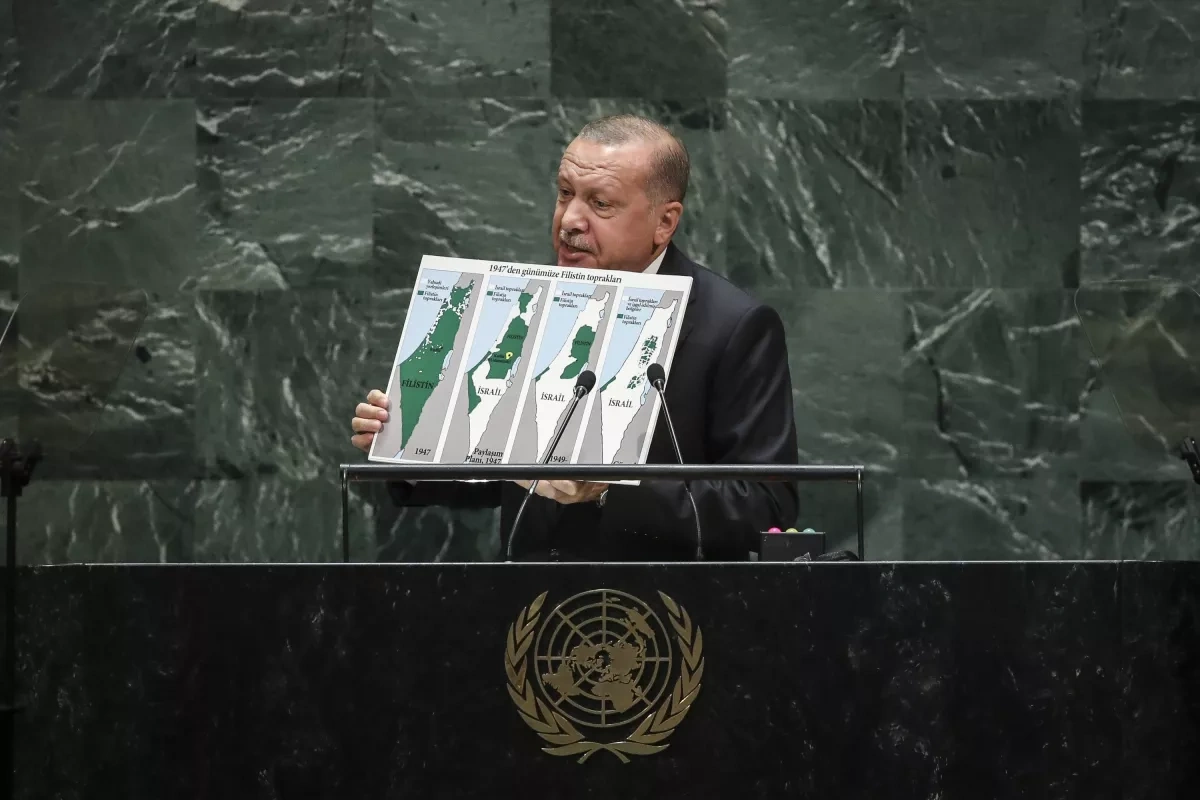
In 2019, he displayed maps showing changes in Israeli and Palestinian-controlled territory over decades as he questioned the effectiveness of UN resolutions concerning the conflict.
The issue became more prominent following the outbreak of the Gaza war in 2023. In his 2024 General Assembly address, Erdoğan criticized Israel’s military campaign in Gaza and called on countries that had not recognized Palestine to do so.
He also renewed his criticism of the UN system, saying the organization had increasingly failed to fulfil its founding mission and invoking his “world is bigger than five” slogan while criticizing the Security Council’s response to the Gaza conflict.
The Russia-Ukraine war has also featured prominently in Erdoğan’s recent appearances.
Türkiye, a NATO member that maintains relations with both Moscow and Kyiv, played a central role alongside the UN in brokering the Black Sea Grain Initiative in 2022.
During a General Assembly speech, Erdoğan used a photograph of a grain vessel passing through the Bosporus to highlight the agreement, describing the Istanbul deal as one of the UN’s most significant recent achievements. He argued that the initiative demonstrated that negotiations could produce results even on issues considered vital by the parties to a conflict.
Pursuing Turkish interests
Cyprus has been another recurring issue in Erdoğan’s speeches, alongside Türkiye’s disputes and diplomatic priorities in the Eastern Mediterranean, developments in the Caucasus, Islamophobia, racism and climate change.
His 2026 address is expected to again focus on major international and regional challenges while continuing Ankara’s longstanding calls for changes to the global governance system.
Erdoğan is also expected to hold bilateral meetings with other heads of state and government during his visit to New York, alongside his participation in the General Assembly.
By Nazrin Sadigova