The results of a poll conducted by the Kyiv International Institute of Sociology (KIIS) between August 21 and September 10 were, to put it mildly, unexpected and raise legitimate questions, especially given the scandalous backdrop against which the survey was conducted.
According to KIIS, 54% of Ukrainian citizens currently trust the incumbent president, including 18% who fully trust him and 36% who tend to trust him. Meanwhile, 41% of citizens expressed distrust in the head of state: 25% said they completely distrust him, while 16% said they tend not to trust him. The institute notes that in late July and early August, 55% of Ukrainians said they trusted Zelenskyy, while 40% expressed distrust.
In other words, during the period covered by this August–September survey, public opinion changed by just one percentage point towards lower trust and one percentage point towards higher distrust. This is particularly noteworthy given that the fieldwork began almost immediately after the National Anti-Corruption Bureau of Ukraine (NABU) and the Specialized Anti-Corruption Prosecutor’s Office (SAPO) announced new investigations involving individuals from the authorities’ inner circle, including Iryna Mudra, who at the time served as deputy head of the Office of the President.
The special operation was dubbed “Forrest Gump” and, according to information released by NABU and SAPO on August 19, concerned the laundering of UAH 150 million (about $3.36 million) to provide bail for one of the suspects in another corruption case, “Midas”. Later, the High Anti-Corruption Court ordered Mudra to be held in custody, with the possibility of release on bail. Events of this kind should, at the very least, have prompted a public debate about trust in the presidential administration, especially given that the person in question held one of the senior positions in the Office of the President. Yet none of this was reflected in the results of the KIIS poll.
At the same time, studies conducted by other organisations paint a completely different picture. For example, a survey by the Centre for Social Research (SOCIS), in which 2,000 adults were interviewed in person in early August, recorded trust in Zelenskyy at 42.5%, while 54% of respondents said they did not trust him. According to the published results, the margin of error was 2.6%. Even more striking is the difference with a May 30 study by Active Group, conducted among 1,000 respondents via the SunFlower Sociology online panel, in which only 26.8% expressed trust in Zelenskyy.
Thus, a rather curious picture of divergent findings emerges: depending on the polling organisation, the level of trust in the same individual varies considerably. Figures of 26.8%, 42.5% and 54% do not represent a minor statistical margin of error or a difference of one or two percentage points; they reflect fundamentally different interpretations of public sentiment. Of course, it would be entirely wrong to automatically declare one of these polls false, since the methodologies, dates of fieldwork, interviewing methods, samples, question wording and even the context in which respondents answered the question about trust in the president all differ.
In addition, KIIS systematically warns that, in wartime conditions, additional deviations may occur that are not accounted for by the standard statistical margin of error. However, back in 2020, the institute’s then-director general, Volodymyr Paniotto, wrote about persistent accusations of “selling out sociology”, “commissioned research” and manipulation, and pointed to a particularly important detail: almost all opinion polls in Ukraine have political or business sponsors, while studies funded by sociologists themselves or by independent foundations account for less than 1%. Moreover, he specifically stressed that the sponsor determines the subject matter and may decide which portion of the information obtained is ultimately published.
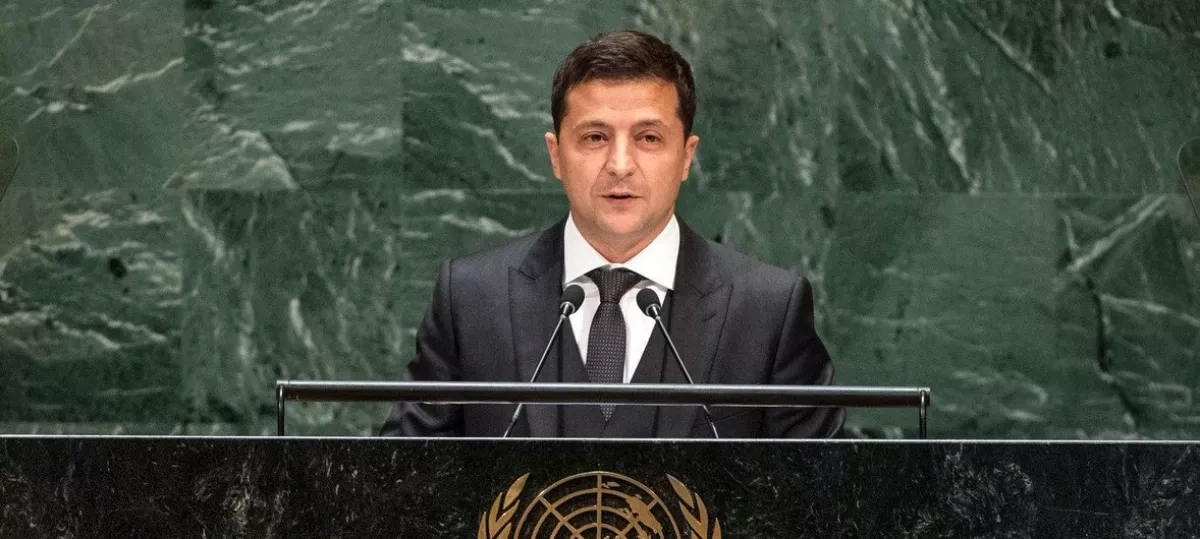
Paniotto’s revelations sound particularly striking now, following the publication by KIIS of, to put it mildly, surprising poll results that essentially fail to take into account the broader record of Zelenskyy’s presidency. In 2019, he came to power promising to end the war in Donbas and restore Ukraine’s control over all occupied territories, as he openly stated from the podium of the UN General Assembly at the time.
At the same time, it is crucial not to forget how Zelenskyy said that, for him, spending money from the state budget on road paving was a higher priority than spending it on the army, while he categorically dismissed all warnings from Ukraine’s allies about the inevitability of a full-scale Russian-Ukrainian war. The head of state chose to prepare Ukrainians not for a military confrontation with a nuclear power, but for the May holidays and barbecues.
After the war began, the Ukrainian president spoke of victory, the return of all territories, and reaching the 1991 borders, but reality proved far more complicated than the sweeping political statements. In this context, the story of the Kursk region is particularly telling. After the operation began in August 2024, Zelenskyy described it as one of the elements of Ukraine’s “victory plan”, speaking of creating an exchange fund, destroying Russia’s military potential and protecting the country’s border regions. What of this did we actually see in reality? Nothing. The Ukrainian Armed Forces were forced to withdraw from the Kursk region, no exchange of territories took place, and some of the most combat-capable units of the Ukrainian army involved in the operation suffered losses.
All of this was followed by a series of corruption scandals. First came the scandal at Energoatom involving senior officials, with the main figure ultimately being Timur Mindich, who managed to flee Ukraine. Mindich is a long-time business partner of the incumbent president and co-owner of Kvartal 95 Studio. As of May 20, 2019 — the day Volodymyr Zelenskyy was inaugurated — he jointly owned three companies in the Russian Federation through a Cypriot firm together with the Shefir brothers and Andriy Yakovlev: Weisberg Pictures, Platinumfilm and Green Films.
Then NABU and SAPO exposed an organised group allegedly involved in the laundering of UAH 460 million (about $10.3 million) through luxury construction. The case concerns the Dynasty cooperative in Kozyn, near Kyiv. According to sources cited by Ukrainska Pravda, the cottages there were being built for Volodymyr Zelenskyy, former head of the Office of the President Andriy Yermak, former Deputy Prime Minister Oleksii Chernyshov and the aforementioned Timur Mindich. This was followed by Operation “Forrest Gump”, the threads of which, as we have already noted, led to the very top of Ukraine’s political establishment.
Against this backdrop, KIIS presents the results of a public opinion poll suggesting that none of this has had virtually any impact on Ukrainians’ attitude towards President Zelenskyy, with the head of state’s trust rating allegedly still exceeding his disapproval rating. This automatically leads to two conclusions: either the Kyiv International Institute of Sociology, using various methods of manipulation in conducting its surveys, is publishing data on the level of public trust in Zelenskyy that is far removed from reality, or Ukrainians actually approve of his actions, which is why Ukraine today finds itself in its current situation — with total corruption and total lies on the part of government officials.