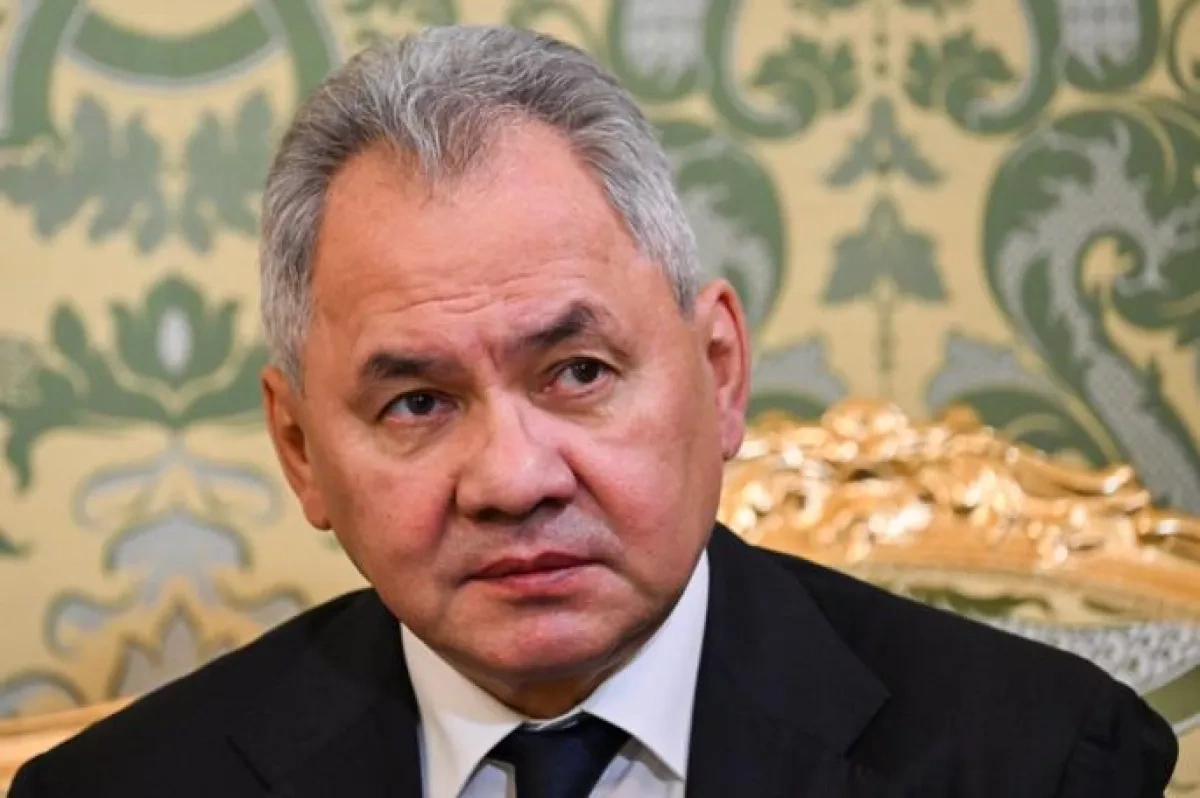
Russia does not intend to finance Armenia’s European integration, and every step Yerevan takes in this direction “has objective consequences”, Russian Security Council Secretary Sergei Shoigu has stated.
Speaking at a meeting of the praesidium of the Security Council’s Scientific and Expert Council, he said Armenia’s policy shows a clear desire to expand cooperation with NATO, as well as what he described as Armenia’s openly consumerist approach to the Collective Security Treaty Organisation (CSTO) and the Eurasian Economic Union (EAEU), Caliber.Az reports, citing Russian media.
“Russian President Vladimir Putin has made our position on this absolutely clear: Yerevan needs to decide on its course and hold a referendum on joining the EU or remaining in the EAEU,” Shoigu stressed. “I want to emphasise: Russia is not ready and will not finance Armenia’s European integration, and every step in this direction has objective consequences.”
In his words, an unfriendly policy and blatant “double standards” are evident in the treatment of Russian businesses operating in Armenia.
“What is happening to enterprises and entire sectors in which Russia has invested billions is difficult to call anything other than a ‘raider takeover’,” he added.
“At the same time, the arguments being put forward are frankly absurd — for example, the claim that Armenia is losing opportunities to integrate into international railway networks if Russia continues to manage the Armenian railways,” he continued.
Baku and Moscow
He further stated that Russia and Azerbaijan have overcome the crisis in their relations, and bilateral cooperation should now be developed further.
He said Russia is pleased that the recent period of crisis in bilateral ties has been overcome through the joint efforts of Moscow and Baku.
“Now the common task is to ensure that Russian-Azerbaijani cooperation continues to develop steadily in accordance with the agreements reached by the leaders,” he clarified.
Shoigu outlined that Russia believes relations with Azerbaijan should develop based on the bilateral legal framework, including the Declaration on Allied Cooperation signed at the highest level, as well as the principles of good-neighbourliness and partnership.
“Russian President Vladimir Putin has repeatedly spoken in favour of joint efforts in this direction,” he added.
Western Countries in the South Caucasus
Security Council chief also claimed that Western countries are interested only in controlling the resources and logistical capabilities of the South Caucasus.
According to him, the South Caucasus had always been the focus of close attention from Western countries and that the West’s geopolitical ambitions had not changed.
“They need control over the resources and logistical capabilities of the region, which has historically served as a link between Central Asia and Europe, between the Caspian and Black seas, and between North and South, West and East,” he stressed.
He maintained that Armenia and Georgia are facing open and blatant interference by the West in their political affairs.
“Westerners are openly and blatantly trying to interfere in the political situation. In the South Caucasus, we can see this not only in Armenia but also in Georgia,” he explained.
Shoigu also said he was convinced that “there are no irreconcilable contradictions between states, and when disagreements arise, one should immediately assess who benefits from turning neighbouring peoples and states against each other.”
“As a rule, Westerners are behind this, interested in maintaining their control over profitable sectors of the economy, transport and logistics corridors, and resources,” he added.
In this context, Shoigu referred to a recent statement by Georgian Parliament Speaker Shalva Papuashvili, who “clearly and sensibly” said that “perhaps escalation with Russia is in the interests of Germany or Lithuania, but not Georgia.”
Russia in the Caucasus
Shoigu also reiterated that Russia should firmly defend its own interests amid Western subversive activities in the Caucasus.
“Given these trends, Russia should act in a targeted, precise manner, firmly defending its interests,” he stressed, referring to the desire of the United States and European Union to weaken Russia’s position in the Caucasus region.
By Bakhtiyar Abbasov