BAKU, Azerbaijan, September 17. Both Muslim and
Christian religious monuments had been vandalized, while some
Christian monuments underwent falsification in Karabakh and East
Zangezur during the occupation, Head of the State Service for the
Protection, Development, and Restoration of Cultural Heritage under
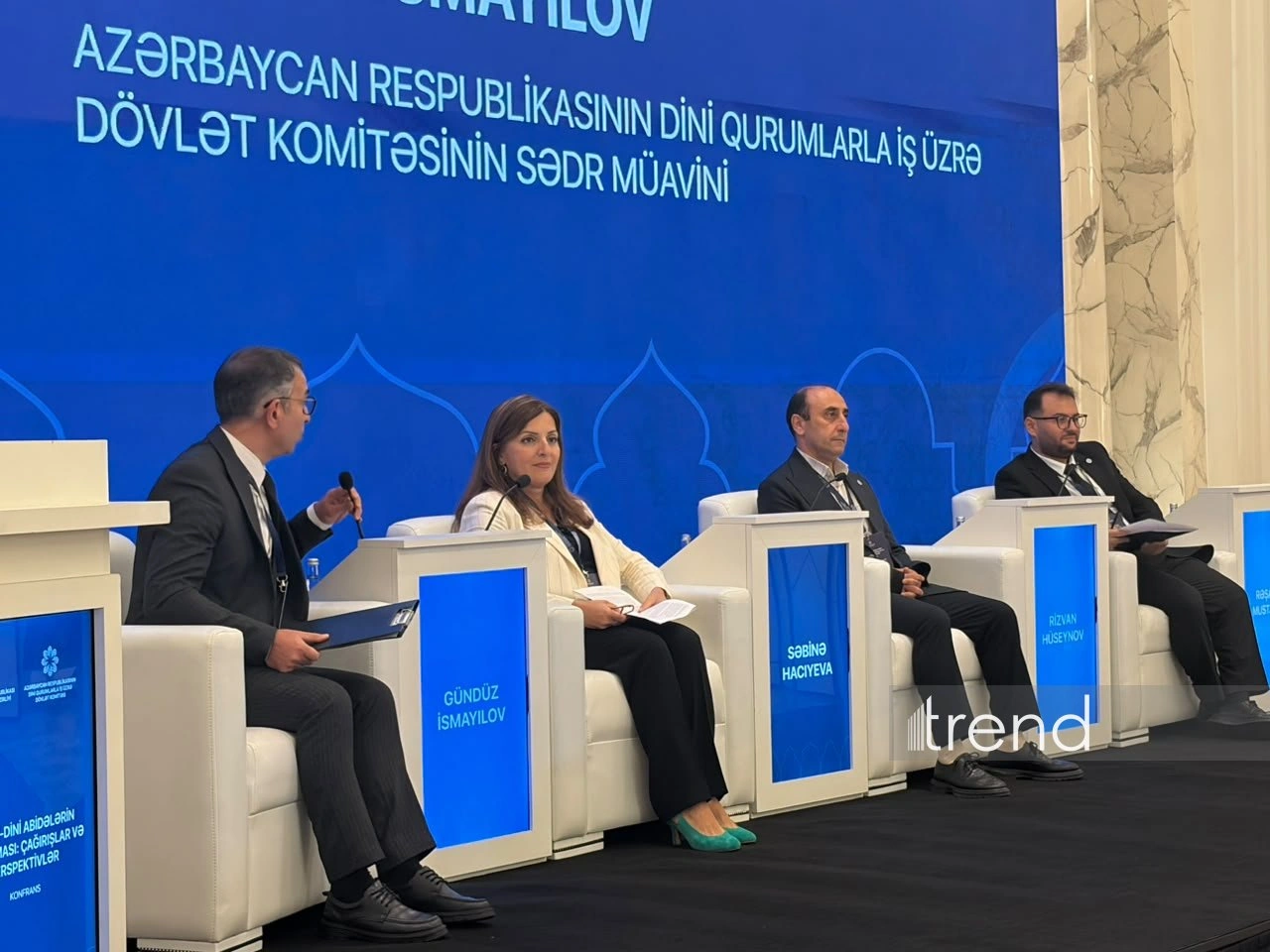
the Ministry of Culture, Sabina Hajiyeva, said at a conference
titled "Protection of Historical-Religious Monuments: Challenges
and Prospects," Trend's correspondent reports from the event.
Hajiyeva highlighted that various acts of vandalism had been
recorded against monuments located in the liberated
territories.
"We have conditionally categorized the monuments based on their
condition upon liberation and their current state: those completely
wiped off the face of the earth, severely damaged, partially
destroyed, and those in satisfactory or good condition. There are
monuments whose current state makes it difficult to even determine
whether they were originally Christian or Muslim religious sites,
or even residential houses," she explained.
The head of the state service noted that, alongside Muslim
religious monuments, cemeteries in the liberated territories were
also destroyed and desecrated. Instances of falsification and
illegal intervention have been observed in large and historically
significant monuments of Christian heritage.
According to her, some small churches had received no
intervention at all for 30 years and had fallen into a state of
ruin. In contrast, various interventions were carried out on
larger, historically significant Christian monuments.
Hajiyeva also mentioned the Ganjasar Monastery in this context.
She said that instances of graves being removed from the cemetery
surrounding the complex and relocated elsewhere, as well as
unauthorized restoration work on the monument itself, had been
identified.
She emphasized that employees of the state service were among
the first specialists to travel to Karabakh after the territories
were liberated from occupation. She noted that, despite the threat
of landmines, these employees—working alongside the Azerbaijan
National Agency for Mine Action (ANAMA)—conducted repeated
monitoring missions in the area to assess the condition of the
monuments.
Hajiyeva noted that the state-approved list from 2001 included
705 monuments located in the territories liberated from occupation.
Subsequent monitoring and research have led to the identification
of additional examples of historical and cultural heritage.
"The Cabinet of Ministers has already added 144 monuments to the
list, and the process is ongoing for more than 100 others," she
said. The head of the state service also touched upon the
architectural features of the mosque located within the Garghabazar
complex. According to her, although the structure might resemble a
Christian monument at first glance, it lacks the apse and other
characteristic features of Christian temples; furthermore, the name
Haji Giyasaddin is inscribed on it. Research on the monument is
ongoing.
Hajiyeva emphasized that such examples demonstrate how local
architectural methods and techniques were passed down from
generation to generation in the region. Research into both
Christian and Muslim religious monuments is currently
continuing.
A conference on “Preservation of Historical and Religious
Monuments: Challenges and Prospects,” organized jointly by the
Ministry of Culture and the State Committee on Work with Religious
Institutions, has begun in Baku.
The conference is attended by Minister of Culture Adil Karimli,
Chairman of the State Committee on Work with Religious Institutions
Ramin Mammadov, members of the Azerbaijani parliament, rectors of
higher education institutions, representatives of government
agencies, and experts in the field.
The main topics of discussion at the conference will include the
preservation, protection, and restoration of historical and
religious monuments in Azerbaijan; the identification of existing
challenges in this area; and ongoing efforts to preserve the
national, cultural, and religious heritage for future
generations.
The conference will feature an exchange of views on cooperation
among government agencies, religious communities, and scientific
and educational institutions in the preservation of historical and
religious monuments, the application of modern approaches to their
study and restoration, and the prospects for further work in this
area.