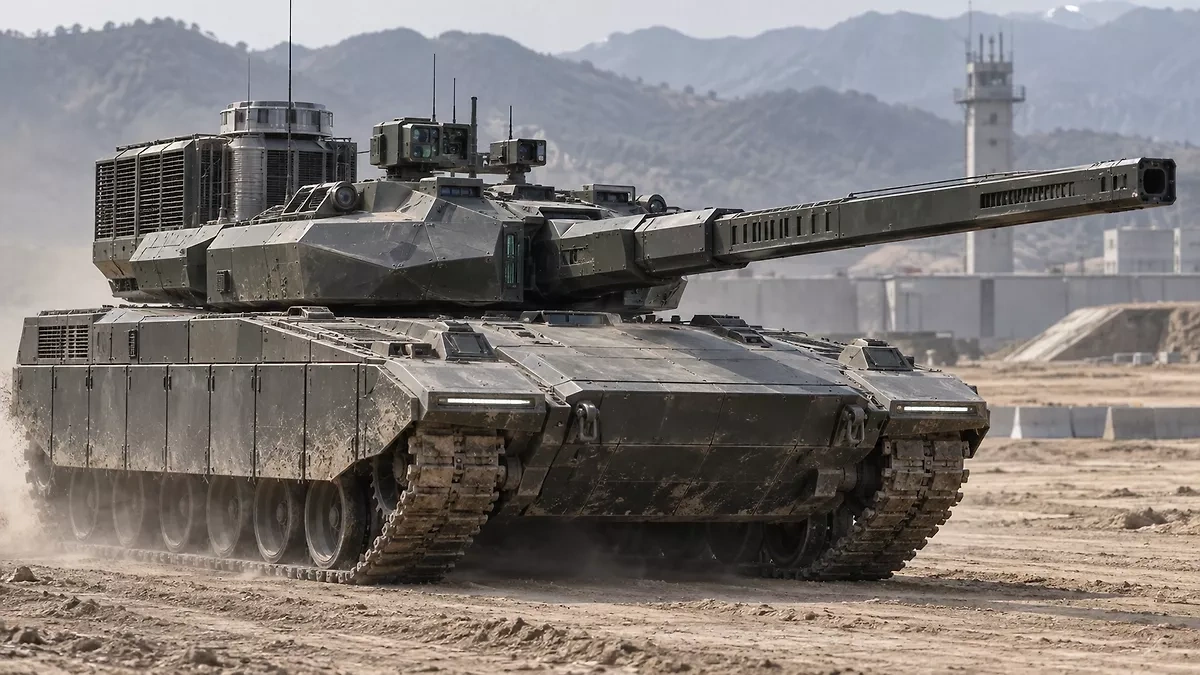
Chinese military researchers have proposed developing a nuclear-powered main battle tank equipped with an electromagnetic railgun capable of striking targets up to 450 kilometres (280 miles) away, with the system potentially emerging after 2045, South China Morning Post reports.
The concept was detailed in a peer-reviewed paper published in June in the Chinese journal Acta Armamentarii. It envisages a 60-ton armoured vehicle powered by a 10-megawatt-class small modular reactor (SMR) and armed with a 50-megajoule (MJ) railgun.
The study was conducted by researchers from Inner Mongolia First Machinery Group, which is involved in China’s armoured vehicle industry, and the Beijing Institute of Technology. It was funded by the National Key Laboratory of Special Vehicle Design and Manufacturing Integration Technology.
The researchers proposed a three-stage development programme. Before 2035, they envision integrating electromagnetic weapons into existing tanks, including a 10MJ gun with a 150km range, electromagnetic armour and a 1,500-horsepower diesel generator.
Between 2035 and 2045, the proposed system would advance to a 20MJ electromagnetic gun with a 300km range, supported by more sophisticated energy-storage technologies and a 2,000-horsepower diesel system.
After 2045, the researchers aim to develop a fully nuclear-powered tank featuring a 50MJ railgun capable of achieving a theoretical projectile velocity of around 3.5km per second and a range of roughly 450km.
However, the concept faces significant technical and practical challenges. The proposed reactor would need to fit within two cubic metres, while radiation shielding would be limited to three tonnes and fuel replacement would need to occur no more frequently than every five years.
A veteran military equipment expert questioned the feasibility of deploying a nuclear reactor on a tank.
“Fission reactors are relatively mature and can be miniaturised, but applying one to a tank is still unrealistic,” said the expert, who requested anonymity.
He also warned that the reactor, shielding, power-conversion equipment and heat-dissipation systems would compete for space and weight with armour and weapons.
“Regardless of whether the technology and materials are sufficient, the overall volume and weight alone could make it lose its practical significance.”
The expert also questioned the battlefield value of effectively unlimited onboard power.
“Even if a tank achieved ‘unlimited power’, the advantage would be limited because personnel still need rest and ammunition still needs replenishment,” he said.
He suggested future systems could instead be uncrewed and use high-energy lasers, microwave weapons, powerful radars and electronic warfare capabilities.
By Vafa Guliyeva