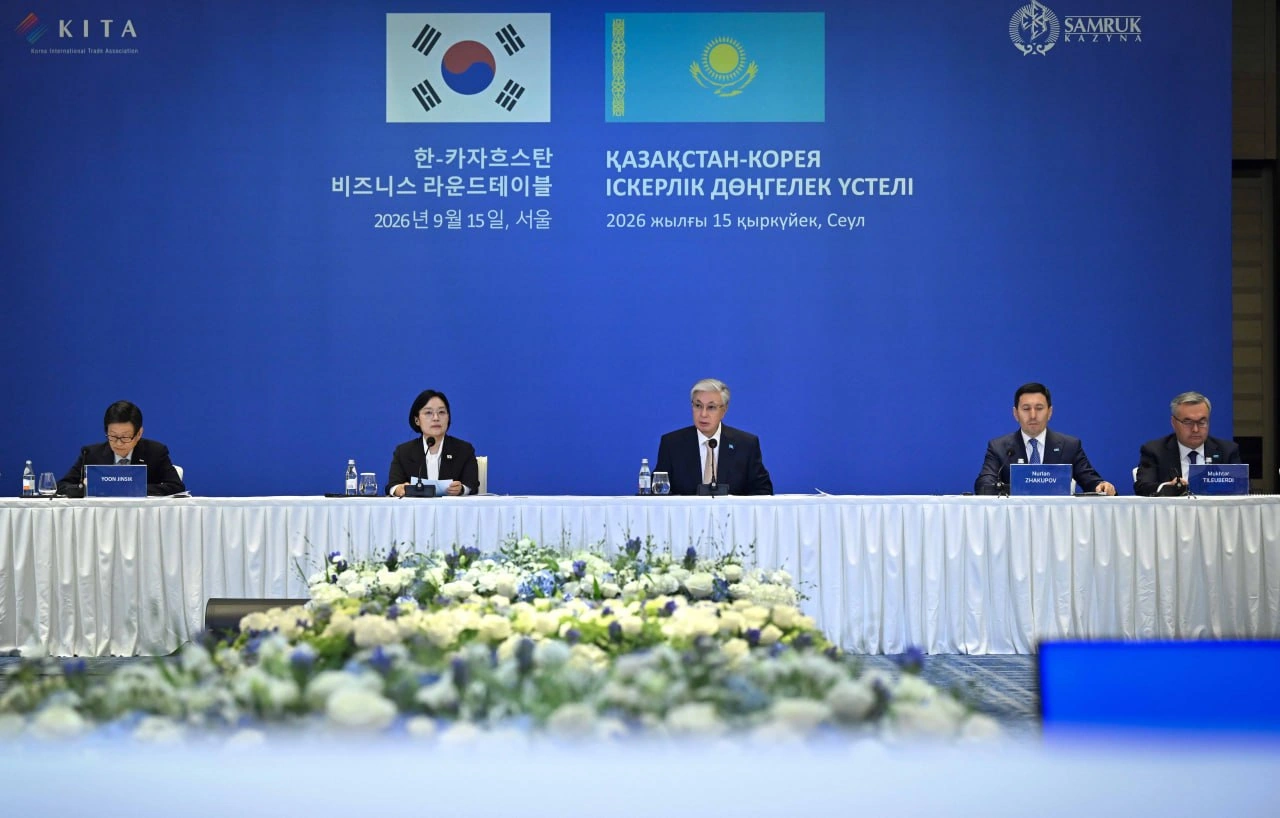
BAKU, Azerbaijan, September 15. Kazakhstan has
proposed establishing a joint venture with South Korea to
facilitate new logistics projects and initiatives.
This was reflected in a statement released by the press office
of the Kazakh President, citing Kassym-Jomart Tokayev’s remarks at
the opening of the Kazakhstan-Korea roundtable.
He said transport and logistics are central to the bilateral
agenda, adding that Kazakhstan, as a natural bridge between Asia
and Europe, intends to turn this geographical advantage into a
modern and efficient transport and logistics framework.
“We are investing significant funds in railways and roads,
seaports, terminals and infrastructure in general to increase the
capacity, speed and reliability of this route. We believe the time
has come to expand Korea's participation in the development of the
Middle Corridor. Kazakhstan welcomes Korean logistics companies,
including CJ Logistics and LX Pantos, which are already creating
modern logistics centers, multimodal terminals, warehouse complexes
and digital supply chain management solutions in our country. To
support this work, I propose establishing a Kazakh-Korean joint
venture that will facilitate the implementation of new logistics
projects and initiatives and ensure the unhindered transit of
Korean cargo through our country. It is encouraging that Kazakh
company Shin-Line and Lotte Global Logistics are already advancing
plans to establish a partnership in this area,” Tokayev said.
Tokayev also pointed to significant opportunities for expanding
cooperation in artificial intelligence and new technologies.
“Human capital plays a key role in our artificial intelligence
strategy. We are convinced that technological leadership ultimately
depends on people and their ability to drive innovation. In this
context, we highly value our partnership with Seoul National
University of Science and Technology to jointly establish the first
Institute of Artificial Intelligence in Kazakhstan,” he said.
Tokayev said Kazakhstan is developing one of the largest data
center ecosystems in Eurasia, including the Data Center Valley in
energy-rich Pavlodar region.
“The project provides capacity of up to one gigawatt, with the
possibility of scalable expansion, designated land plots and
integration with national supercomputing capabilities. Our goal is
to make Kazakhstan the main computing center of Central Asia and a
bridge between Europe and Asia. For Korean technology companies,
this plan provides unique opportunities,” Tokayev said.
He added that Kazakhstan is ready to expand supplies of
materials and components for microelectronics and semiconductor
production, noting significant potential for practical cooperation
with global industry leaders such as Samsung Electronics and SK
Hynix.